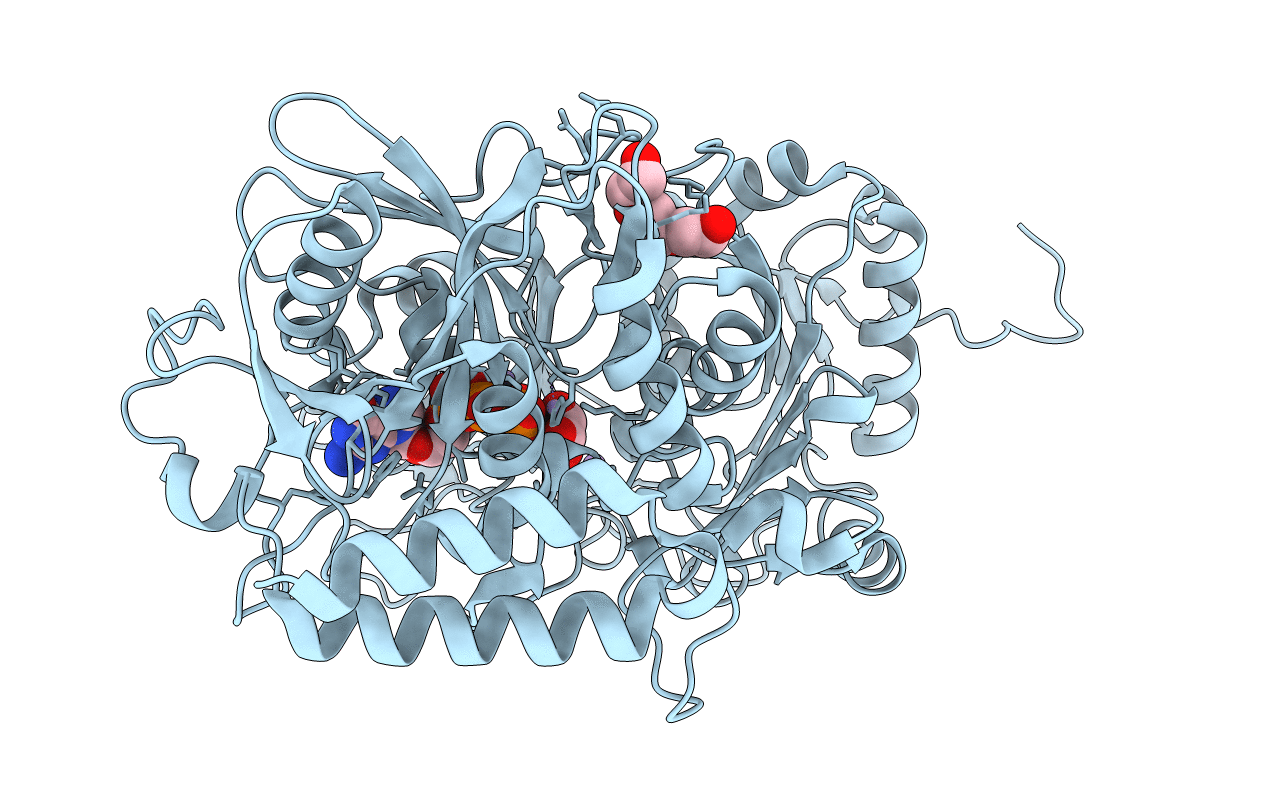
3DT2 image
Deposition Date 2008-07-14
Release Date 2008-08-26
Last Version Date 2024-02-21
Entry Detail
PDB ID:
3DT2
Keywords:
Title:
The structure of rat cytosolic PEPCK in complex with oxalate and GTP
Biological Source:
Source Organism:
Host Organism:
Method Details:
Experimental Method:
Resolution:
1.50 Å
R-Value Free:
0.18
R-Value Work:
0.15
R-Value Observed:
0.16
Space Group:
P 21 21 21

Macromolecular Entities
Structures with similar UniProt ID
Protein Blast
Polymer Type:polypeptide(L)
Molecule:Phosphoenolpyruvate carboxykinase, cytosolic [GTP]
Gene (Uniprot):Pck1
Chain IDs:A
Chain Length:624
Number of Molecules:1
Biological Source:Rattus norvegicus
Primary Citation
Enzymes with lid-gated active sites must operate by an induced fit mechanism instead of conformational selection.
Proc.Natl.Acad.Sci.Usa 105 13829 13834 (2008)
PMID: 18772387 DOI: 10.1073/pnas.0805364105

Abstact

The induced fit and conformational selection/population shift models are two extreme cases of a continuum aimed at understanding the mechanism by which the final key-lock or active enzyme conformation is achieved upon formation of the correctly ligated enzyme. Structures of complexes representing the Michaelis and enolate intermediate complexes of the reaction catalyzed by phosphoenolpyruvate carboxykinase provide direct structural evidence for the encounter complex that is intrinsic to the induced fit model and not required by the conformational selection model. In addition, the structural data demonstrate that the conformational selection model is not sufficient to explain the correlation between dynamics and catalysis in phosphoenolpyruvate carboxykinase and other enzymes in which the transition between the uninduced and the induced conformations occludes the active site from the solvent. The structural data are consistent with a model in that the energy input from substrate association results in changes in the free energy landscape for the protein, allowing for structural transitions along an induced fit pathway.

Legend

Protein

Chemical

Disease

Primary Citation of related structures
Feedback Form
Name
Email
Institute
Feedback