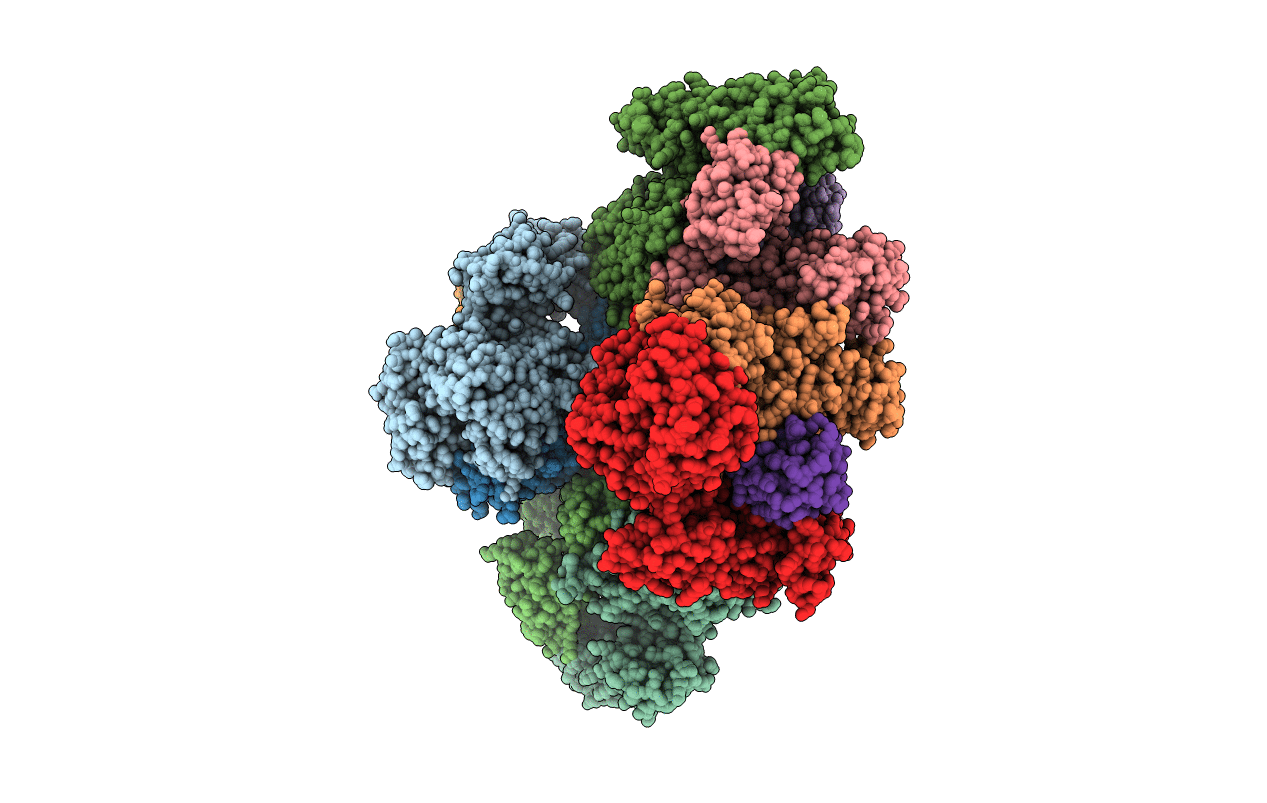
3DBH image
Deposition Date 2008-05-31
Release Date 2008-08-12
Last Version Date 2023-08-30
Entry Detail
PDB ID:
3DBH
Keywords:
Title:
Structural Dissection of a Gating Mechanism Preventing Misactivation of Ubiquitin by NEDD8's E1 (APPBP1-UBA3Arg190Ala-NEDD8Ala72Arg)
Biological Source:
Source Organism:
Homo sapiens (Taxon ID: 9606)
Host Organism:
Method Details:
Experimental Method:
Resolution:
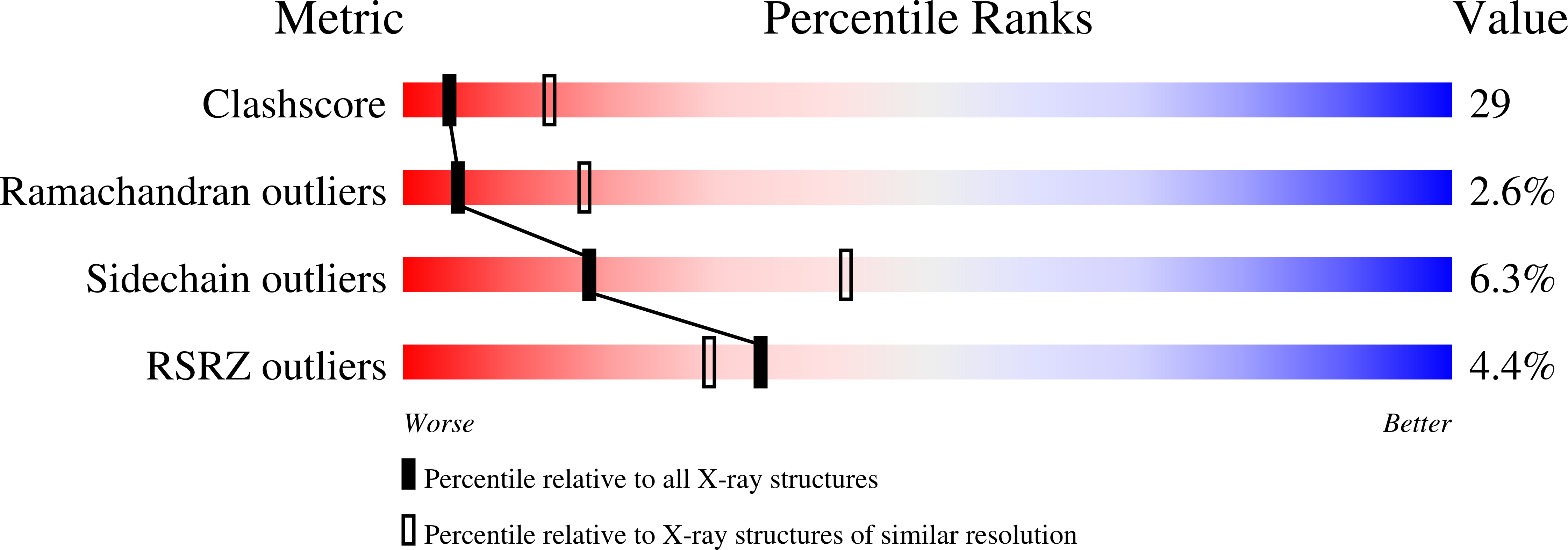
2.85 Å
R-Value Free:
0.27
R-Value Work:
0.22
R-Value Observed:
0.22
Space Group:
P 21 21 21
Macromolecular Entities
Structures with similar UniProt ID
Protein Blast
Polymer Type:polypeptide(L)
Molecule:NEDD8-activating enzyme E1 regulatory subunit
Gene (Uniprot):NAE1
Chain IDs:A, D (auth: C), G (auth: E), J (auth: G)
Chain Length:531
Number of Molecules:4
Biological Source:Homo sapiens
Structures with similar UniProt ID
Protein Blast
Polymer Type:polypeptide(L)
Molecule:NEDD8-activating enzyme E1 catalytic subunit
Gene (Uniprot):UBA3
Mutagens:R190A, C216A
Chain IDs:B, E (auth: D), H (auth: F), K (auth: H)
Chain Length:434
Number of Molecules:4
Biological Source:Homo sapiens
Structures with similar UniProt ID
Protein Blast
Polymer Type:polypeptide(L)
Molecule:NEDD8
Gene (Uniprot):NEDD8
Mutagens:A172R
Chain IDs:C (auth: I), F (auth: J), I (auth: K), L
Chain Length:88
Number of Molecules:4
Biological Source:Homo sapiens
Ligand Molecules
Primary Citation
Structural dissection of a gating mechanism preventing misactivation of ubiquitin by NEDD8's E1.
Biochemistry 47 8961 8969 (2008)
PMID: 18652489 DOI: 10.1021/bi800604c

Abstact

Post-translational covalent modification by ubiquitin and ubiquitin-like proteins (UBLs) is a major eukaryotic mechanism for regulating protein function. In general, each UBL has its own E1 that serves as the entry point for a cascade. The E1 first binds the UBL and catalyzes adenylation of the UBL's C-terminus, prior to promoting UBL transfer to a downstream E2. Ubiquitin's Arg 72, which corresponds to Ala72 in the UBL NEDD8, is a key E1 selectivity determinant: swapping ubiquitin and NEDD8 residue 72 identity was shown previously to swap their E1 specificity. Correspondingly, Arg190 in the UBA3 subunit of NEDD8's heterodimeric E1 (the APPBP1-UBA3 complex), which corresponds to a Gln in ubiquitin's E1 UBA1, is a key UBL selectivity determinant. Here, we dissect this specificity with biochemical and X-ray crystallographic analysis of APPBP1-UBA3-NEDD8 complexes in which NEDD8's residue 72 and UBA3's residue 190 are substituted with different combinations of Ala, Arg, or Gln. APPBP1-UBA3's preference for NEDD8's Ala72 appears to be indirect, due to proper positioning of UBA3's Arg190. By contrast, our data are consistent with direct positive interactions between ubiquitin's Arg72 and an E1's Gln. However, APPBP1-UBA3's failure to interact with a UBL having Arg72 is not due to a lack of this favorable interaction, but rather arises from UBA3's Arg190 acting as a negative gate. Thus, parallel residues from different UBL pathways can utilize distinct mechanisms to dictate interaction selectivity, and specificity can be amplified by barriers that prevent binding to components of different conjugation cascades.

Legend

Protein

Chemical

Disease

Primary Citation of related structures
Feedback Form
Name
Email
Institute
Feedback