3D4T image
Deposition Date 2008-05-15
Release Date 2008-07-15
Last Version Date 2025-08-06
Entry Detail
PDB ID:
3D4T
Keywords:
Title:
Crystal structure of the periplasmic thioredoxin SoxS from Paracoccus pantotrophus (oxidized form)
Biological Source:
Source Organism:
Host Organism:
Method Details:
Experimental Method:
Resolution:
2.05 Å
R-Value Free:
0.21
R-Value Work:
0.17
R-Value Observed:
0.17
Space Group:
P 31 2 1
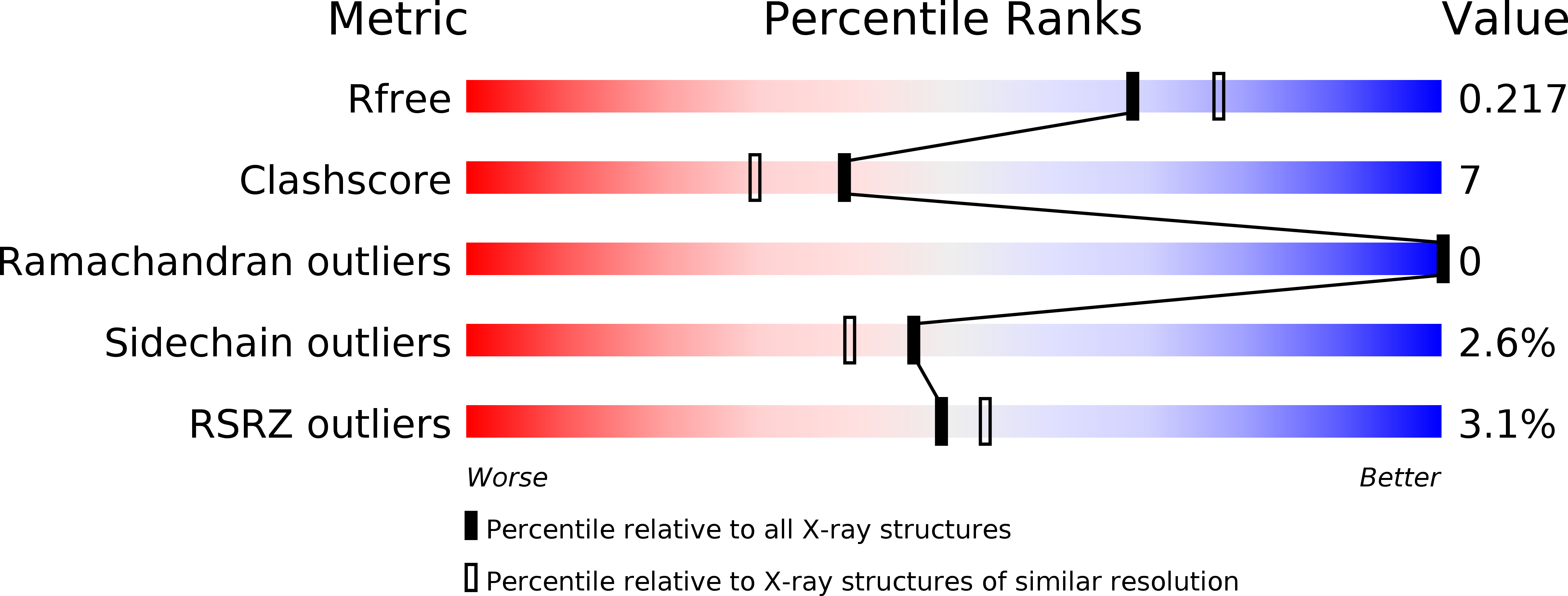
Macromolecular Entities
Structures with similar UniProt ID
Protein Blast
Polymer Type:polypeptide(L)
Molecule:Putative uncharacterized protein
Chain IDs:A
Chain Length:116
Number of Molecules:1
Biological Source:Paracoccus denitrificans
Ligand Molecules
Primary Citation
The structure of the periplasmic thiol-disulfide oxidoreductase SoxS from Paracoccus pantotrophus indicates a triple Trx/Grx/DsbC functionality in chemotrophic sulfur oxidation.
Acta Crystallogr.,Sect.D 65 229 240 (2009)
PMID: 19237745 DOI: 10.1107/S0907444908043023

Abstact

The periplasmic thiol-disulfide oxidoreductase SoxS is beneficial for the sulfur-oxidizing (Sox) phenotype of the facultative chemotrophic bacterium Paracoccus pantotrophus and is not part of the Sox enzyme system. SoxS combines features of thioredoxins, glutaredoxins and the thiol-disulfide oxidoreductases of the Dsb family in structure, target specificity and reaction. The structure of SoxS was solved in oxidized and reduced forms at 2.1 and 1.9 A resolution, respectively. SoxS revealed high structural homology to typical cytoplasmic bacterial thioredoxins. In contrast, SoxS contained the active-site motif Pro-Gly-Cys-Leu-Tyr-Cys that is not present in other thioredoxins. Interestingly, the sequence of this motif is closely related to the Pro-Gly-Cys-Pro-Tyr-Cys sequence of some glutaredoxins and to the Pro-Xaa-Cys-Xaa-Tyr-Cys sequences of some members of the DsbC and DsbG subfamilies of thiol-disulfide oxidoreductases. Furthermore, the proposed substrate of SoxS, the interprotein disulfide of SoxY, Cys110(Y)-Cys110(Y), is structurally similar to oxidized glutathione. However, SoxS is proposed to specifically reduce the interprotein disulfide between two SoxY subunits, releasing a heterodimeric SoxYZ as an active part of the sulfur-oxidation cycle.

Legend

Protein

Chemical

Disease

Primary Citation of related structures
Feedback Form
Name
Email
Institute
Feedback