Planned Maintenance: Some services may turn out to be unavailable from 15th January, 2026 to 16th January, 2026. We apologize for the inconvenience!

3D22 image
Deposition Date 2008-05-07
Release Date 2008-07-01
Last Version Date 2024-10-16
Entry Detail
PDB ID:
3D22
Keywords:
Title:
Crystal structure of a poplar thioredoxin h mutant, PtTrxh4C61S
Biological Source:
Source Organism(s):
Expression System(s):
Method Details:
Experimental Method:
Resolution:
1.60 Å
R-Value Free:
0.19
R-Value Work:
0.19
R-Value Observed:
0.19
Space Group:
P 21 21 21
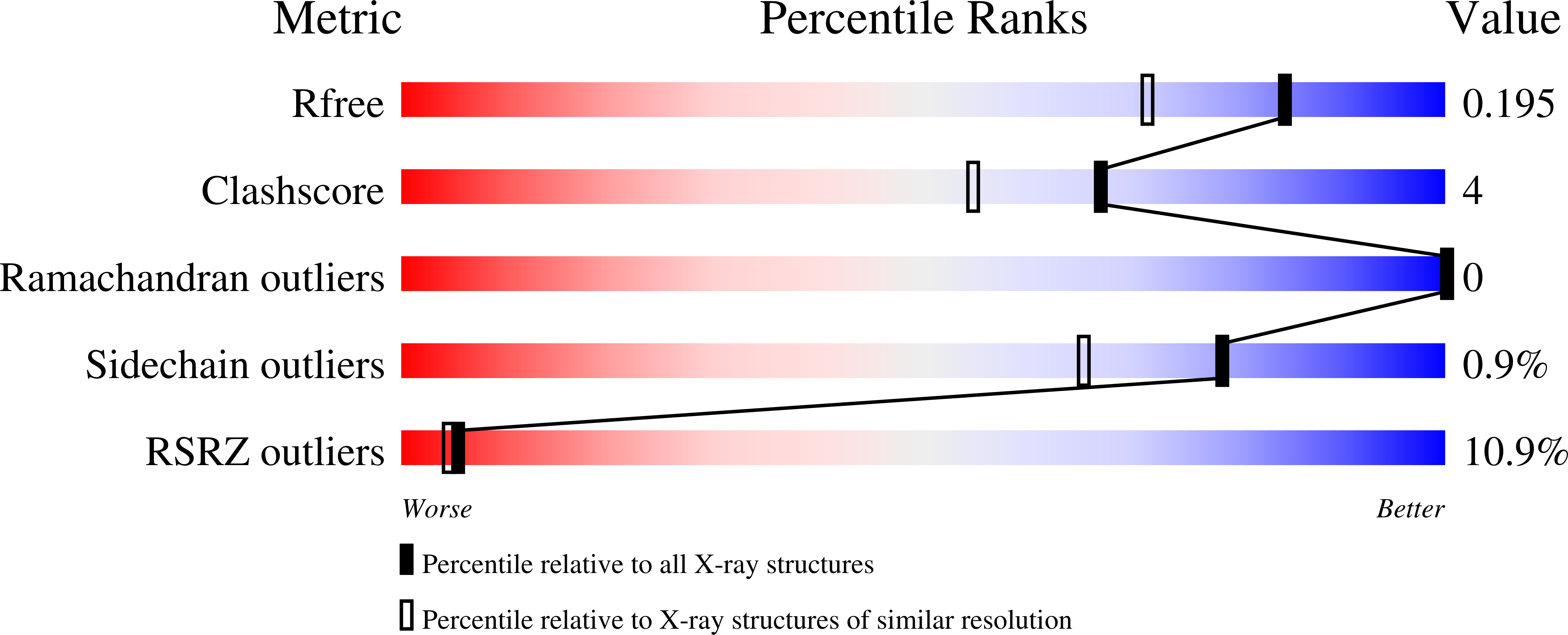
Macromolecular Entities
Structures with similar UniProt ID
Protein Blast
Polymer Type:polypeptide(L)
Molecule:Thioredoxin H-type
Mutagens:C61S, K62R
Chain IDs:A
Chain Length:139
Number of Molecules:1
Biological Source:Populus trichocarpa x Populus deltoides
Ligand Molecules
Primary Citation
An Atypical Catalytic Mechanism Involving Three Cysteines of Thioredoxin.
J.Biol.Chem. 283 23062 23072 (2008)
PMID: 18552403 DOI: 10.1074/jbc.M802093200

Abstact

Unlike other thioredoxins h characterized so far, a poplar thioredoxin of the h type, PtTrxh4, is reduced by glutathione and glutaredoxin (Grx) but not NADPH:thioredoxin reductase (NTR). PtTrxh4 contains three cysteines: one localized in an N-terminal extension (Cys(4)) and two (Cys(58) and Cys(61)) in the classical thioredoxin active site ((57)WCGPC(61)). The property of a mutant in which Cys(58) was replaced by serine demonstrates that it is responsible for the initial nucleophilic attack during the catalytic cycle. The observation that the C4S mutant is inactive in the presence of Grx but fully active when dithiothreitol is used as a reductant indicates that Cys(4) is required for the regeneration of PtTrxh4 by Grx. Biochemical and x-ray crystallographic studies indicate that two intramolecular disulfide bonds involving Cys(58) can be formed, linking it to either Cys(61) or Cys(4). We propose thus a four-step disulfide cascade mechanism involving the transient glutathionylation of Cys(4) to convert this atypical thioredoxin h back to its active reduced form.

Legend

Protein

Chemical

Disease

Primary Citation of related structures
Feedback Form
Name
Email
Institute
Feedback