3CU0 image
Deposition Date 2008-04-15
Release Date 2008-05-06
Last Version Date 2023-08-30
Entry Detail
PDB ID:
3CU0
Keywords:
Title:
human beta 1,3-glucuronyltransferase I (GlcAT-I) in complex with UDP and GAL-GAL(6-SO4)-XYL(2-PO4)-O-SER
Biological Source:
Source Organism:
Homo sapiens (Taxon ID: 9606)
Method Details:
Experimental Method:
Resolution:
1.90 Å
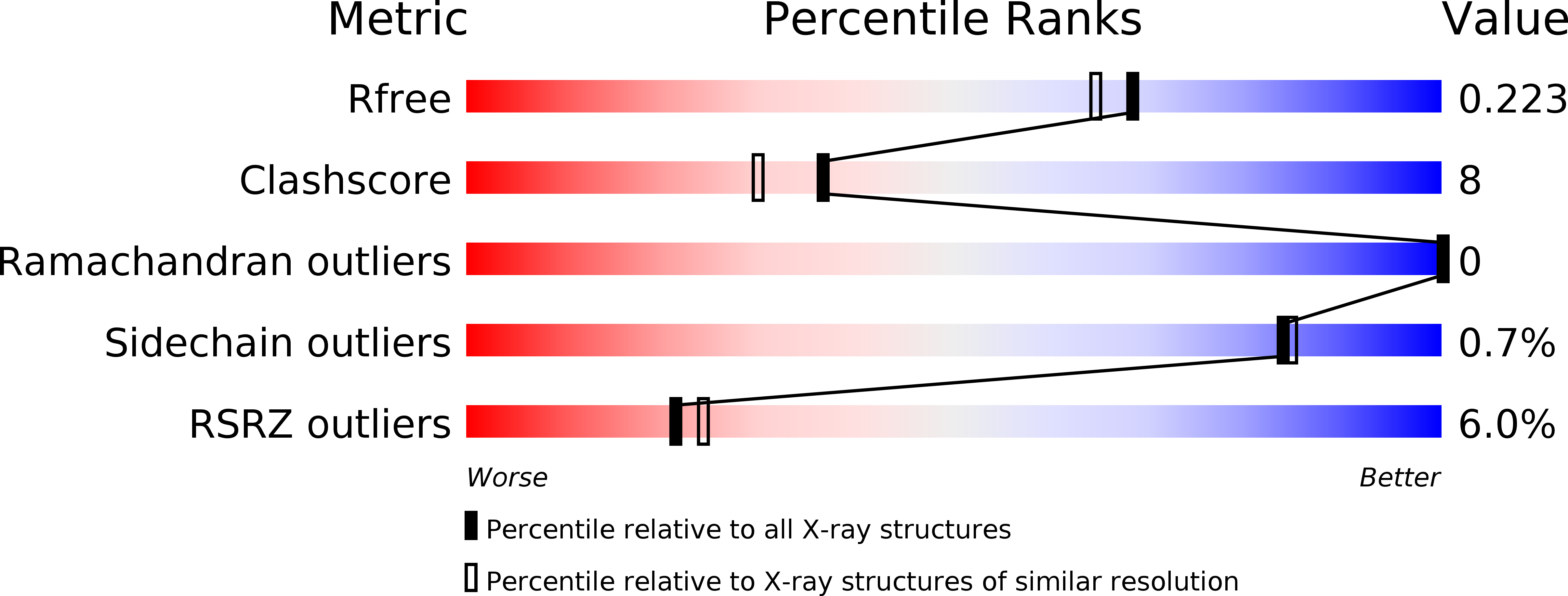
R-Value Free:
0.23
R-Value Work:
0.21
R-Value Observed:
0.21
Space Group:
P 1 21 1
Macromolecular Entities
Structures with similar UniProt ID
Protein Blast
Polymer Type:polypeptide(L)
Molecule:Galactosylgalactosylxylosylprotein 3-beta-glucuronosyltransferase 3
Gene (Uniprot):B3GAT3
Chain IDs:A, B
Chain Length:281
Number of Molecules:2
Biological Source:Homo sapiens
Primary Citation
2-o-phosphorylation of xylose and 6-o-sulfation of galactose in the protein linkage region of glycosaminoglycans influence the glucuronyltransferase-I activity involved in the linkage region synthesis.
J.Biol.Chem. 283 16801 16807 (2008)
PMID: 18400750 DOI: 10.1074/jbc.M709556200

Abstact

Sulfated glycosaminoglycans (GAGs), including heparan sulfate and chondroitin sulfate, are synthesized on the so-called common GAG-protein linkage region (GlcUAbeta1-3Galbeta1-3Galbeta1-4Xylbeta1-O-Ser) of core proteins, which is formed by the stepwise addition of monosaccharide residues by the respective specific glycosyltransferases. Glucuronyltransferase-I (GlcAT-I) is the key enzyme that completes the synthesis of this linkage region, which is a prerequisite for the conversion of core proteins to functional proteoglycans bearing GAGs. The Xyl and Gal residues in the linkage region can be modified by phosphorylation and sulfation, respectively, although the biological significance of these modifications remains to be clarified. Here we present evidence that these modifications can significantly influence the catalytic activity of GlcAT-I. Enzyme assays showed that the synthetic substrates, Gal-Gal-Xyl(2-O-phosphate)-O-Ser and Gal-Gal(6-O-sulfate)-Xyl(2-O-phosphate)-O-Ser, served as better substrates than the unmodified compound, whereas Gal(6-O-sulfate)-Gal-Xyl(2-O-phosphate)-O-Ser exhibited no acceptor activity. The crystal structure of the catalytic domain of GlcAT-I with UDP and Gal-Gal(6-O-sulfate)-Xyl(2-O-phosphate)-O-Ser bound revealed that the Xyl(2-O-phosphate)-O-Ser is disordered and the 6-O-sulfate forms interactions with Gln(318) from the second GlcAT-I monomer in the dimeric enzyme. The results indicate the possible involvement of these modifications in the processing and maturation of the growing linkage region oligosaccharide required for the assembly of GAG chains.

Legend

Protein

Chemical

Disease

Primary Citation of related structures
Feedback Form
Name
Email
Institute
Feedback