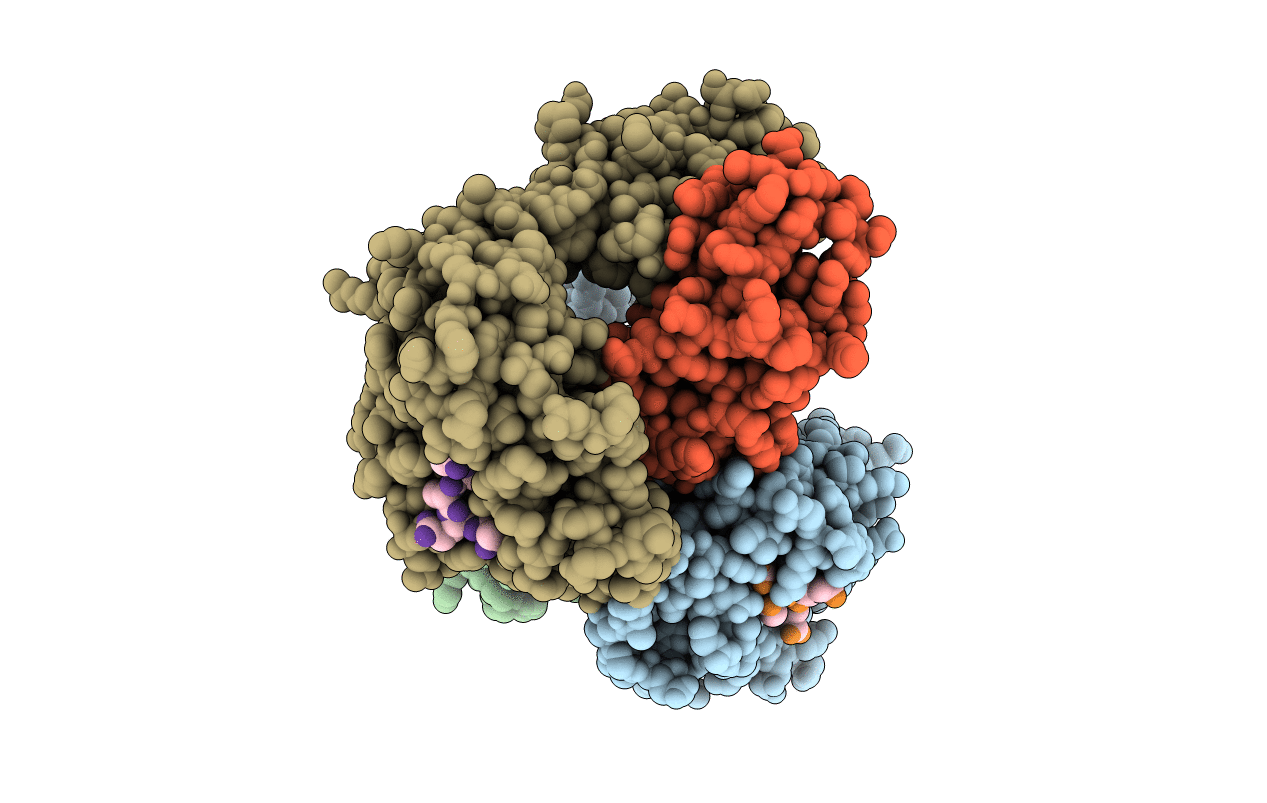
3CPL image
Deposition Date 2008-03-31
Release Date 2008-11-18
Last Version Date 2024-10-30
Entry Detail
PDB ID:
3CPL
Keywords:
Title:
Crystal Structure of H-2Db in complex with a variant M6A of the NP366 peptide from influenza A virus
Biological Source:
Source Organism:
Mus musculus (Taxon ID: 10090)
Host Organism:
Method Details:
Experimental Method:
Resolution:
2.50 Å
R-Value Free:
0.28
R-Value Work:
0.22
R-Value Observed:
0.22
Space Group:
P 1
Macromolecular Entities
Structures with similar UniProt ID
Protein Blast
Polymer Type:polypeptide(L)
Molecule:H-2 class I histocompatibility antigen, D-B alpha chain
Gene (Uniprot):H2-D1
Chain IDs:A, D (auth: C)
Chain Length:275
Number of Molecules:2
Biological Source:Mus musculus
Structures with similar UniProt ID
Protein Blast
Polymer Type:polypeptide(L)
Molecule:Beta-2-microglobulin
Gene (Uniprot):B2m
Chain IDs:B, E (auth: D)
Chain Length:99
Number of Molecules:2
Biological Source:Mus musculus
Polymer Type:polypeptide(L)
Molecule:NP366 peptide
Chain IDs:C (auth: E), F
Chain Length:9
Number of Molecules:2
Biological Source:
Primary Citation
Complete modification of TCR specificity and repertoire selection does not perturb a CD8+ T cell immunodominance hierarchy.
Proc.Natl.Acad.Sci.USA 105 19408 19413 (2008)
PMID: 19047637 DOI: 10.1073/pnas.0810274105

Abstact

Understanding T cell immunodominance hierarchies is fundamental to the development of cellular-based vaccines and immunotherapy. A combination of influenza virus infection in C57BL/6J mice and reverse genetics is used here to dissect the role of T cell antigen receptor (TCR) repertoire in the immunodominant D(b)NP(366)CD8(+) T cell response. Infection with an engineered virus (NPM6A) containing a single alanine (A) mutation at the critical p6 NP(366-374) residue induced a noncross-reactive CD8(+) T cell response characterized by a novel, narrower TCR repertoire per individual mouse that was nonetheless equivalent in magnitude to that generated after WT virus challenge. Although of lower overall avidity, the levels of both cytotoxic T lymphocyte activity and cytokine production were comparable with those seen for the native response. Importantly, the overdominance profile characteristic of secondary D(b)NP(366)-specific clonal expansions was retained for the NPM6A mutant. The primary determinants of immunodominance in this endogenous, non-TCR-transgenic model of viral immunity are thus independent of TCR repertoire composition and diversity. These findings both highlight the importance of effective antigen dose for T cell vaccination and/or immunotherapy and demonstrate the feasibility of priming the memory T cell compartment with engineered viruses to protect against commonly selected mutants viral (or tumor) escape mutants.

Legend

Protein

Chemical

Disease

Primary Citation of related structures
Feedback Form
Name
Email
Institute
Feedback