3CKF image
Deposition Date 2008-03-14
Release Date 2009-01-27
Last Version Date 2023-08-30
Entry Detail
PDB ID:
3CKF
Title:
The crystal structure of OspA deletion mutant
Biological Source:
Source Organism(s):
Expression System(s):
Method Details:
Experimental Method:
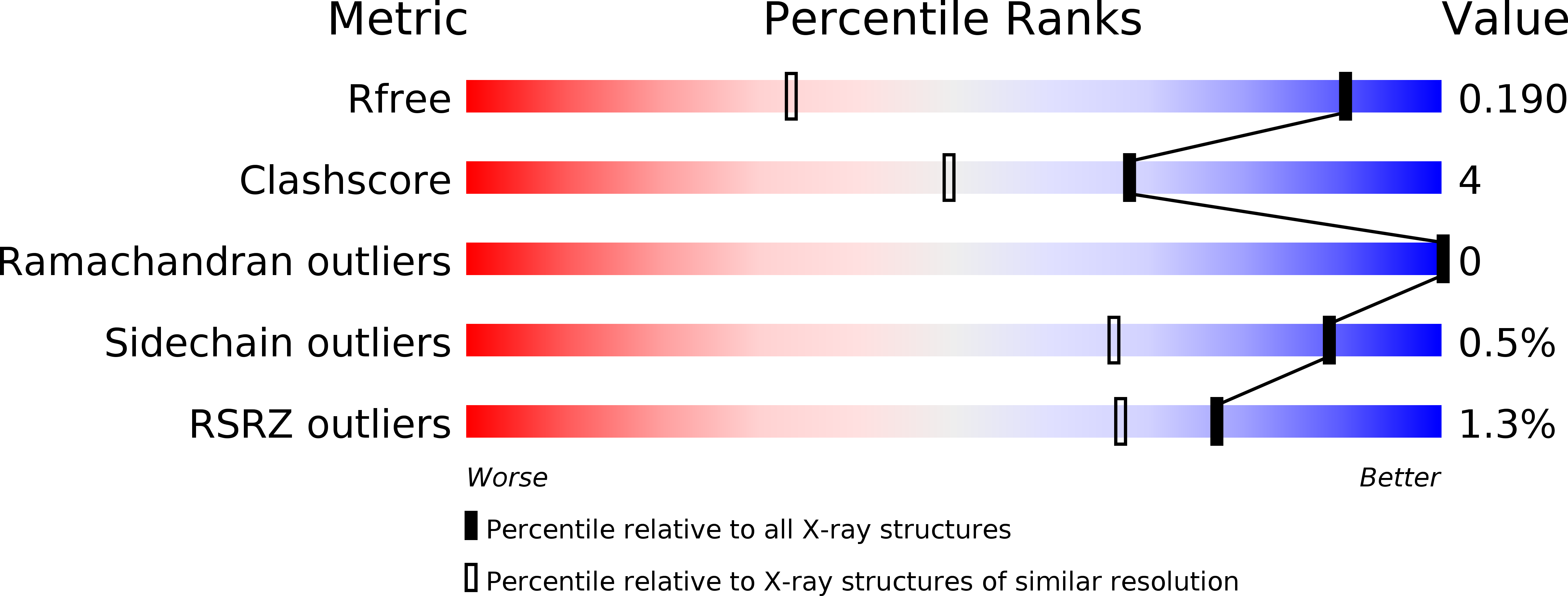
Resolution:
1.25 Å
R-Value Free:
0.19
R-Value Work:
0.15
R-Value Observed:
0.15
Space Group:
P 1 21 1
Macromolecular Entities
Structures with similar UniProt ID
Protein Blast
Polymer Type:polypeptide(L)
Molecule:Outer surface protein A
Gene (Uniprot):ospA
Mutagens:E37S,E45S,K46S,K48A,K60A,K64S,K83A,E104S,K107S,K216S,E217S,K231S
Chain IDs:A
Chain Length:228
Number of Molecules:1
Biological Source:Borrelia burgdorferi
Primary Citation
The promiscuity of beta-strand pairing allows for rational design of beta-sheet face inversion
J.Am.Chem.Soc. 130 14370 14371 (2008)
PMID: 18842042 DOI: 10.1021/ja805011h

Abstact

Recent studies suggest the dominant role of main-chain H-bond formation in specifying beta-sheet topology. Its essentially sequence-independent nature implies a large degree of freedom in designing beta-sheet-based nanomaterials. Here we show rational design of beta-sheet face inversions by incremental deletions of beta-strands from the single-layer beta-sheet of Borrelia outer surface protein A. We show that a beta-sheet structure can be maintained when a large number of native contacts are removed and that one can design large-scale conformational transitions of a beta-sheet such as face inversion by exploiting the promiscuity of strand-strand interactions. High-resolution X-ray crystal structures confirmed the success of the design and supported the importance of main-chain H-bonds in determining beta-sheet topology. This work suggests a simple but effective strategy for designing and controlling nanomaterials based on beta-rich peptide self-assemblies.

Legend

Protein

Chemical

Disease

Primary Citation of related structures
Feedback Form
Name
Email
Institute
Feedback