3CI7 image
Deposition Date 2008-03-11
Release Date 2008-10-21
Last Version Date 2024-11-20
Entry Detail
PDB ID:
3CI7
Title:
Crystal structure of a simplified BPTI containing 20 alanines
Method Details:
Experimental Method:
Resolution:
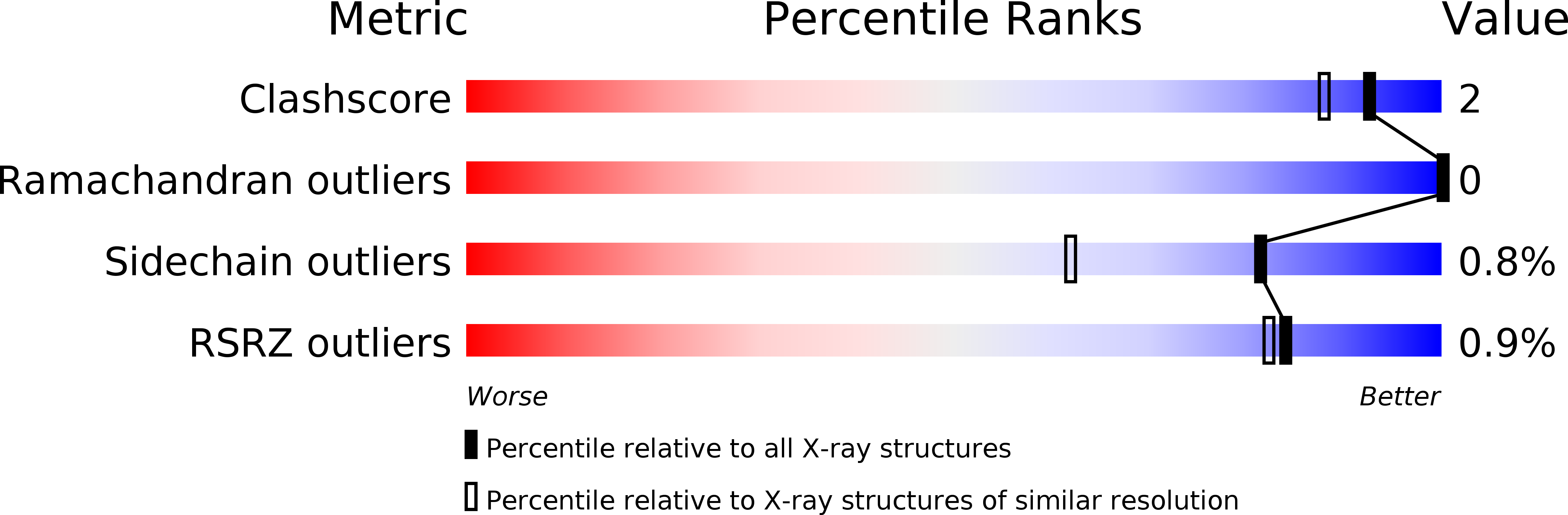
1.40 Å
R-Value Free:
0.20
R-Value Observed:
0.15
Space Group:
P 21 21 21
Macromolecular Entities
Polymer Type:polypeptide(L)
Molecule:bovine pancreatic trypsin inhibitor
Chain IDs:A, B, C, D
Chain Length:58
Number of Molecules:4
Biological Source:
Ligand Molecules
Primary Citation
Crystal structure of an extensively simplified variant of bovine pancreatic trypsin inhibitor in which over one-third of the residues are alanines
Proc.Natl.Acad.Sci.Usa 105 15334 15339 (2008)
PMID: 18829434 DOI: 10.1073/pnas.0802699105

Abstact

We report the high-resolution crystal structures of an extensively simplified variant of bovine pancreatic trypsin inhibitor containing 20 alanines (BPTI-20st) and a reference single-disulfide-bonded variant (BPTI-[5,55]st) at, respectively, 1.39 and 1.09 A resolutions. The sequence was simplified based on the results of an alanine scanning experiment, as reported previously. The effects of the multiple alanine substitutions on the overall backbone structure were surprisingly small (C(alpha) atom RMSD of 0.53 A) being limited to small local structural perturbations. Both BPTI variants retained a wild-type level of trypsin inhibitory activity. The side-chain configurations of residues buried in the hydrophobic cores (<30% accessible surface area) were almost perfectly retained in both BPTI-20st and BPTI-[5,55]st, indicating that neither multiple alanine replacements nor the removal of the disulfide bonds affected their precise placements. However, the side chains of three partially buried residues (Q31, R20, and to some extent Y21) and several unburied residues rearranged into alternative dense-packing structures, suggesting some plasticity in their shape complementarity. These results indicate that a protein sequence simplified over its entire length can retain its densely packed, native side-chain structure, and suggest that both the design and fold recognition of natively folded proteins may be easier than previously thought.

Legend

Protein

Chemical

Disease

Primary Citation of related structures
Feedback Form
Name
Email
Institute
Feedback