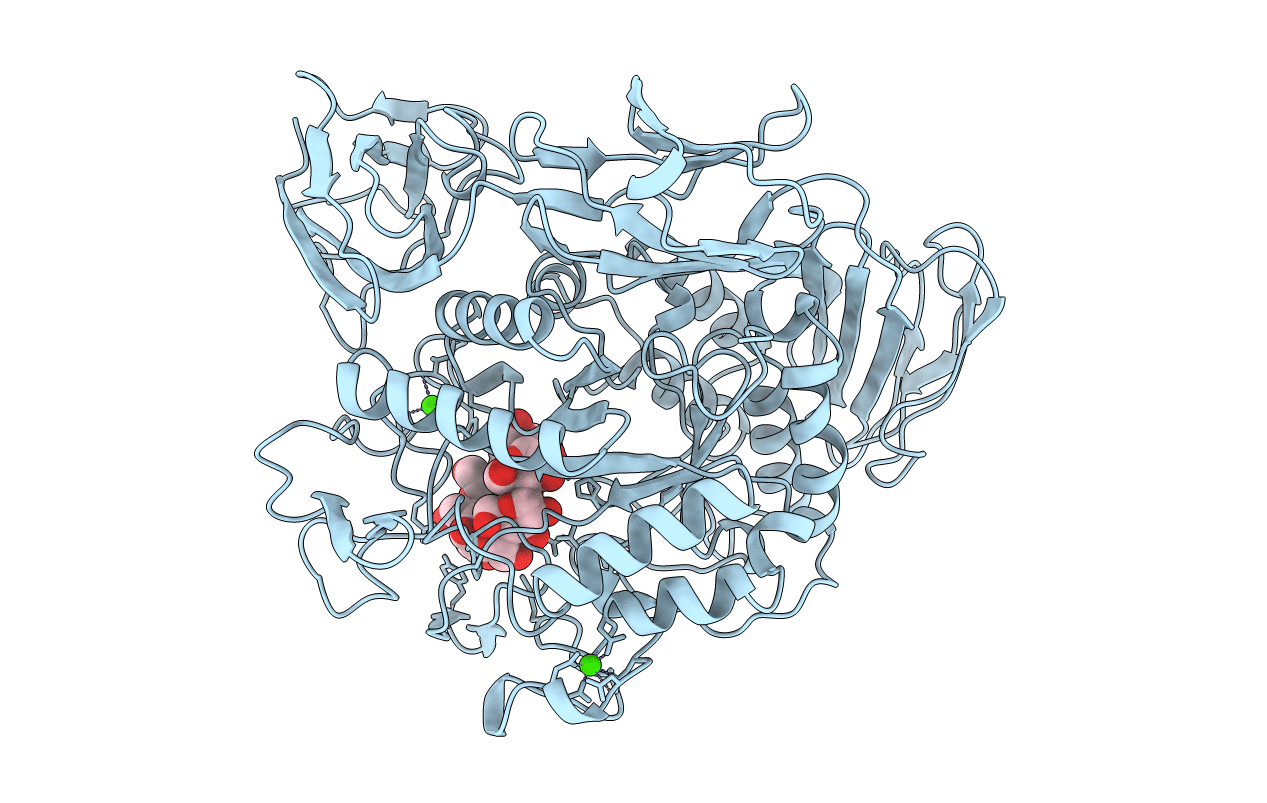
3CGT image
Deposition Date 1998-01-22
Release Date 1998-05-27
Last Version Date 2024-11-13
Entry Detail
PDB ID:
3CGT
Title:
STRUCTURE OF CYCLODEXTRIN GLYCOSYLTRANSFERASE COMPLEXED WITH ITS MAIN PRODUCT BETA-CYCLODEXTRIN
Biological Source:
Source Organism:
Host Organism:
Method Details:
Experimental Method:
Resolution:
2.40 Å
R-Value Free:
0.22
R-Value Work:
0.17
R-Value Observed:
0.17
Space Group:
P 21 21 21
Macromolecular Entities
Structures with similar UniProt ID
Protein Blast
Polymer Type:polypeptide(L)
Molecule:CYCLODEXTRIN GLYCOSYLTRANSFERASE
Mutagens:E257A
Chain IDs:A
Chain Length:684
Number of Molecules:1
Biological Source:Bacillus circulans
Ligand Molecules
Peptide-like Molecules
PRD_900012
Primary Citation
Structure of cyclodextrin glycosyltransferase complexed with a derivative of its main product beta-cyclodextrin.
Biochemistry 37 5909 5915 (1998)
PMID: 9558324 DOI: 10.1021/bi9729918

Abstact

Crystals of the inactive mutant Glu257-->Ala of cyclodextrin glycosyltransferase were soaked with the cyclodextrin (CD) derivative S-(alpha-D-glucopyranosyl)-6-thio-beta-CD. The structural analysis showed its beta-CD moiety with no density indication for the exocyclic glucosyl unit. For steric reasons, however, the position of this unit is restricted to be at only two of the seven glucosyl groups of beta-CD. The analysis indicated that the enzyme can cyclize branched alpha-glucans. The ligated beta-CD moiety revealed how the enzyme binds its predominant cyclic product. The conformation of the ligated beta-CD was intermediate between the more symmetrical conformation in beta-CD dodecahydrate crystals and the conformation of a bound linear alpha-glucan chain. Its scissile bond was displaced by 2.8 A from the position in linear alpha-glucans. Accordingly, the complex represents the situation after the cyclization reaction but before diffusion into the solvent, where a more symmetrical conformation is assumed, or the equivalent state in the reverse reaction. Furthermore, a unifying nomenclature for oligosaccharide-binding subsites in proteins is proposed.

Legend

Protein

Chemical

Disease

Primary Citation of related structures
Feedback Form
Name
Email
Institute
Feedback