3CFI image
Deposition Date 2008-03-03
Release Date 2009-01-13
Last Version Date 2024-11-20
Entry Detail
PDB ID:
3CFI
Title:
Nanobody-aided structure determination of the EPSI:EPSJ pseudopilin heterdimer from Vibrio Vulnificus
Biological Source:
Source Organism:
Vibrio vulnificus (Taxon ID: 672)
Lama glama (Taxon ID: 9844)
Host Organism:
Method Details:
Experimental Method:
Resolution:
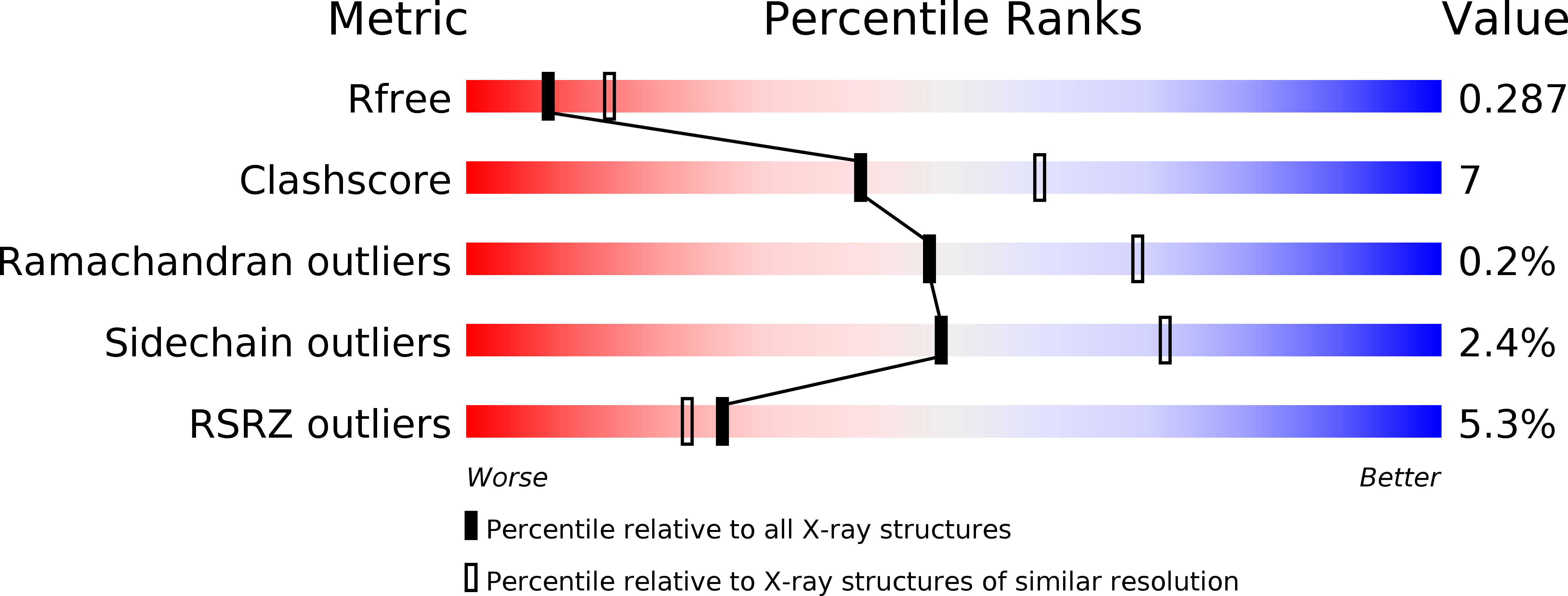
2.58 Å
R-Value Free:
0.27
R-Value Work:
0.22
R-Value Observed:
0.23
Space Group:
P 1
Macromolecular Entities
Structures with similar UniProt ID
Protein Blast
Polymer Type:polypeptide(L)
Molecule:Type II secretory pathway, pseudopilin EpsI
Gene (Uniprot):VV0219
Chain IDs:A, D, G, J
Chain Length:84
Number of Molecules:4
Biological Source:Vibrio vulnificus
Structures with similar UniProt ID
Protein Blast
Polymer Type:polypeptide(L)
Molecule:Type II secretory pathway, PSEUDOPILIN EpsJ
Gene (Uniprot):VV0220
Chain IDs:B, E, H, K
Chain Length:164
Number of Molecules:4
Biological Source:Vibrio vulnificus
Polymer Type:polypeptide(L)
Molecule:Nanobody NBEPSIJ_11
Chain IDs:C, F, I, L
Chain Length:116
Number of Molecules:4
Biological Source:Lama glama
Ligand Molecules
Primary Citation
Nanobody-aided structure determination of the EpsI:EpsJ pseudopilin heterodimer from Vibrio vulnificus.
J.Struct.Biol. 166 8 15 (2009)
PMID: 19118632 DOI: 10.1016/j.jsb.2008.11.008

Abstact

Pseudopilins form the central pseudopilus of the sophisticated bacterial type 2 secretion systems. The crystallization of the EpsI:EpsJ pseudopilin heterodimer from Vibrio vulnificus was greatly accelerated by the use of nanobodies, which are the smallest antigen-binding fragments derived from heavy-chain only camelid antibodies. Seven anti-EpsI:EpsJ nanobodies were generated and co-crystallization of EpsI:EpsJ nanobody complexes yielded several crystal forms very rapidly. In the structure solved, the nanobodies are arranged in planes throughout the crystal lattice, linking layers of EpsI:EpsJ heterodimers. The EpsI:EpsJ dimer observed confirms a right-handed architecture of the pseudopilus, but, compared to a previous structure of the EpsI:EpsJ heterodimer, EpsI differs 6 degrees in orientation with respect to EpsJ; one loop of EpsJ is shifted by approximately 5A due to interactions with the nanobody; and a second loop of EpsJ underwent a major change of 17A without contacts with the nanobody. Clearly, nanobodies accelerate dramatically the crystallization of recalcitrant protein complexes and can reveal conformational flexibility not observed before.

Legend

Protein

Chemical

Disease

Primary Citation of related structures
Feedback Form
Name
Email
Institute
Feedback