3BXM image
Deposition Date 2008-01-14
Release Date 2009-01-27
Last Version Date 2024-10-16
Entry Detail
PDB ID:
3BXM
Keywords:
Title:
Structure of an inactive mutant of human glutamate carboxypeptidase II [GCPII(E424A)] in complex with N-acetyl-Asp-Glu (NAAG)
Biological Source:
Source Organism:
Homo sapiens (Taxon ID: 9606)
Method Details:
Experimental Method:
Resolution:
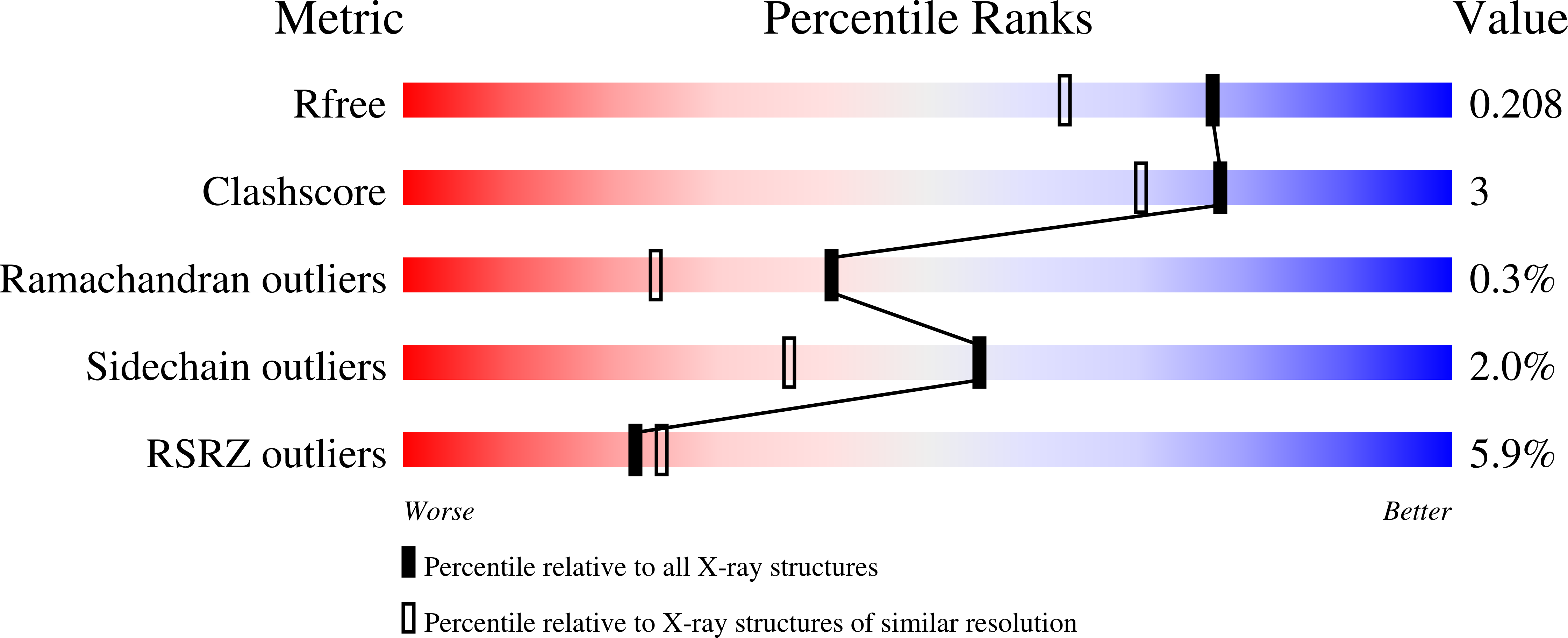
1.71 Å
R-Value Free:
0.21
R-Value Work:
0.18
R-Value Observed:
0.18
Space Group:
I 2 2 2
Macromolecular Entities
Structures with similar UniProt ID
Protein Blast
Polymer Type:polypeptide(L)
Molecule:Glutamate carboxypeptidase 2
Gene (Uniprot):FOLH1
Mutagens:E424A
Chain IDs:A
Chain Length:709
Number of Molecules:1
Biological Source:Homo sapiens
Polymer Type:polypeptide(L)
Molecule:N-Acetyl-Aspartyl-Glutamate (NAAG)
Chain IDs:B (auth: I)
Chain Length:3
Number of Molecules:1
Biological Source:
Modified Residue
Compound ID Chain ID Parent Comp ID Details 2D Image
ASN A ASN GLYCOSYLATION SITE
Primary Citation
Reaction mechanism of glutamate carboxypeptidase II revealed by mutagenesis, X-ray crystallography, and computational methods.
Biochemistry 48 4126 4138 (2009)
PMID: 19301871 DOI: 10.1021/bi900220s

Abstact

Glutamate carboxypeptidase II (GCPII, EC 3.4.17.21) is a zinc-dependent exopeptidase and an important therapeutic target for neurodegeneration and prostate cancer. The hydrolysis of N-acetyl-l-aspartyl-l-glutamate (N-Ac-Asp-Glu), the natural dipeptidic substrate of the GCPII, is intimately involved in cellular signaling within the mammalian nervous system, but the exact mechanism of this reaction has not yet been determined. To investigate peptide hydrolysis by GCPII in detail, we constructed a mutant of human GCPII [GCPII(E424A)], in which Glu424, a putative proton shuttle residue, is substituted with alanine. Kinetic analysis of GCPII(E424A) using N-Ac-Asp-Glu as substrate revealed a complete loss of catalytic activity, suggesting the direct involvement of Glu424 in peptide hydrolysis. Additionally, we determined the crystal structure of GCPII(E424A) in complex with N-Ac-Asp-Glu at 1.70 A resolution. The presence of the intact substrate in the GCPII(E424A) binding cavity substantiates our kinetic data and allows a detailed analysis of GCPII/N-Ac-Asp-Glu interactions. The experimental data are complemented by the combined quantum mechanics/molecular mechanics calculations (QM/MM) which enabled us to characterize the transition states, including the associated reaction barriers, and provided detailed information concerning the GCPII reaction mechanism. The best estimate of the reaction barrier was calculated to be DeltaG(++) approximately 22(+/-5) kcal x mol(-1), which is in a good agreement with the experimentally observed reaction rate constant (k(cat) approximately 1 s(-1)). Combined together, our results provide a detailed and consistent picture of the reaction mechanism of this highly interesting enzyme at the atomic level.

Legend

Protein

Chemical

Disease

Primary Citation of related structures
Feedback Form
Name
Email
Institute
Feedback