3BNX image
Deposition Date 2007-12-14
Release Date 2008-03-25
Last Version Date 2023-08-30
Entry Detail
PDB ID:
3BNX
Keywords:
Title:
Crystal structure of Aristolochene synthase complexed with farnesyl diphosphate
Biological Source:
Source Organism:
Host Organism:
Method Details:
Experimental Method:
Resolution:
2.10 Å
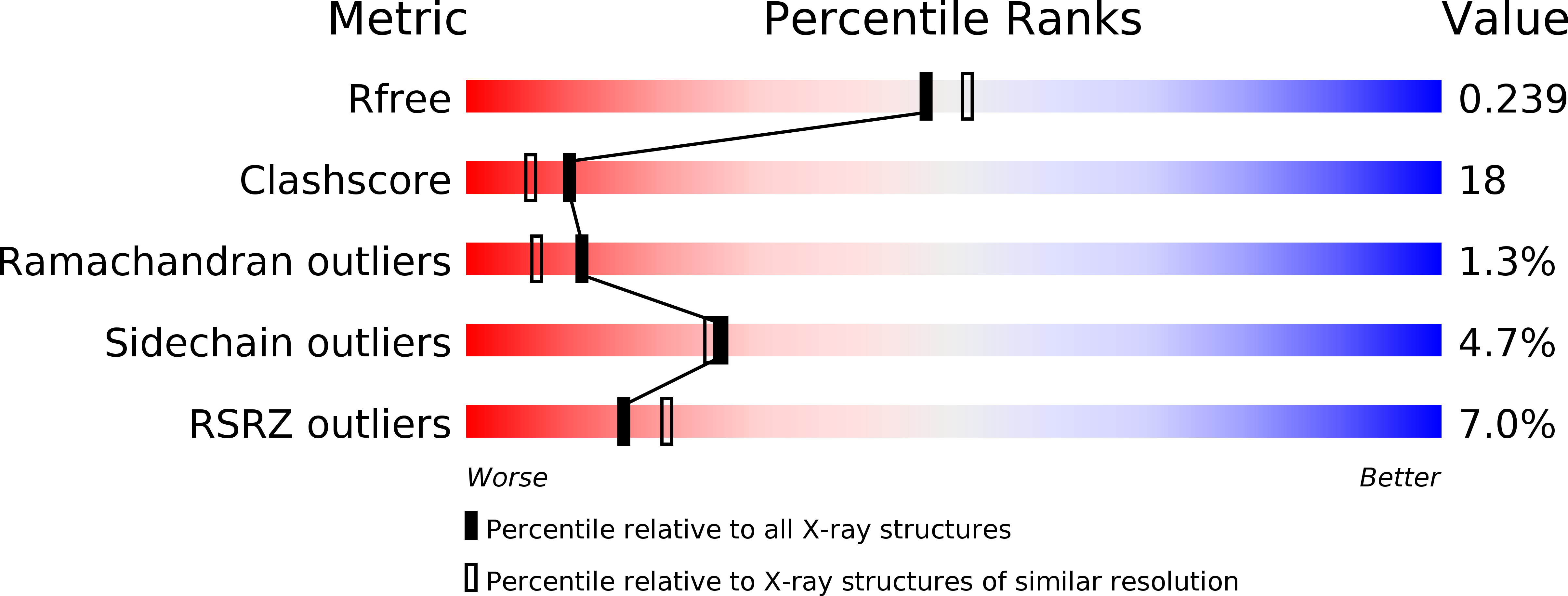
R-Value Free:
0.27
R-Value Work:
0.24
Space Group:
P 1 21 1
Macromolecular Entities
Structures with similar UniProt ID
Protein Blast
Polymer Type:polypeptide(L)
Molecule:Aristolochene synthase
Gene (Uniprot):Ari1
Chain IDs:A, B, C, D
Chain Length:320
Number of Molecules:4
Biological Source:Aspergillus terreus
Primary Citation
X-ray Crystallographic Studies of Substrate Binding to Aristolochene Synthase Suggest a Metal Ion Binding Sequence for Catalysis
J.Biol.Chem. 283 15431 15439 (2008)
PMID: 18385128 DOI: 10.1074/jbc.M800659200

Abstact

The universal sesquiterpene precursor, farnesyl diphosphate (FPP), is cyclized in an Mg(2+)-dependent reaction catalyzed by the tetrameric aristolochene synthase from Aspergillus terreus to form the bicyclic hydrocarbon aristolochene and a pyrophosphate anion (PP(i)) coproduct. The 2.1-A resolution crystal structure determined from crystals soaked with FPP reveals the binding of intact FPP to monomers A-C, and the binding of PP(i) and Mg(2+)(B) to monomer D. The 1.89-A resolution structure of the complex with 2-fluorofarnesyl diphosphate (2F-FPP) reveals 2F-FPP binding to all subunits of the tetramer, with Mg(2+)(B)accompanying the binding of this analogue only in monomer D. All monomers adopt open activesite conformations in these complexes, but slight structural changes in monomers C and D of each complex reflect the very initial stages of a conformational transition to the closed state. Finally, the 2.4-A resolution structure of the complex with 12,13-difluorofarnesyl diphosphate (DF-FPP) reveals the binding of intact DF-FPP to monomers A-C in the open conformation and the binding of PP(i), Mg(2+)(B), and Mg(2+)(C) to monomer D in a predominantly closed conformation. Taken together, these structures provide 12 independent "snapshots" of substrate or product complexes that suggest a possible sequence for metal ion binding and conformational changes required for catalysis.

Legend

Protein

Chemical

Disease

Primary Citation of related structures
Feedback Form
Name
Email
Institute
Feedback