3AJM image
Deposition Date 2010-06-09
Release Date 2010-06-30
Last Version Date 2024-03-13
Entry Detail
PDB ID:
3AJM
Keywords:
Title:
Crystal structure of programmed cell death 10 in complex with inositol 1,3,4,5-tetrakisphosphate
Biological Source:
Source Organism:
Homo sapiens (Taxon ID: 9606)
Host Organism:
Method Details:
Experimental Method:
Resolution:
2.30 Å
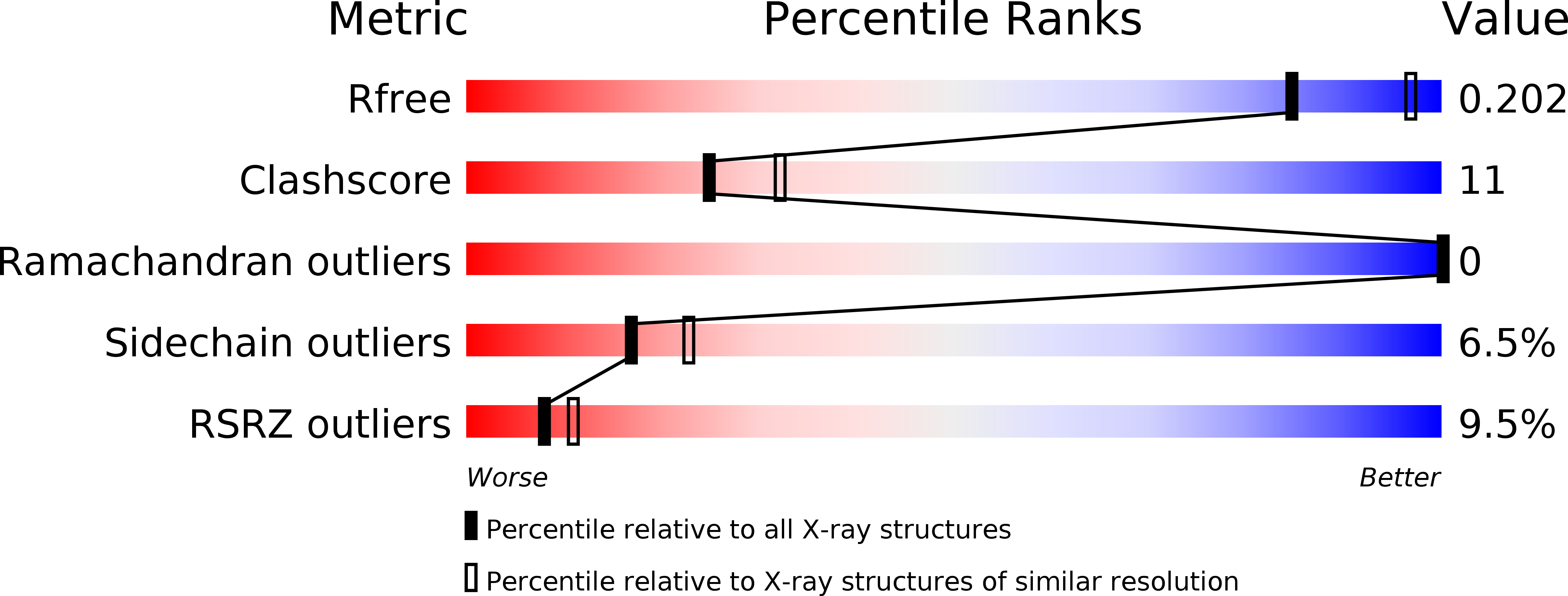
R-Value Free:
0.26
R-Value Work:
0.21
R-Value Observed:
0.21
Space Group:
P 41 21 2
Macromolecular Entities
Structures with similar UniProt ID
Protein Blast
Polymer Type:polypeptide(L)
Molecule:Programmed cell death protein 10
Gene (Uniprot):PDCD10
Chain IDs:A, B
Chain Length:213
Number of Molecules:2
Biological Source:Homo sapiens
Ligand Molecules
Primary Citation
Crystal structure of human programmed cell death 10 complexed with inositol-(1,3,4,5)-tetrakisphosphate: a novel adaptor protein involved in human cerebral cavernous malformation.
Biochem.Biophys.Res.Commun. 399 587 592 (2010)
PMID: 20682288 DOI: 10.1016/j.bbrc.2010.07.119

Abstact

Programmed cell death 10 (PDCD10) is a novel adaptor protein involved in human cerebral cavernous malformation, a common vascular lesion mostly occurring in the central nervous system. By interacting with different signal proteins, PDCD10 could regulate various physiological processes in the cell. The crystal structure of human PDCD10 complexed with inositol-(1,3,4,5)-tetrakisphosphate has been determined at 2.3A resolution. The structure reveals an integrated dimer via a unique assembly that has never been observed before. Each PDCD10 monomer contains two independent domains: an N-terminal domain with a new fold involved in the tight dimer assembly and a C-terminal four-helix bundle domain that closely resembles the focal adhesion targeting domain of focal adhesion kinase. An eight-residue flexible linker connects the two domains, potentially conferring mobility onto the C-terminal domain, resulting in the conformational variability of PDCD10. A variable basic cleft on the top of the dimer interface binds to phosphatidylinositide and regulates the intracellular localization of PDCD10. Two potential sites, respectively located on the two domains, are critical for recruiting different binding partners, such as germinal center kinase III proteins and the focal adhesion protein paxillin.

Legend

Protein

Chemical

Disease

Primary Citation of related structures
Feedback Form
Name
Email
Institute
Feedback