3AFL image
Deposition Date 2010-03-09
Release Date 2010-04-28
Last Version Date 2023-11-01
Entry Detail
PDB ID:
3AFL
Keywords:
Title:
Crystal structure of exotype alginate lyase Atu3025 H531A complexed with alginate trisaccharide
Biological Source:
Source Organism:
Host Organism:
Method Details:
Experimental Method:
Resolution:
2.99 Å
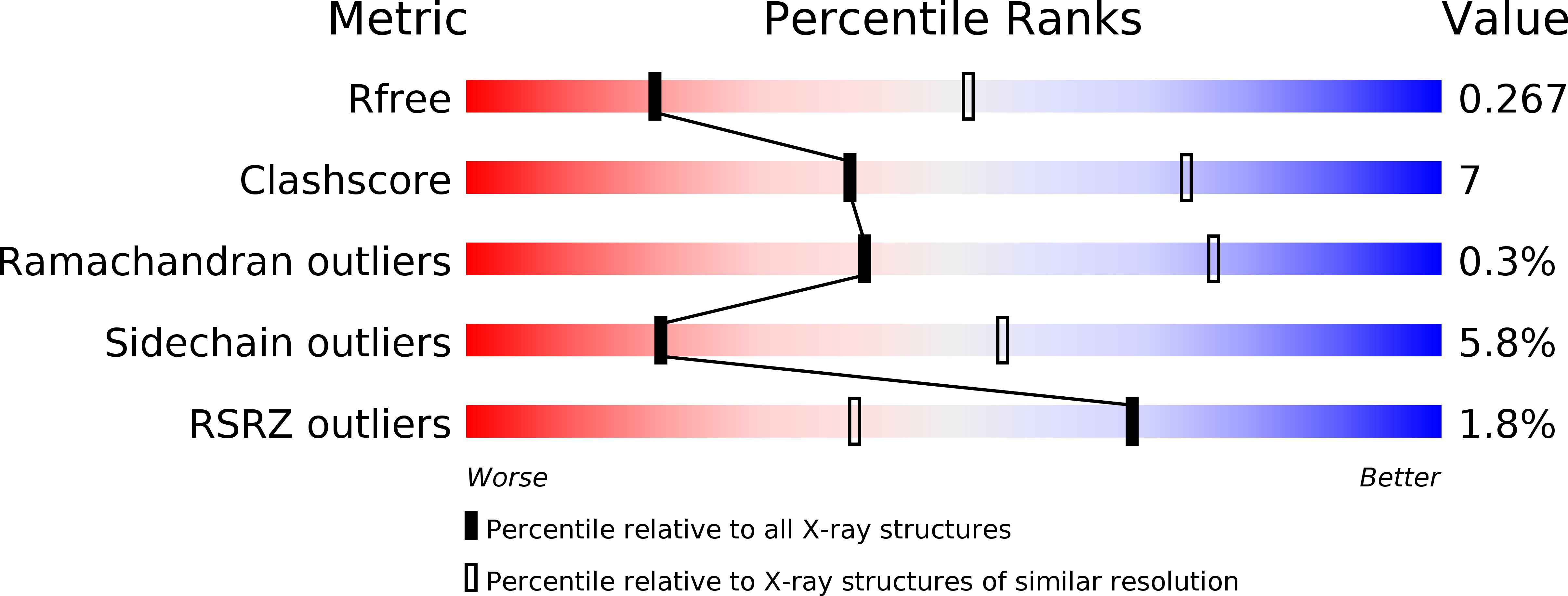
R-Value Free:
0.26
R-Value Work:
0.19
R-Value Observed:
0.20
Space Group:
P 21 21 21
Macromolecular Entities
Structures with similar UniProt ID
Protein Blast
Polymer Type:polypeptide(L)
Molecule:Oligo alginate lyase
Gene (Uniprot):Atu3025
Mutagens:H531A
Chain IDs:A
Chain Length:776
Number of Molecules:1
Biological Source:Agrobacterium tumefaciens
Primary Citation
Crystal structure of exotype alginate lyase Atu3025 from Agrobacterium tumefaciens
J.Biol.Chem. 285 24519 24528 (2010)
PMID: 20507980 DOI: 10.1074/jbc.M110.125450

Abstact

Alginate, a major component of the cell wall matrix in brown seaweeds, is degraded by alginate lyases through a beta-elimination reaction. Almost all alginate lyases act endolytically on substrate, thereby yielding unsaturated oligouronic acids having 4-deoxy-l-erythro-hex-4-enepyranosyluronic acid at the nonreducing end. In contrast, Agrobacterium tumefaciens alginate lyase Atu3025, a member of polysaccharide lyase family 15, acts on alginate polysaccharides and oligosaccharides exolytically and releases unsaturated monosaccharides from the substrate terminal. The crystal structures of Atu3025 and its inactive mutant in complex with alginate trisaccharide (H531A/DeltaGGG) were determined at 2.10- and 2.99-A resolutions with final R-factors of 18.3 and 19.9%, respectively, by x-ray crystallography. The enzyme is comprised of an alpha/alpha-barrel + anti-parallel beta-sheet as a basic scaffold, and its structural fold has not been seen in alginate lyases analyzed thus far. The structural analysis of H531A/DeltaGGG and subsequent site-directed mutagenesis studies proposed the enzyme reaction mechanism, with His(311) and Tyr(365) as the catalytic base and acid, respectively. Two structural determinants, i.e. a short alpha-helix in the central alpha/alpha-barrel domain and a conformational change at the interface between the central and C-terminal domains, are essential for the exolytic mode of action. This is, to our knowledge, the first report on the structure of the family 15 enzyme.

Legend

Protein

Chemical

Disease

Primary Citation of related structures
Feedback Form
Name
Email
Institute
Feedback