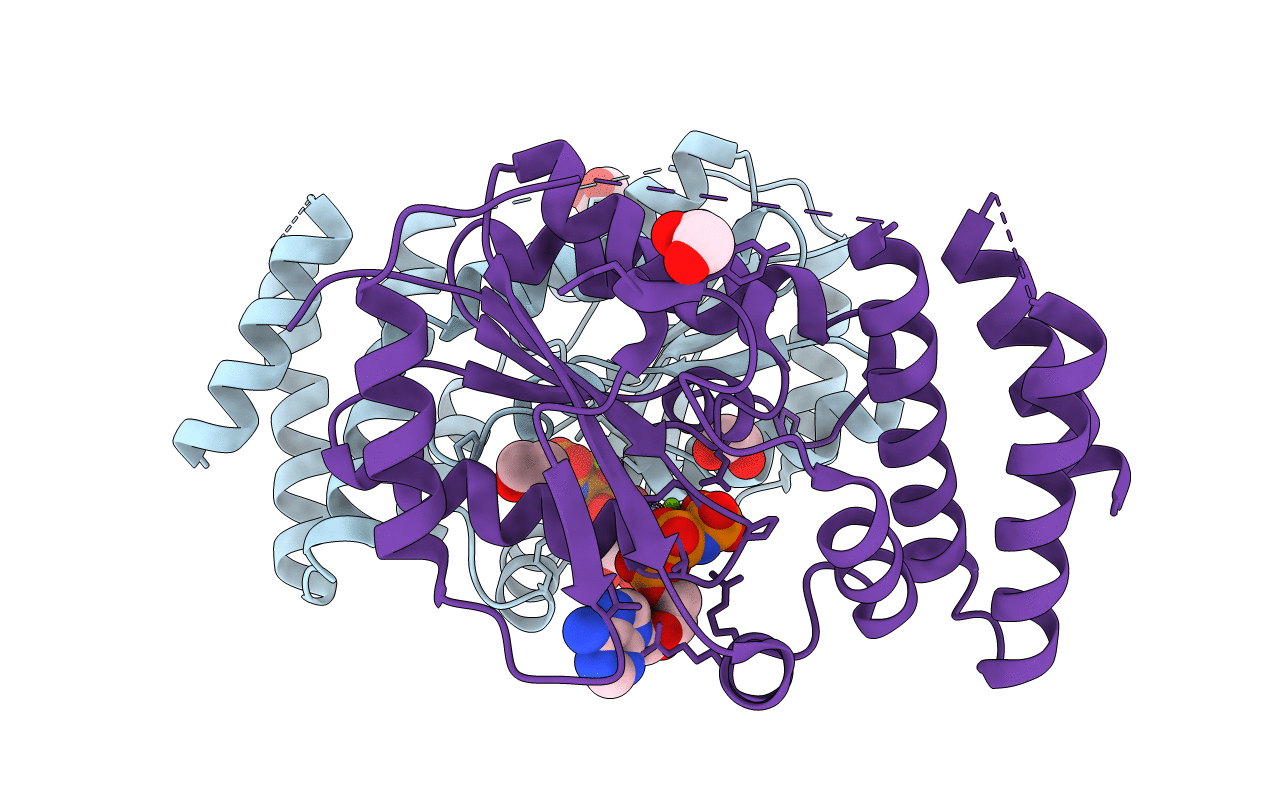
3A4L image
Deposition Date 2009-07-10
Release Date 2009-10-20
Last Version Date 2024-03-13
Entry Detail
PDB ID:
3A4L
Keywords:
Title:
Crystal structure of archaeal O-phosphoseryl-tRNA(Sec) kinase
Biological Source:
Source Organism:
Host Organism:
Method Details:
Experimental Method:
Resolution:
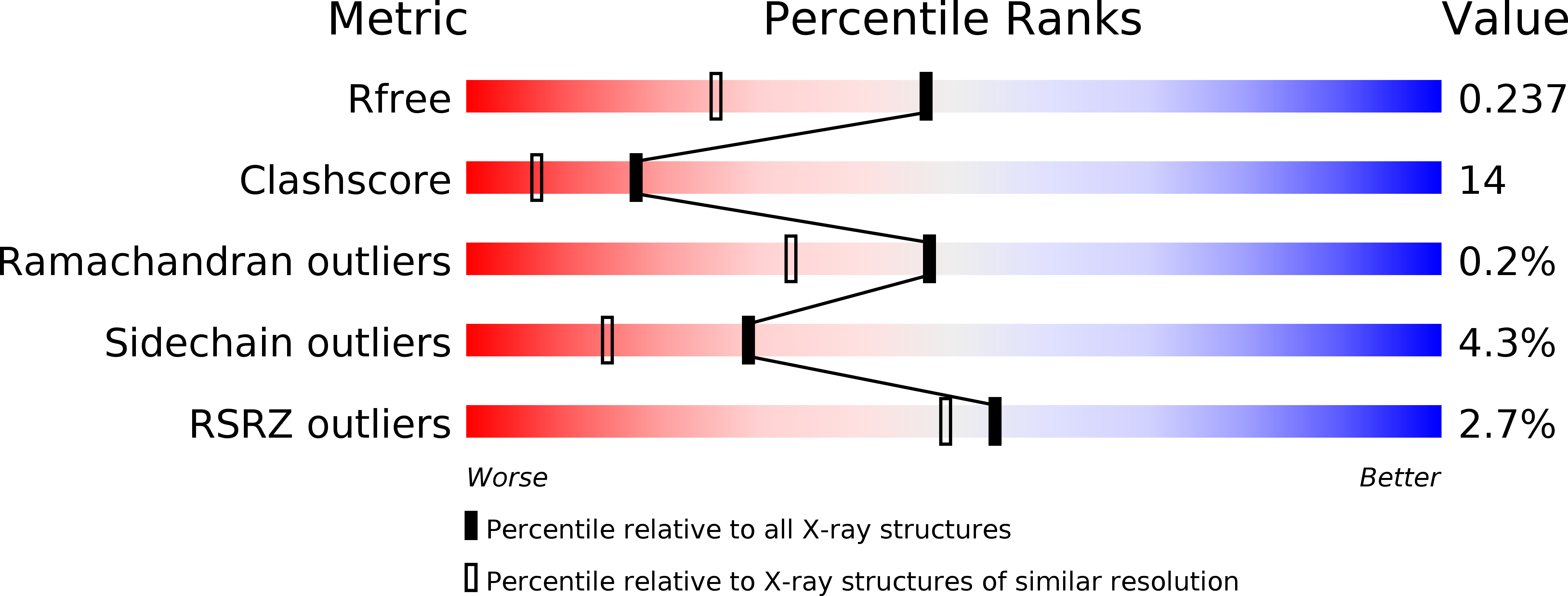
1.80 Å
R-Value Free:
0.24
R-Value Work:
0.20
R-Value Observed:
0.21
Space Group:
P 1 21 1
Macromolecular Entities
Structures with similar UniProt ID
Protein Blast
Polymer Type:polypeptide(L)
Molecule:L-seryl-tRNA(Sec) kinase
Gene (Uniprot):pstK
Chain IDs:A, B
Chain Length:260
Number of Molecules:2
Biological Source:Methanocaldococcus jannaschii
Primary Citation
Structure of a tRNA-dependent kinase essential for selenocysteine decoding
Proc.Natl.Acad.Sci.USA 106 16215 16220 (2009)
PMID: 19805283 DOI: 10.1073/pnas.0908861106

Abstact

Compared to bacteria, archaea and eukaryotes employ an additional enzyme for the biosynthesis of selenocysteine (Sec), the 21(st) natural amino acid (aa). An essential RNA-dependent kinase, O-phosphoseryl-tRNA(Sec) kinase (PSTK), converts seryl-tRNA(Sec) to O-phosphoseryl-tRNA(Sec), the immediate precursor of selenocysteinyl-tRNA(Sec). The sequence of Methanocaldococcus jannaschii PSTK (MjPSTK) suggests an N-terminal kinase domain (177 aa) followed by a presumed tRNA binding region (75 aa). The structures of MjPSTK complexed with ADP and AMPPNP revealed that this enzyme belongs to the P-loop kinase class, and that the kinase domain is closely related to gluconate kinase and adenylate kinase. ATP is bound by the P-loop domain (residues 11-18). Formed by antiparallel dimerization of two PSTK monomers, the enzyme structure shows a deep groove with positive electrostatic potential. Located in this groove is the enzyme's active site, which biochemical and genetic data suggest is composed of Asp-41, Arg-44, Glu-55, Tyr-82, Tyr-83, Met-86, and Met-132. Based on structural comparison with Escherichia coli adenylate kinase a docking model was generated that assigns these amino acids to the recognition of the terminal A76-Ser moieties of Ser-tRNA(Sec). The geometry and electrostatic environment of the groove in MjPSTK are perfectly complementary to the unusually long acceptor helix of tRNA(Sec).

Legend

Protein

Chemical

Disease

Primary Citation of related structures
Feedback Form
Name
Email
Institute
Feedback