3A2W image
Deposition Date 2009-06-04
Release Date 2009-10-27
Last Version Date 2024-11-06
Entry Detail
PDB ID:
3A2W
Keywords:
Title:
Peroxiredoxin (C50S) from Aeropytum pernix K1 (peroxide-bound form)
Biological Source:
Source Organism:
Host Organism:
Method Details:
Experimental Method:
Resolution:
2.30 Å
R-Value Free:
0.24
R-Value Work:
0.20
R-Value Observed:
0.20
Space Group:
P 1
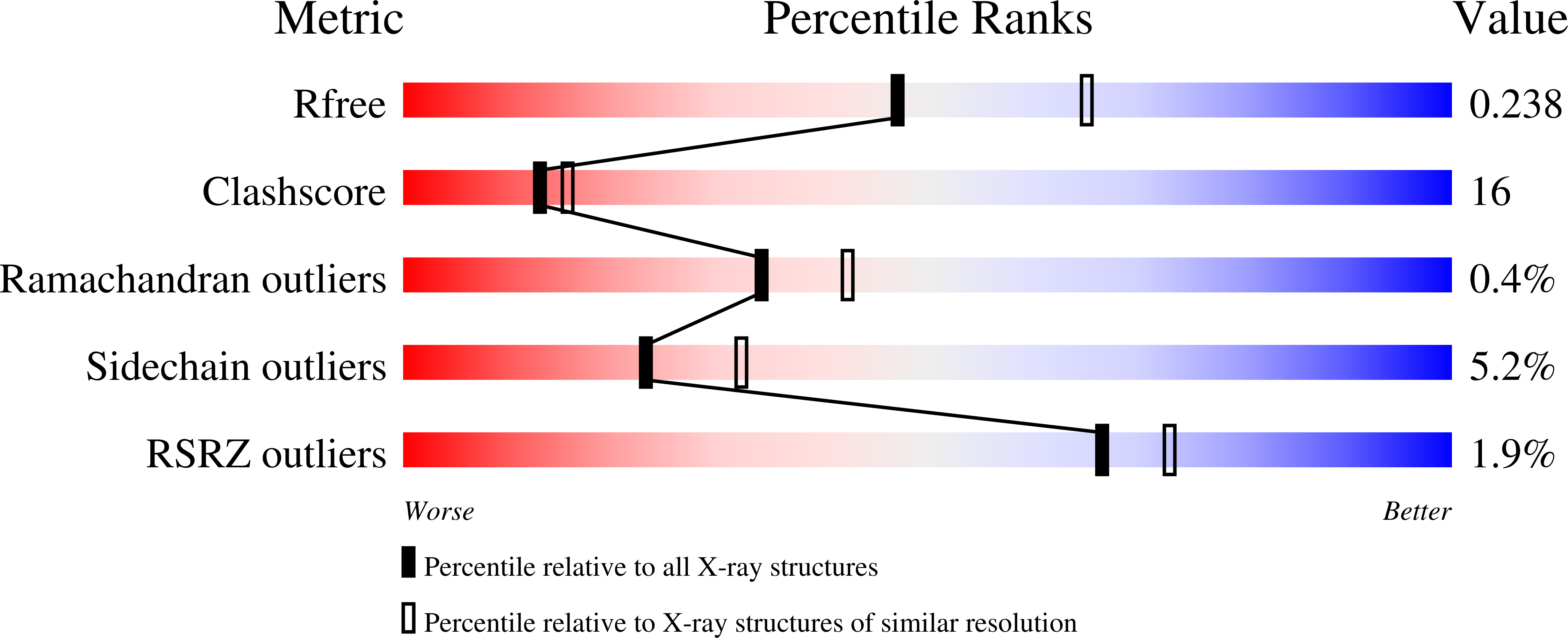
Macromolecular Entities
Structures with similar UniProt ID
Protein Blast
Polymer Type:polypeptide(L)
Molecule:Probable peroxiredoxin
Gene (Uniprot):APE_2278
Mutagens:C50S
Chain IDs:A, B, C, D, E, F, G, H, I, J
Chain Length:249
Number of Molecules:10
Biological Source:Aeropyrum pernix
Primary Citation
Crystal structure of peroxiredoxin from Aeropyrum pernix K1 complexed with its substrate, hydrogen peroxide
J.Biochem. 147 109 115 (2010)
PMID: 19819903 DOI: 10.1093/jb/mvp154

Abstact

Peroxiredoxin (Prx) reduces hydrogen peroxide and alkyl peroxides to water and corresponding alcohols, respectively. The reaction is dependent on a peroxidatic cysteine, whose sulphur atom nucleophilically attacks one of the oxygen atoms of the peroxide substrate. In spite of the many structural studies that have been carried out on this reaction, the tertiary structure of the hydrogen peroxide-bound form of Prx has not been elucidated. In this paper, we report the crystal structure of Prx from Aeropyrum pernix K1 in the peroxide-bound form. The conformation of the polypeptide chain is the same as that in the reduced apo-form. The hydrogen peroxide molecule is in close contact with the peroxidatic Cys50 and the neighbouring Thr47 and Arg126 side chain atoms, as well as with the main chain nitrogen atoms of Val49 and Cys50. Bound peroxide was also observed in the mutant C50S, in which the peroxidatic cysteine was replaced by serine. Therefore, the sulphur atom of the peroxidatic cysteine is not essential for peroxide binding, although it enhances the binding affinity. Hydrogen peroxide binds to the protein so that it fills the active site pocket. This study provides insight into the early stage of the Prx reaction.

Legend

Protein

Chemical

Disease

Primary Citation of related structures
Feedback Form
Name
Email
Institute
Feedback