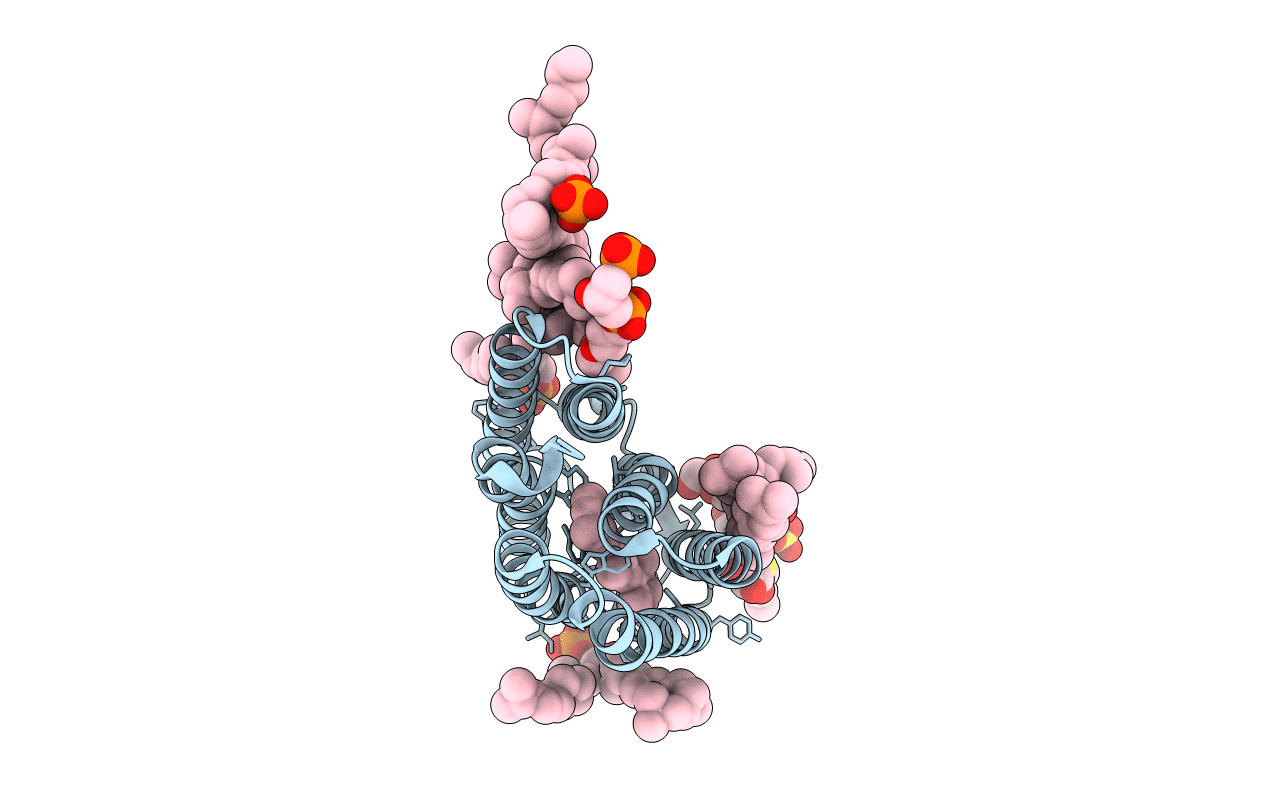
2ZZL image
Deposition Date 2009-02-18
Release Date 2009-10-06
Last Version Date 2023-11-01
Entry Detail
PDB ID:
2ZZL
Title:
Structure of bacteriorhodopsin's M intermediate at pH 7
Biological Source:
Source Organism:
Method Details:
Experimental Method:
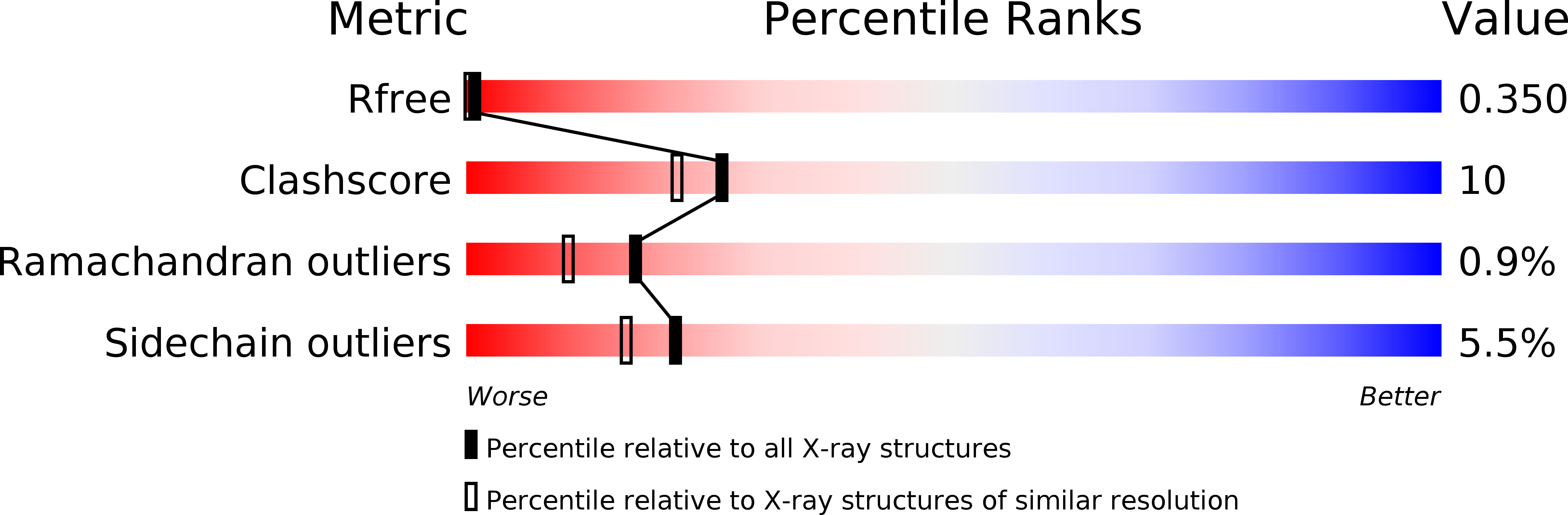
Resolution:
2.03 Å
R-Value Free:
0.23
R-Value Work:
0.20
R-Value Observed:
0.20
Space Group:
P 6 2 2
Macromolecular Entities
Structures with similar UniProt ID
Protein Blast
Polymer Type:polypeptide(L)
Molecule:Bacteriorhodopsin
Gene (Uniprot):bop
Chain IDs:A
Chain Length:262
Number of Molecules:1
Biological Source:Halobacterium salinarum
Primary Citation
Crystal Structures of Different Substates of Bacteriorhodopsin's M Intermediate at Various pH Levels.
J.Mol.Biol. ? ? ? (2009)
PMID: 19712684 DOI: 10.1016/j.jmb.2009.08.047

Abstact

The hexagonal P622 crystal of bacteriorhodopsin, which is made up of stacked membranes, is stable provided that the precipitant concentration in the soaking solution is higher than a critical value (i.e., 1.5 M ammonium sulfate). Diffraction data showed that the crystal lattice shrank linearly with increasing precipitant concentration, due primarily to narrowing of intermembrane spaces. Although the crystal shrinkage did not affect the rate of formation of the photoreaction M intermediate, its lifetime increased exponentially with the precipitant concentration. It was suggested that the energetic barrier of the M-to-N transition becomes higher when the motional freedom of the EF loop is reduced by crystal lattice force. As a result of this property, the M state accumulated predominantly when the crystal that was soaked at a high precipitant concentration was illuminated at room temperature. Structural data obtained at various pH levels showed that the overall structure of M is not strongly dependent on pH, except that Glu194 and Glu204 in the proton release complex are more separated at pH 7 than at pH 4.4. This result suggests that light-induced disruption of the paired structure of Glu194 and Glu204 is incomplete when external pH is lower than the pK(a) value of the proton release group in the M state.

Legend

Protein

Chemical

Disease

Primary Citation of related structures
Feedback Form
Name
Email
Institute
Feedback