2ZUA image
Deposition Date 2008-10-15
Release Date 2009-08-25
Last Version Date 2023-11-01
Entry Detail
PDB ID:
2ZUA
Keywords:
Title:
Crystal structure of nucleoside diphosphate kinase from Haloarcula quadrata
Biological Source:
Source Organism:
Host Organism:
Method Details:
Experimental Method:
Resolution:
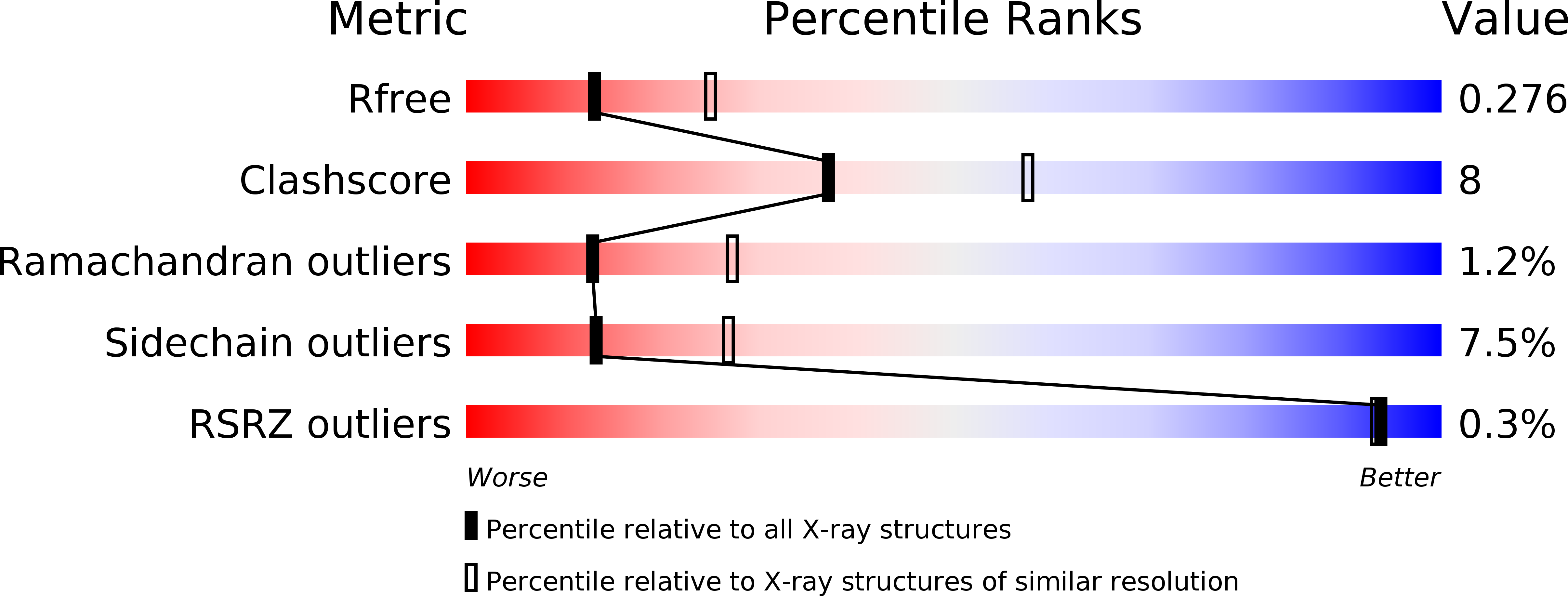
2.59 Å
R-Value Free:
0.28
R-Value Work:
0.22
R-Value Observed:
0.22
Space Group:
P 63
Macromolecular Entities
Structures with similar UniProt ID
Protein Blast
Polymer Type:polypeptide(L)
Molecule:Nucleoside diphosphate kinase
Gene (Uniprot):ndk
Chain IDs:A, B, C, D
Chain Length:174
Number of Molecules:4
Biological Source:Haloarcula quadrata
Primary Citation
Molecular mechanism of distinct salt-dependent enzyme activity of two halophilic nucleoside diphosphate kinases
Biophys.J. 96 4692 4700 (2009)
PMID: 19486691 DOI: 10.1016/j.bpj.2009.03.012

Abstact

Nucleoside diphosphate kinases from haloarchaea Haloarcula quadrata (NDK-q) and H. sinaiiensis (NDK-s) are identical except for one out of 154 residues, i.e., Arg(31) in NDK-q and Cys(31) in NDK-s. However, the salt-dependent activity profiles of NDK-q and NDK-s are quite different: the optimal NaCl concentrations of NDK-q and NDK-s are 1 M and 2 M, respectively. We analyzed the relationships of the secondary, tertiary, and quaternary structures and NDK activity of these NDKs at various salt concentrations, and revealed that 1), NDK-q is present as a hexamer under a wide range of salt concentrations (0.2-4 M NaCl), whereas NDK-s is present as a hexamer at an NaCl concentration above 2 M and as a dimer at NaCl concentrations below 1 M; 2), dimeric NDK-s has lower activity than hexameric NDK-s; and 3), dimeric NDK-s has higher helicity than hexameric NDK-s. We also determined the crystal structure of hexameric NDK-q, and revealed that Arg(31) plays an important role in stabilizing the hexamer. Thus the substitution of Arg (as in NDK-q) to Cys (as in NDK-s) at position 31 destabilizes the hexameric assembly, and causes dissociation to less active dimers at low salt concentrations.

Legend

Protein

Chemical

Disease

Primary Citation of related structures
Feedback Form
Name
Email
Institute
Feedback