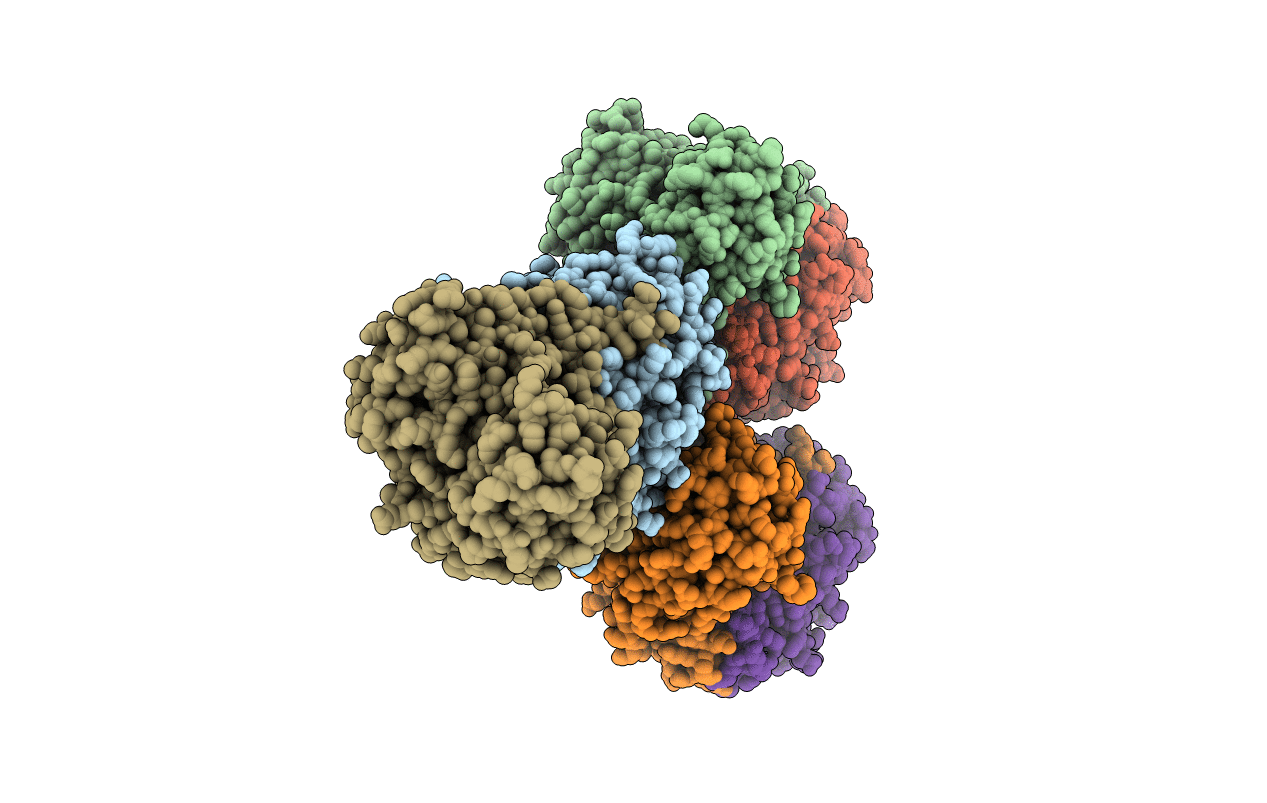
2ZP7 image
Deposition Date 2008-06-30
Release Date 2009-01-13
Last Version Date 2025-03-26
Entry Detail
PDB ID:
2ZP7
Keywords:
Title:
Crystal structure of LysN, alpha-aminoadipate aminotransferase (Leucine complex), from Thermus thermophilus HB27
Biological Source:
Source Organism:
Host Organism:
Method Details:
Experimental Method:
Resolution:
2.26 Å
R-Value Free:
0.26
R-Value Work:
0.20
R-Value Observed:
0.20
Space Group:
P 1 21 1

Macromolecular Entities
Structures with similar UniProt ID
Protein Blast
Polymer Type:polypeptide(L)
Molecule:Alpha-aminodipate aminotransferase
Gene (Uniprot):lysN
Chain IDs:A, B, C, D, E, F
Chain Length:397
Number of Molecules:6
Biological Source:Thermus thermophilus
Primary Citation
Mechanism for multiple-substrates recognition of alpha-aminoadipate aminotransferase from Thermus thermophilus
Proteins ? ? ? (2008)
PMID: 18831049 DOI: 10.1002/prot.22245

Abstact

Alpha-aminoadipate aminotransferase (AAA-AT), a homolog of mammalian kynurenine aminotransferase II (Kat II), transfers an amino group to 2-oxoadipate to yield alpha-aminoadipate in lysine biosynthesis through the alpha-aminoadipate pathway in Thermus thermophilus. AAA-AT catalyzes transamination against various substrates, including AAA, glutamate, leucine, and aromatic amino acids. To elucidate the structural change for recognition of various substrates, we determined crystal structures of AAA-AT in four forms: with pyridoxal 5'-phosphate (PLP) (PLP complex), with PLP and leucine (PLP/Leu complex), with N-phosphopyridoxyl-leucine (PPL) (PPL complex), and with N-phosphopyridoxyl-alpha-aminoadipate (PPA) at 2.67, 2.26, 1.75, and 1.67 A resolution, respectively. The PLP complex is in an open state, whereas PLP/Leu, PPL, and PPA complexes are in closed states with maximal displacement (over 7 A) of the alpha2 helix and the beta1 strand in the small domain to cover the active site, indicating that conformational change is induced by substrate binding. In PPL and PLP/Leu complexes, several hydrophobic residues on the alpha2 helix recognize the hydrophobic side chain of the bound leucine moiety whereas, in the PPA complex, the alpha2 helix rotates to place the guanidium moiety of Arg23 on the helix at the appropriate position to interact with the carboxyl side chain of the AAA moiety. These results indicate that AAA-AT can recognize various kinds of substrates using the mobile alpha2 helix. The crystal structures and site-directed mutagenesis revealed that intersubunit-electrostatic interactions contribute to the elevated thermostability of this enzyme.

Legend

Protein

Chemical

Disease

Primary Citation of related structures
Feedback Form
Name
Email
Institute
Feedback