2ZCG image
Deposition Date 2007-11-08
Release Date 2008-03-11
Last Version Date 2023-11-01
Entry Detail
PDB ID:
2ZCG
Keywords:
Title:
Structure and inhibition of orotidine 5'-phosphate decarboxylase from plasmodium falciparum
Biological Source:
Source Organism(s):
Expression System(s):
Method Details:
Experimental Method:
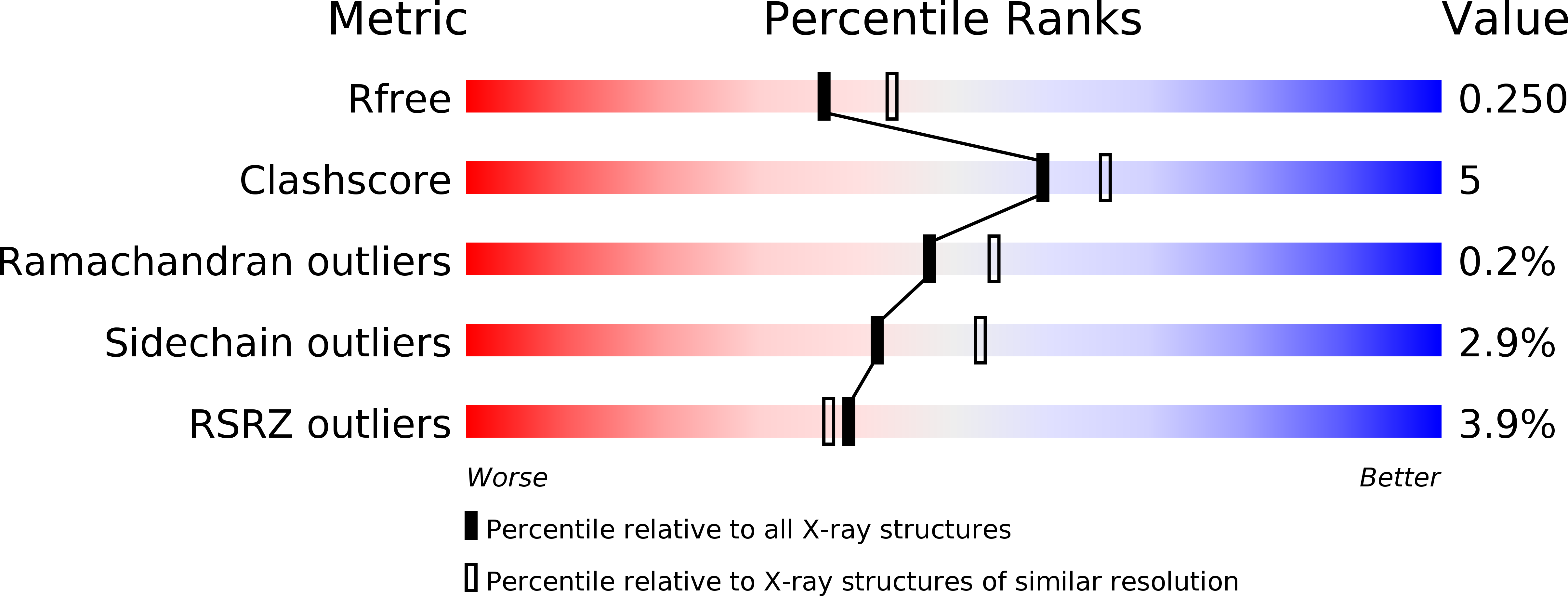
Resolution:
2.22 Å
R-Value Free:
0.27
R-Value Work:
0.20
R-Value Observed:
0.20
Space Group:
P 1 21 1
Macromolecular Entities
Structures with similar UniProt ID
Protein Blast
Polymer Type:polypeptide(L)
Molecule:Orotidine 5'-phosphate decarboxylase
Gene (Uniprot):ompdc
Chain IDs:A, B
Chain Length:323
Number of Molecules:2
Biological Source:Plasmodium falciparum
Primary Citation
Structure and Inhibition of Orotidine 5'-Monophosphate Decarboxylase from Plasmodium falciparum
Biochemistry 47 3842 3854 (2008)
PMID: 18303855 DOI: 10.1021/bi702390k

Abstact

Orotidine 5'-monophosphate (OMP) decarboxylase from Plasmodium falciparum (PfODCase, EC 4.1.1.23) has been overexpressed, purified, subjected to kinetic and biochemical analysis, and crystallized. The native enzyme is a homodimer with a subunit molecular mass of 38 kDa. The saturation curve for OMP as a substrate conformed to Michaelis-Menten kinetics with K m = 350 +/- 60 nM and V max = 2.70 +/- 0.10 micromol/min/mg protein. Inhibition patterns for nucleoside 5'-monophosphate analogues were linear competitive with respect to OMP with a decreasing potency of inhibition of PfODCase in the order: pyrazofurin 5'-monophosphate (K i = 3.6 +/- 0.7 nM) > xanthosine 5'-monophosphate (XMP, K i = 4.4 +/- 0.7 nM) > 6-azauridine 5'-monophosphate (AzaUMP, K i = 12 +/- 3 nM) > allopurinol-3-riboside 5'-monophosphate (K i = 240 +/- 20 nM). XMP is an approximately 150-fold more potent inhibitor of PfODCase compared with the human enzyme. The structure of PfODCase was solved in the absence of ligand and displays a classic TIM-barrel fold characteristic of the enzyme. Both the phosphate-binding loop and the betaalpha5-loop have conformational flexibility, which may be associated with substrate capture and product release along the reaction pathway.

Legend

Protein

Chemical

Disease

Primary Citation of related structures
Feedback Form
Name
Email
Institute
Feedback