2ZA6 image
Deposition Date 2007-10-02
Release Date 2008-01-22
Last Version Date 2023-11-01
Entry Detail
PDB ID:
2ZA6
Title:
recombinant horse L-chain apoferritin
Biological Source:
Source Organism:
Equus caballus (Taxon ID: 9796)
Host Organism:
Method Details:
Experimental Method:
Resolution:
1.75 Å
R-Value Free:
0.22
R-Value Work:
0.19
R-Value Observed:
0.19
Space Group:
F 4 3 2
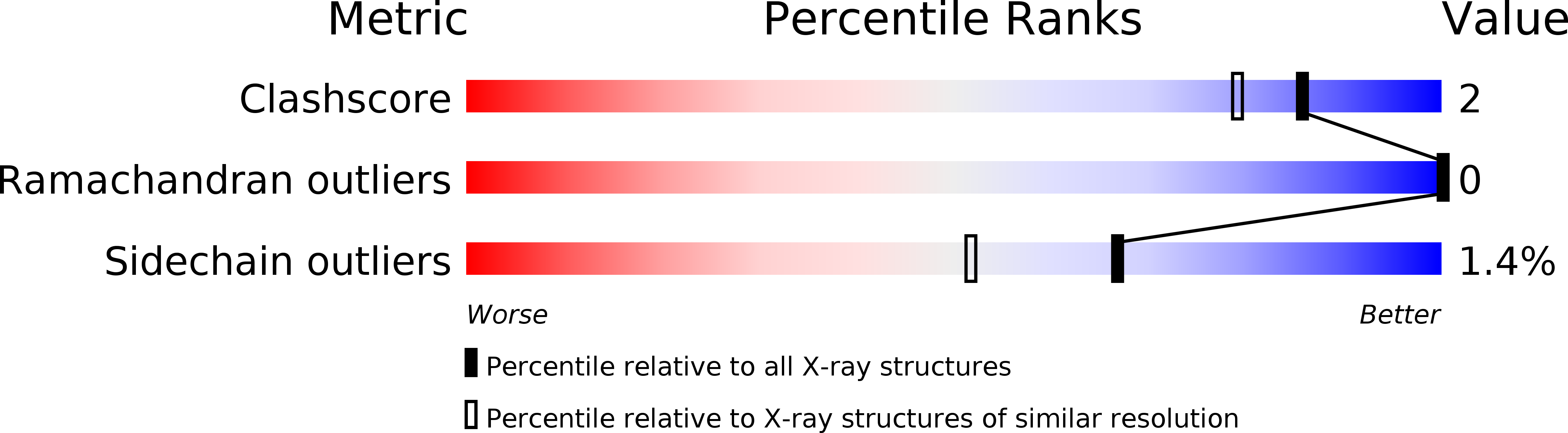
Macromolecular Entities
Structures with similar UniProt ID
Protein Blast
Polymer Type:polypeptide(L)
Molecule:Ferritin light chain
Gene (Uniprot):FTL
Chain IDs:A
Chain Length:175
Number of Molecules:1
Biological Source:Equus caballus
Ligand Molecules
Primary Citation
Effect of N-terminal Residues on the Structural Stability of Recombinant Horse L-chain Apoferritin in an Acidic Environment
J.BIOCHEM.(TOKYO) 142 707 713 (2007)
PMID: 17938140 DOI: 10.1093/jb/mvm187

Abstact

The denaturation of recombinant horse L-chain apoferritin (rLF), which is composed of 24 L-chain subunits, in acidic solution was studied. Using two rLF mutants, lacking four (Fer4) or eight (Fer8) N-terminal amino acid residues, the effect of N-terminal residues on the protein's stability was investigated. Of the two mutants and wild-type rLF, the tertiary and secondary structures of Fer8 were found to be most sensitive to an acidic environment. The Fer8 protein dissociated easily into subunit dimers at or below pH 2.0. Comparing the crystal structures of the mutant proteins, deletion of the N-terminal residues was found to result in fewer inter- and intra-subunit hydrogen bonds. The loss of these bonds is assumed to be responsible for lower endurance against acidic denaturation in N-terminus-deleted mutants. These results indicated that the inter- and intra-subunit hydrogen bonds of N-terminal residues affect the denaturation, especially oligomer formation of apoferritin subunits and will be of use in designing ferritin-based nanodevices.

Legend

Protein

Chemical

Disease

Primary Citation of related structures
Feedback Form
Name
Email
Institute
Feedback