2Z3N image
Deposition Date 2007-06-04
Release Date 2007-10-23
Last Version Date 2023-11-01
Entry Detail
PDB ID:
2Z3N
Keywords:
Title:
complex structure of LF-transferase and peptide B
Biological Source:
Source Organism:
Escherichia coli (Taxon ID: 562)
Method Details:
Experimental Method:
Resolution:
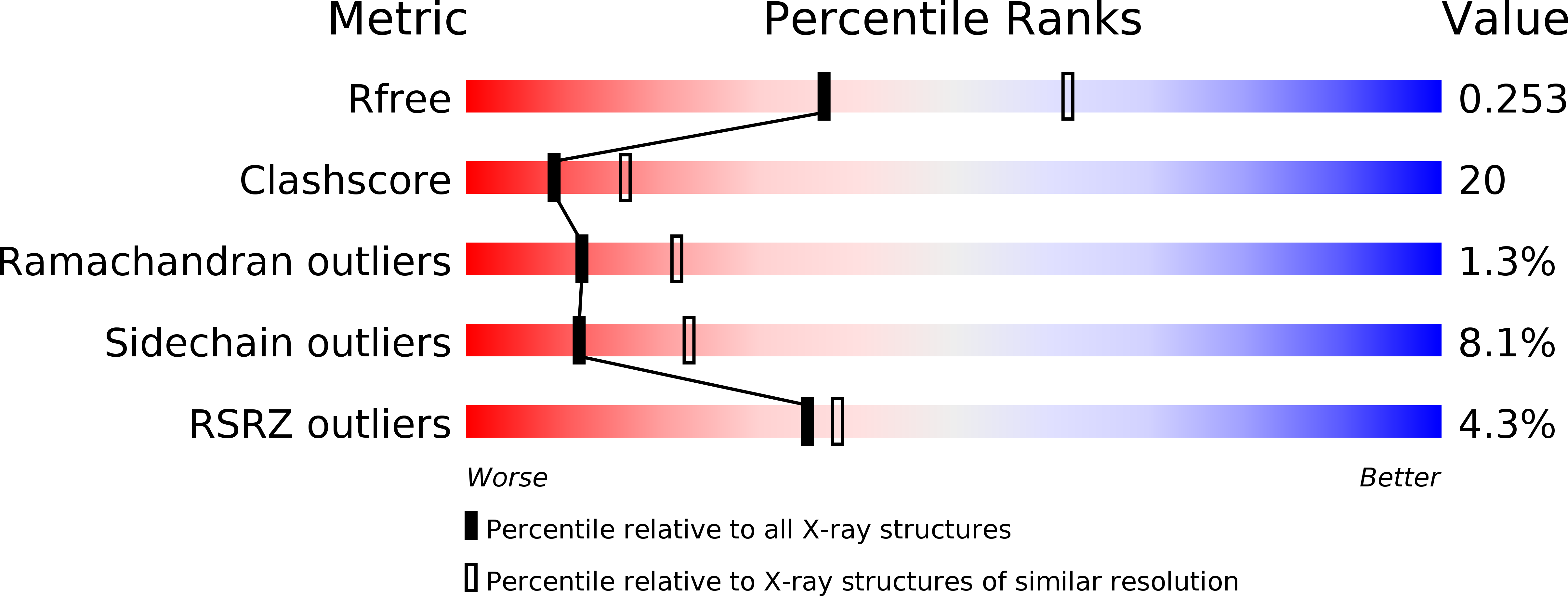
2.50 Å
R-Value Free:
0.25
R-Value Work:
0.22
R-Value Observed:
0.22
Space Group:
P 21 21 2
Macromolecular Entities
Structures with similar UniProt ID
Protein Blast
Polymer Type:polypeptide(L)
Molecule:Leucyl/phenylalanyl-tRNA-protein transferase
Gene (Uniprot):aat
Chain IDs:A, B
Chain Length:233
Number of Molecules:2
Biological Source:Escherichia coli
Polymer Type:polypeptide(L)
Molecule:peptide (PHE)(ARG)(TYR)(LEU)(GLY)
Chain IDs:C, D
Chain Length:5
Number of Molecules:2
Biological Source:
Ligand Molecules
Primary Citation
Protein-based peptide-bond formation by aminoacyl-tRNA protein transferase
Nature 449 867 871 (2007)
PMID: 17891155 DOI: 10.1038/nature06167

Abstact

Eubacterial leucyl/phenylalanyl-tRNA protein transferase (LF-transferase) catalyses peptide-bond formation by using Leu-tRNA(Leu) (or Phe-tRNA(Phe)) and an amino-terminal Arg (or Lys) of a protein, as donor and acceptor substrates, respectively. However, the catalytic mechanism of peptide-bond formation by LF-transferase remained obscure. Here we determine the structures of complexes of LF-transferase and phenylalanyl adenosine, with and without a short peptide bearing an N-terminal Arg. Combining the two separate structures into one structure as well as mutation studies reveal the mechanism for peptide-bond formation by LF-transferase. The electron relay from Asp 186 to Gln 188 helps Gln 188 to attract a proton from the alpha-amino group of the N-terminal Arg of the acceptor peptide. This generates the attacking nucleophile for the carbonyl carbon of the aminoacyl bond of the aminoacyl-tRNA, thus facilitating peptide-bond formation. The protein-based mechanism for peptide-bond formation by LF-transferase is similar to the reverse reaction of the acylation step observed in the peptide hydrolysis reaction by serine proteases.

Legend

Protein

Chemical

Disease

Primary Citation of related structures
Feedback Form
Name
Email
Institute
Feedback