2YIM image
Deposition Date 2011-05-16
Release Date 2012-03-28
Last Version Date 2023-12-20
Entry Detail
PDB ID:
2YIM
Keywords:
Title:
The enolisation chemistry of a thioester-dependent racemase: the 1.4 A crystal structure of a complex with a planar reaction intermediate analogue
Biological Source:
Source Organism:
Host Organism:
Method Details:
Experimental Method:
Resolution:
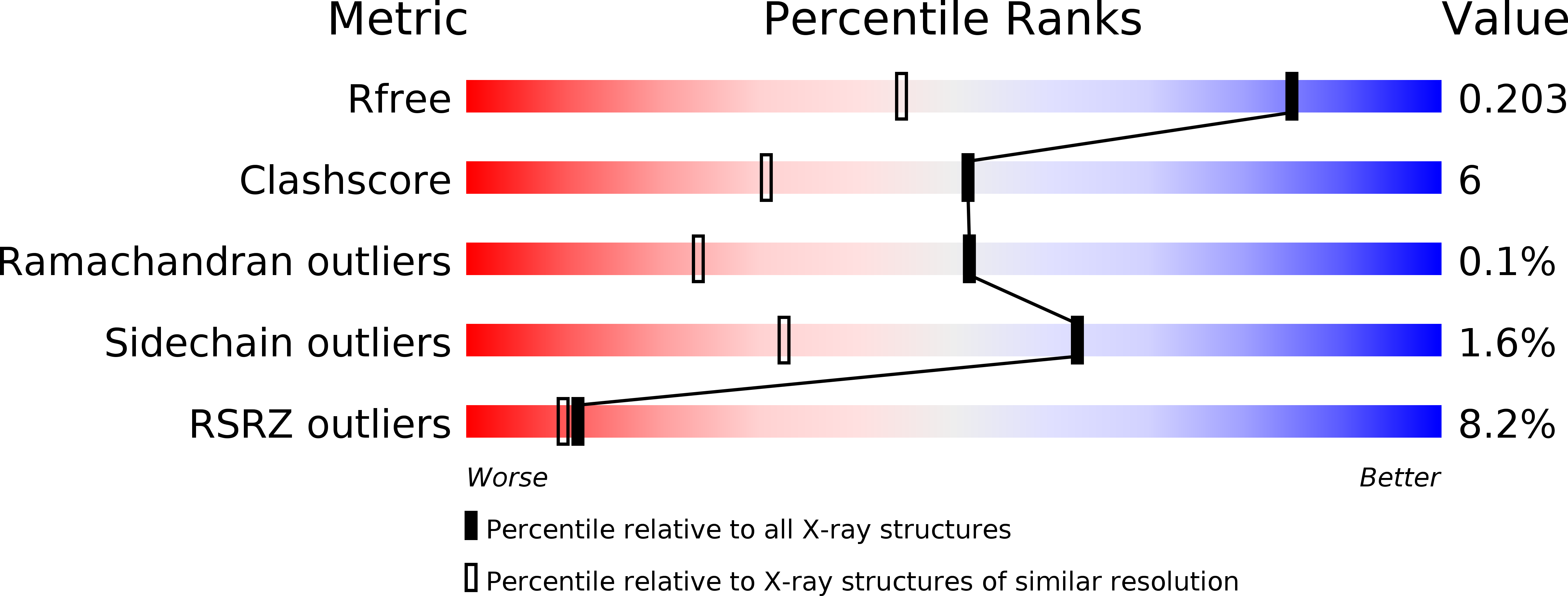
1.41 Å
R-Value Free:
0.20
R-Value Work:
0.18
R-Value Observed:
0.18
Space Group:
C 1 2 1
Macromolecular Entities
Structures with similar UniProt ID
Protein Blast
Polymer Type:polypeptide(L)
Molecule:PROBABLE ALPHA-METHYLACYL-COA RACEMASE MCR (2-METHYLACYL-COA RACEMASE) (2-ARYLPROPIONYL-COA EPIMERASE )
Gene (Uniprot):mcr
Chain IDs:A, B, C, D
Chain Length:360
Number of Molecules:4
Biological Source:MYCOBACTERIUM TUBERCULOSIS
Primary Citation
The Enolization Chemistry of a Thioester-Dependent Racemase: The 1.4 A Crystal Structure of a Reaction Intermediate Complex Characterized by Detailed Qm/Mm Calculations.
J Phys Chem B 116 3619 ? (2012)
PMID: 22360758 DOI: 10.1021/JP210185M

Abstact

In the active site of the bacterial α-methylacyl-CoA racemase of Mycobacterium tuberculosis (MCR), the chirality of the 2-methyl branched C2-atom is interconverted between (S) and (R) isomers. Protein crystallographic data and quantum mechanics/molecular mechanics (QM/MM) computational approaches show that this interconversion is achieved via a planar enolate intermediate. The crystal structure, at 1.4 Å, visualizes the mode of binding of a reaction intermediate analogue, 2-methylacetoacetyl-CoA, in a well-defined planar enolate form. The computational studies confirm that in the conversion from (S) to (R), first a proton is abstracted by Nδ1 (His126), and subsequently the planar enolate form is reprotonated by Oδ2 (Asp156). The calculations also show that the negatively charged thioester oxygen of the enolate intermediate is stabilized by an oxyanion hole formed by N (Asp127), as well as by the side chain atoms of the catalytic residues, Asp156 and His126, both being protonated simultaneously, at the intermediate stage of the catalytic cycle. The computational analysis also reveals that the conversion of the (S)- to (R)- chirality is achieved by a movement of 1.7 Å of the chiral C2-carbon, with smaller shifts (approximately 1 Å) of the carbon atom of the 2-methyl group, the C3-atom of the fatty acid tail, and the C1-carbon and O1-oxygen atoms of the thioester moiety.

Legend

Protein

Chemical

Disease

Primary Citation of related structures
Feedback Form
Name
Email
Institute
Feedback