2YB5 image
Deposition Date 2011-03-01
Release Date 2012-01-25
Last Version Date 2024-05-08
Entry Detail
PDB ID:
2YB5
Keywords:
Title:
Structure of the fusidic acid resistance protein FusC
Biological Source:
Source Organism:
Host Organism:
Method Details:
Experimental Method:
Resolution:
2.10 Å
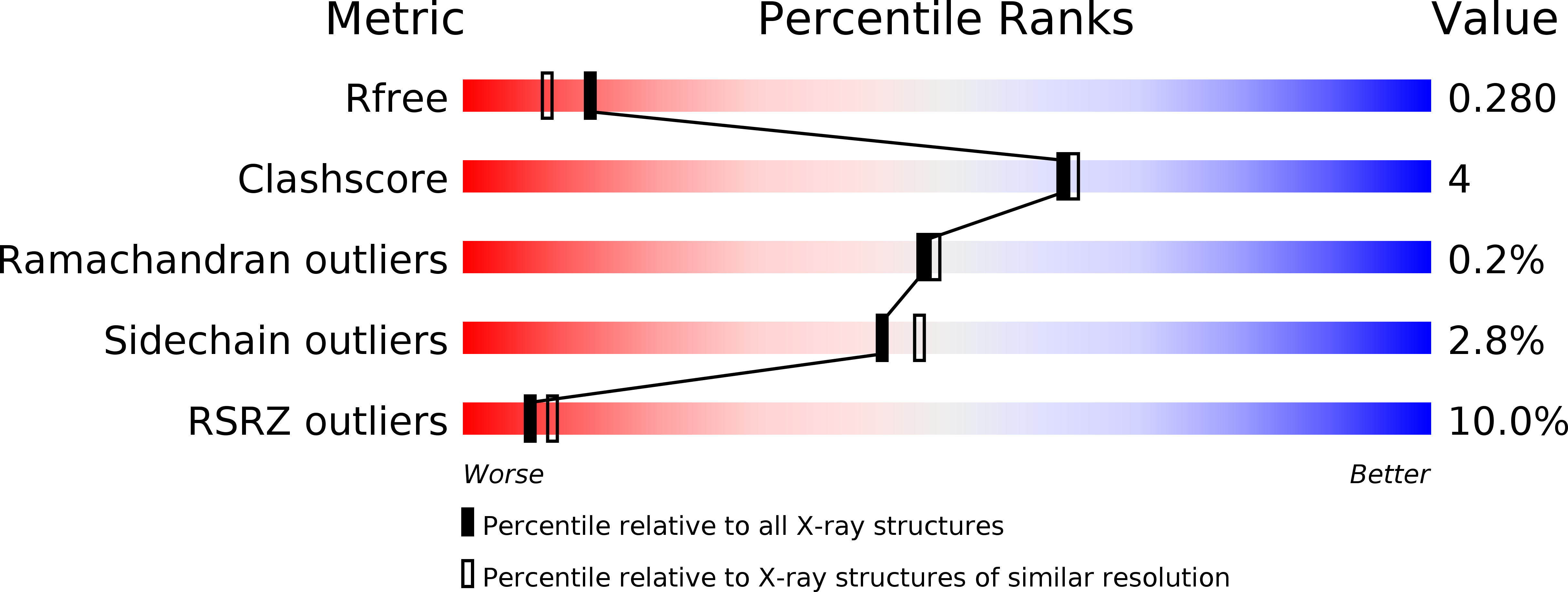
R-Value Free:
0.28
R-Value Work:
0.21
R-Value Observed:
0.21
Space Group:
P 1 21 1
Macromolecular Entities
Structures with similar UniProt ID
Protein Blast
Polymer Type:polypeptide(L)
Molecule:PUTATIVE FUSIDIC ACID RESISTANCE PROTEIN
Chain IDs:A, B (auth: F)
Chain Length:215
Number of Molecules:2
Biological Source:STAPHYLOCOCCUS AUREUS
Primary Citation
Ribosome Clearance by Fusb-Type Proteins Mediates Resistance to the Antibiotic Fusidic Acid
Proc.Natl.Acad.Sci.USA 109 2102 ? (2012)
PMID: 22308410 DOI: 10.1073/PNAS.1117275109

Abstact

Resistance to the antibiotic fusidic acid (FA) in the human pathogen Staphylococcus aureus usually results from expression of FusB-type proteins (FusB or FusC). These proteins bind to elongation factor G (EF-G), the target of FA, and rescue translation from FA-mediated inhibition by an unknown mechanism. Here we show that the FusB family are two-domain metalloproteins, the C-terminal domain of which contains a four-cysteine zinc finger with a unique structural fold. This domain mediates a high-affinity interaction with the C-terminal domains of EF-G. By binding to EF-G on the ribosome, FusB-type proteins promote the dissociation of stalled ribosome⋅EF-G⋅GDP complexes that form in the presence of FA, thereby allowing the ribosomes to resume translation. Ribosome clearance by these proteins represents a highly unusual antibiotic resistance mechanism, which appears to be fine-tuned by the relative abundance of FusB-type protein, ribosomes, and EF-G.

Legend

Protein

Chemical

Disease

Primary Citation of related structures
Feedback Form
Name
Email
Institute
Feedback