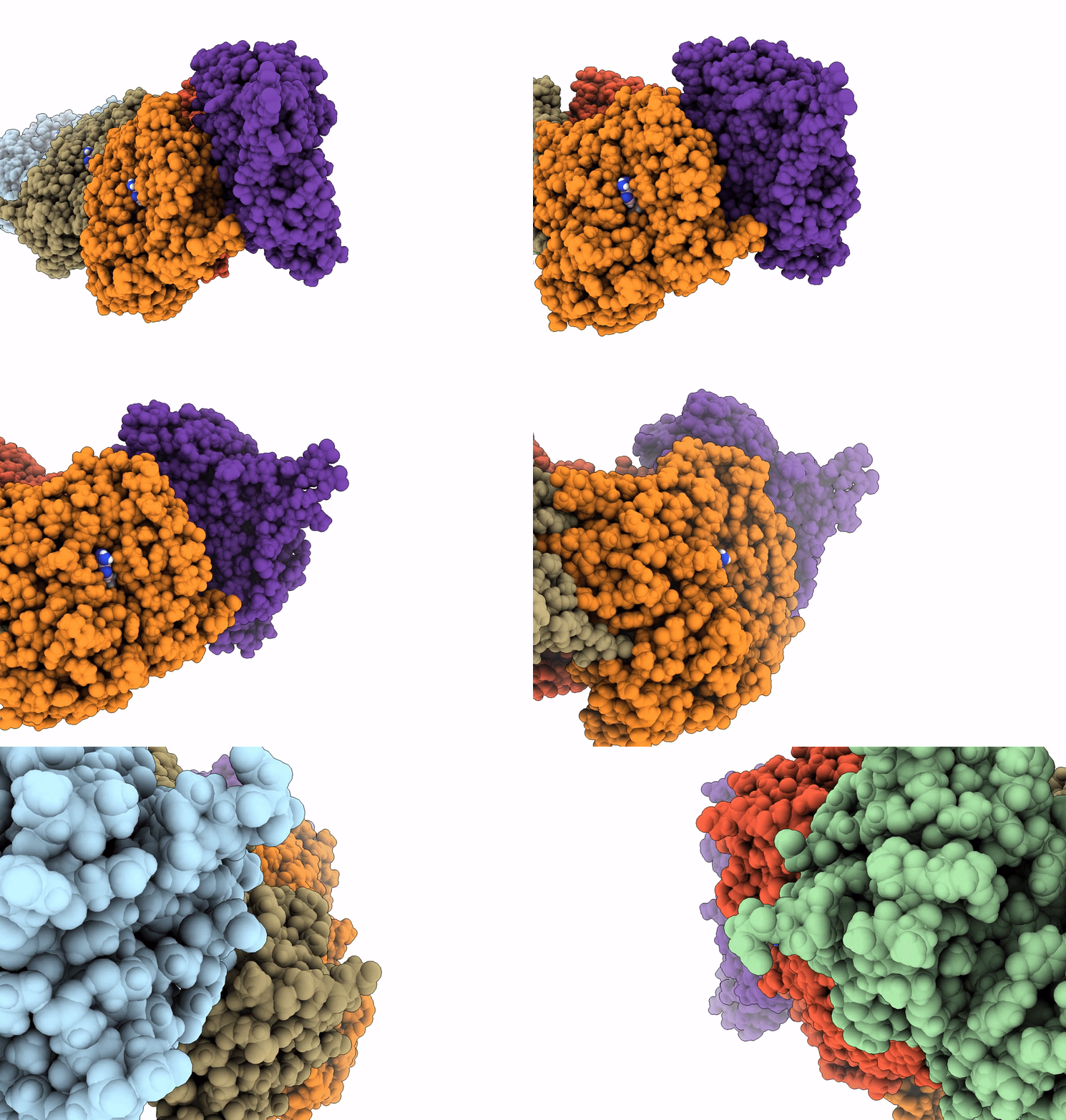
2Y83 image
Deposition Date 2011-02-02
Release Date 2011-03-30
Last Version Date 2024-05-08
Entry Detail
PDB ID:
2Y83
Title:
Actin filament pointed end
Biological Source:
Source Organism:
Method Details:
Experimental Method:
Resolution:
22.90 Å
Aggregation State:
FILAMENT
Reconstruction Method:
SINGLE PARTICLE
Macromolecular Entities
Structures with similar UniProt ID
Protein Blast
Polymer Type:polypeptide(L)
Molecule:ACTIN, ALPHA SKELETAL MUSCLE
Gene (Uniprot):ACTA1
Chain IDs:A (auth: O), B (auth: P), C (auth: Q), D (auth: R), E (auth: S), F (auth: T)
Chain Length:375
Number of Molecules:6
Biological Source:ORYCTOLAGUS CUNICULUS
Primary Citation
Structural Basis for the Slow Dynamics of the Actin Filament Pointed End.
Embo J. 30 1230 ? (2011)
PMID: 21378753 DOI: 10.1038/EMBOJ.2011.48

Abstact

The actin filament has clear polarity where one end, the pointed end, has a much slower polymerization and depolymerization rate than the other end, the barbed end. This intrinsic difference of the ends significantly affects all actin dynamics in the cell, which has central roles in a wide spectrum of cellular functions. The detailed mechanism underlying this difference has remained elusive, because high-resolution structures of the filament ends have not been available. Here, we present the structure of the actin filament pointed end obtained using a single particle analysis of cryo-electron micrographs. We determined that the terminal pointed end subunit is tilted towards the penultimate subunit, allowing specific and extra loop-to-loop inter-strand contacts between the two end subunits, which is not possible in other parts of the filament. These specific contacts prevent the end subunit from dissociating. For elongation, the loop-to-loop contacts also inhibit the incorporation of another actin monomer at the pointed end. These observations are likely to account for the less dynamic pointed end.

Legend

Protein

Chemical

Disease

Feedback Form
Name
Email
Institute
Feedback