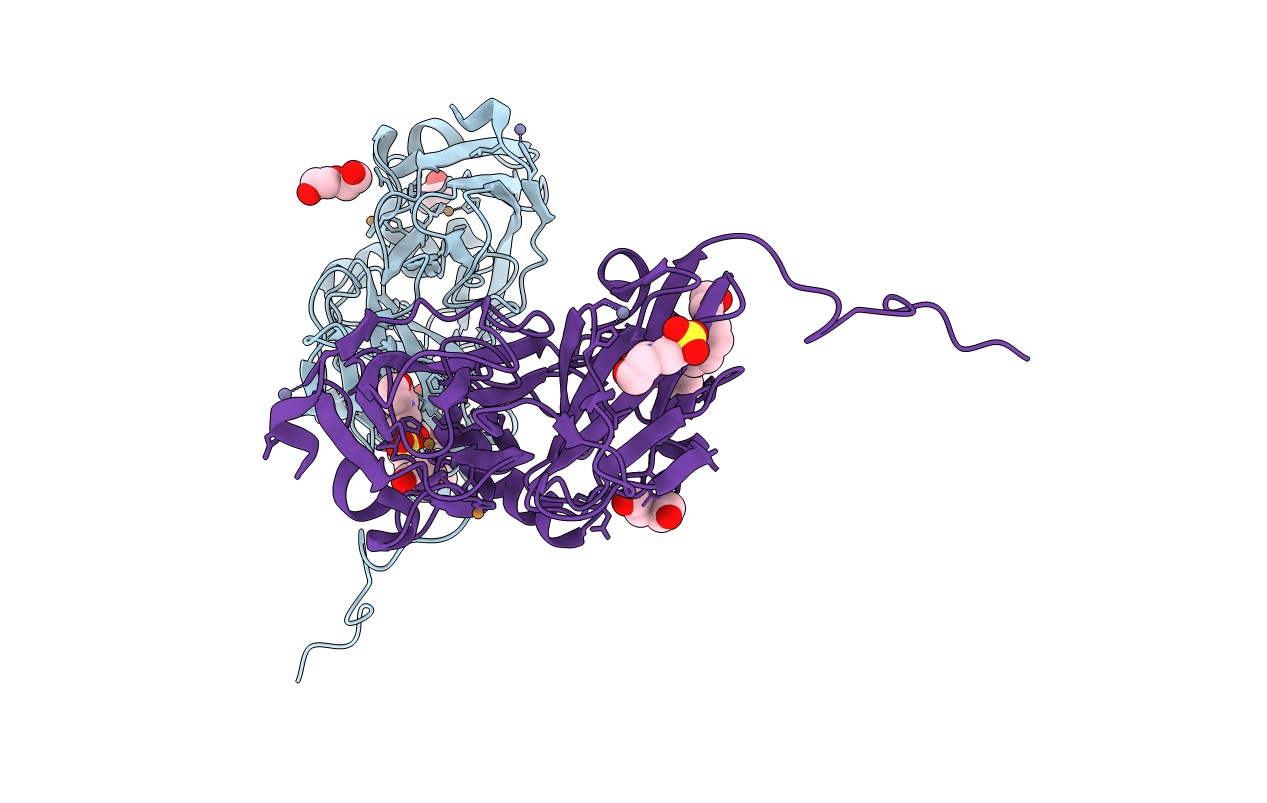
2XXG image
Deposition Date 2010-11-10
Release Date 2011-05-18
Last Version Date 2024-11-20
Entry Detail
PDB ID:
2XXG
Keywords:
Title:
STRUCTURE OF THE N90S MUTANT OF NITRITE REDUCTASE FROM ALCALIGENES XYLOSOXIDANS
Biological Source:
Source Organism:
Host Organism:
Method Details:
Experimental Method:
Resolution:
1.60 Å
R-Value Free:
0.21
R-Value Work:
0.16
R-Value Observed:
0.16
Space Group:
H 3

Macromolecular Entities
Structures with similar UniProt ID
Protein Blast
Polymer Type:polypeptide(L)
Molecule:DISSIMILATORY COPPER-CONTAINING NITRITE REDUCTASE
Gene (Uniprot):nir
Mutagens:YES
Chain IDs:A, B (auth: C)
Chain Length:336
Number of Molecules:2
Biological Source:ACHROMOBACTER XYLOSOXIDANS
Primary Citation
Identification of the Proton Channel to the Active Site Type 2 Cu Centre of Nitrite Reductase: Structural and Enzymatic Properties of the His254Phe and Asn90Ser Mutants
Biochemistry 47 13547 ? (2008)
PMID: 19053252 DOI: 10.1021/BI801369Y

Abstact

Proton and electron delivery to the catalytic site and their associated pathways are crucial elements in understanding the mechanisms of redox enzymes. Two distinct proton channels have previously been identified in copper nitrite reductases based on high- to atomic-resolution crystal structures. These were assigned as the "primary" and "high-pH" proton channels and link the catalytic type 2 Cu center to the enzyme surface. Residue His254 has been identified as a key residue in the primary proton channel from the catalytic T2Cu site to the surface, while Asn90 is thought to be a key residue in the high-pH channel. The structure of the His254Phe mutant was previously determined to 1.85 A resolution, revealing disruption in the H-bonding network of the primary proton channel. The effect of the mutation on proton transfer was not established as the T2Cu center was unusually occupied by Zn. New growth protocols have now led to the incorporation of copper at this site, and here we present spectroscopic, catalytic activity, and structural data for the Cu-loaded H254F mutant of AxNiR. Surprisingly, this species exhibits essentially full catalytic activity, despite the clear disruption of the primary proton channel. In contrast, the Asn90Ser mutation disrupts H-bonding in the high-pH proton channel and results in an approximately 70% decrease in specific activity. These mutations do not change the apparent K(m) for nitrite, and thus, these data clearly demonstrate a role for the high-pH proton channel in the delivery of protons to the catalytic T2Cu center at physiological pH values; it may in fact be the main source of protons to the T2Cu center.

Legend

Protein

Chemical

Disease

Feedback Form
Name
Email
Institute
Feedback