2XNY image
Deposition Date 2010-08-06
Release Date 2011-04-13
Last Version Date 2024-10-16
Entry Detail
PDB ID:
2XNY
Keywords:
Title:
A fragment of streptococcal M1 protein in complex with human fibrinogen
Biological Source:
Source Organism:
Host Organism:
Method Details:
Experimental Method:
Resolution:
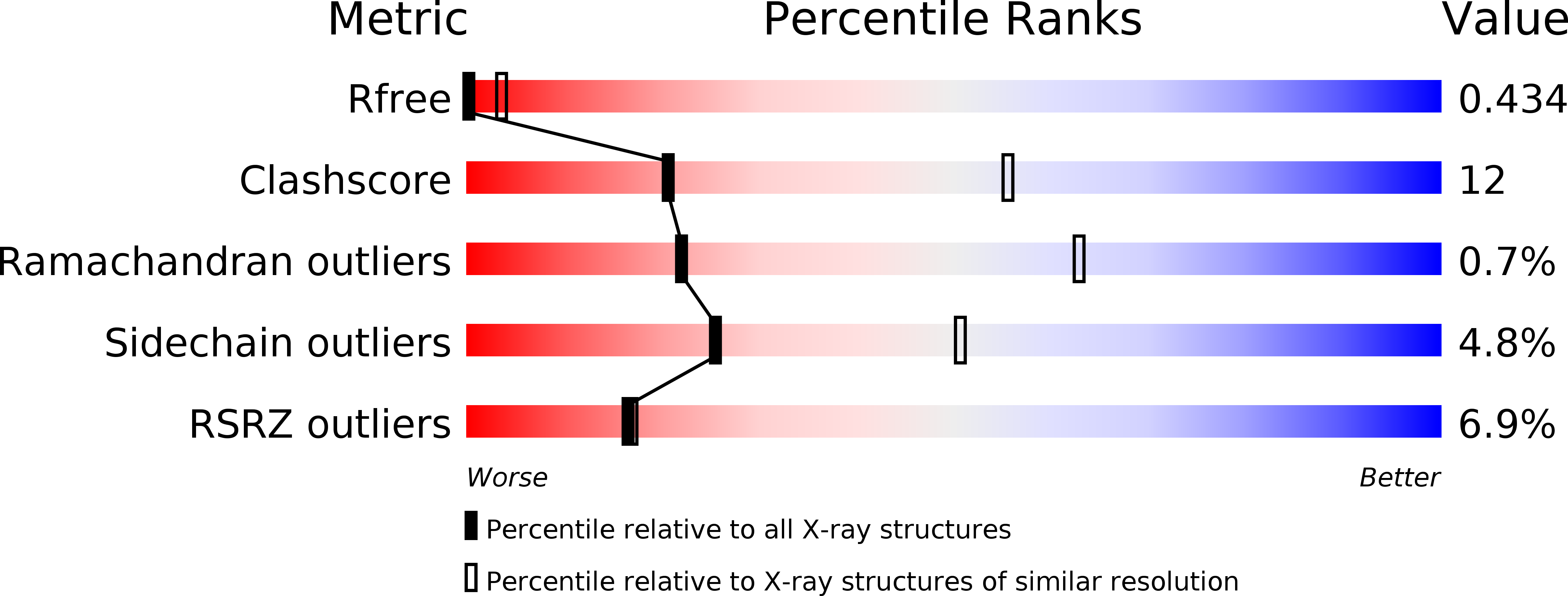
7.50 Å
R-Value Free:
0.40
R-Value Work:
0.42
R-Value Observed:
0.42
Space Group:
P 32 2 1
Macromolecular Entities
Structures with similar UniProt ID
Protein Blast
Polymer Type:polypeptide(L)
Molecule:FIBRINOGEN ALPHA CHAIN
Gene (Uniprot):FGA
Chain IDs:A, D
Chain Length:87
Number of Molecules:2
Biological Source:HOMO SAPIENS
Structures with similar UniProt ID
Protein Blast
Polymer Type:polypeptide(L)
Molecule:FIBRINOGEN BETA CHAIN
Gene (Uniprot):FGB
Chain IDs:B, E
Chain Length:328
Number of Molecules:2
Biological Source:HOMO SAPIENS
Structures with similar UniProt ID
Protein Blast
Polymer Type:polypeptide(L)
Molecule:FIBRINOGEN GAMMA CHAIN
Gene (Uniprot):FGG
Chain IDs:C, F
Chain Length:319
Number of Molecules:2
Biological Source:HOMO SAPIENS
Polymer Type:polypeptide(L)
Molecule:M PROTEIN
Chain IDs:G (auth: M), H (auth: N)
Chain Length:102
Number of Molecules:2
Biological Source:STREPTOCOCCUS PYOGENES
Ligand Molecules
Primary Citation
Streptococcal M1 Protein Constructs a Pathological Host Fibrinogen Network
Nature 472 64 ? (2011)
PMID: 21475196 DOI: 10.1038/NATURE09967

Abstact

M1 protein, a major virulence factor of the leading invasive strain of group A Streptococcus, is sufficient to induce toxic-shock-like vascular leakage and tissue injury. These events are triggered by the formation of a complex between M1 and fibrinogen that, unlike M1 or fibrinogen alone, leads to neutrophil activation. Here we provide a structural explanation for the pathological properties of the complex formed between streptococcal M1 and human fibrinogen. A conformationally dynamic coiled-coil dimer of M1 was found to organize four fibrinogen molecules into a specific cross-like pattern. This pattern supported the construction of a supramolecular network that was required for neutrophil activation but was distinct from a fibrin clot. Disruption of this network into other supramolecular assemblies was not tolerated. These results have bearing on the pathophysiology of streptococcal toxic shock.

Legend

Protein

Chemical

Disease

Feedback Form
Name
Email
Institute
Feedback