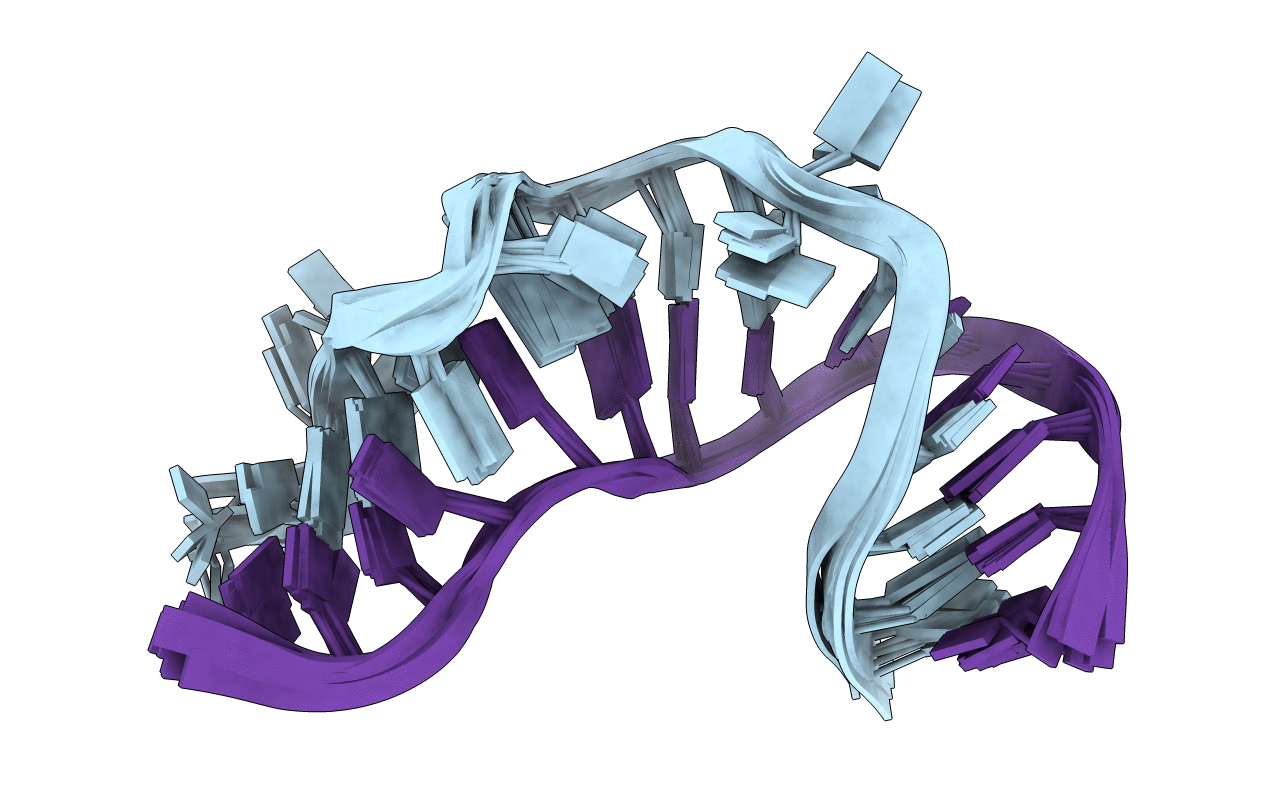
2XEB image
Deposition Date 2010-05-12
Release Date 2010-05-26
Last Version Date 2024-05-15
Entry Detail
PDB ID:
2XEB
Keywords:
Title:
NMR STRUCTURE OF THE PROTEIN-UNBOUND SPLICEOSOMAL U4 SNRNA 5' STEM LOOP
Biological Source:
Source Organism(s):
HOMO SAPIENS (Taxon ID: 9606)
Method Details:
Experimental Method:
Conformers Calculated:
100
Conformers Submitted:
10
Selection Criteria:
LOWEST ENERGY STRUCTURES
Macromolecular Entities
Polymer Type:polyribonucleotide
Molecule:5'-R(P*GP*AP*UP*CP*GP*UP*AP*GP*CP*CP*AP*AP*UP*GP*AP* GP*GP*UP*U)-3'
Mutagens:YES
Chain IDs:A
Chain Length:19
Number of Molecules:1
Biological Source:HOMO SAPIENS
Polymer Type:polyribonucleotide
Molecule:5'-R(P*GP*CP*CP*GP*AP*GP*GP*CP*GP*CP*GP*AP*UP*C)-3'
Mutagens:YES
Chain IDs:B
Chain Length:14
Number of Molecules:1
Biological Source:HOMO SAPIENS
Ligand Molecules
Primary Citation
Structure of the K-turn U4 RNA: a combined NMR and SANS study.
Nucleic Acids Res. 38 6274 6285 (2010)
PMID: 20466811 DOI: 10.1093/nar/gkq380

Abstact

K-turn motifs are universal RNA structural elements providing a binding platform for proteins in several cellular contexts. Their characteristic is a sharp kink in the phosphate backbone that puts the two helical stems of the protein-bound RNA at an angle of 60°. However, to date no high-resolution structure of a naked K-turn motif is available. Here, we present the first structural investigation at atomic resolution of an unbound K-turn RNA (the spliceosomal U4-Kt RNA) by a combination of NMR and small-angle neutron scattering data. With this study, we wish to address the question whether the K-turn structural motif assumes the sharply kinked conformation in the absence of protein binders and divalent cations. Previous studies have addressed this question by fluorescence resonance energy transfer, biochemical assays and molecular dynamics simulations, suggesting that the K-turn RNAs exist in equilibrium between a kinked conformation, which is competent for protein binding, and a more extended conformation, with the population distribution depending on the concentration of divalent cations. Our data shows that the U4-Kt RNA predominantly assumes the more extended conformation in the absence of proteins and divalent cations. The internal loop region is well structured but adopts a different conformation from the one observed in complex with proteins. Our data suggests that the K-turn consensus sequence does not per se code for the kinked conformation; instead the sharp backbone kink requires to be stabilized by protein binders.

Legend

Protein

Chemical

Disease

Primary Citation of related structures
Feedback Form
Name
Email
Institute
Feedback