2X7K image
Deposition Date 2010-03-01
Release Date 2010-03-23
Last Version Date 2025-04-09
Entry Detail
PDB ID:
2X7K
Title:
The crystal structure of PPIL1 in complex with cyclosporine A suggests a binding mode for SKIP
Biological Source:
Source Organism:
Host Organism:
Method Details:
Experimental Method:
Resolution:
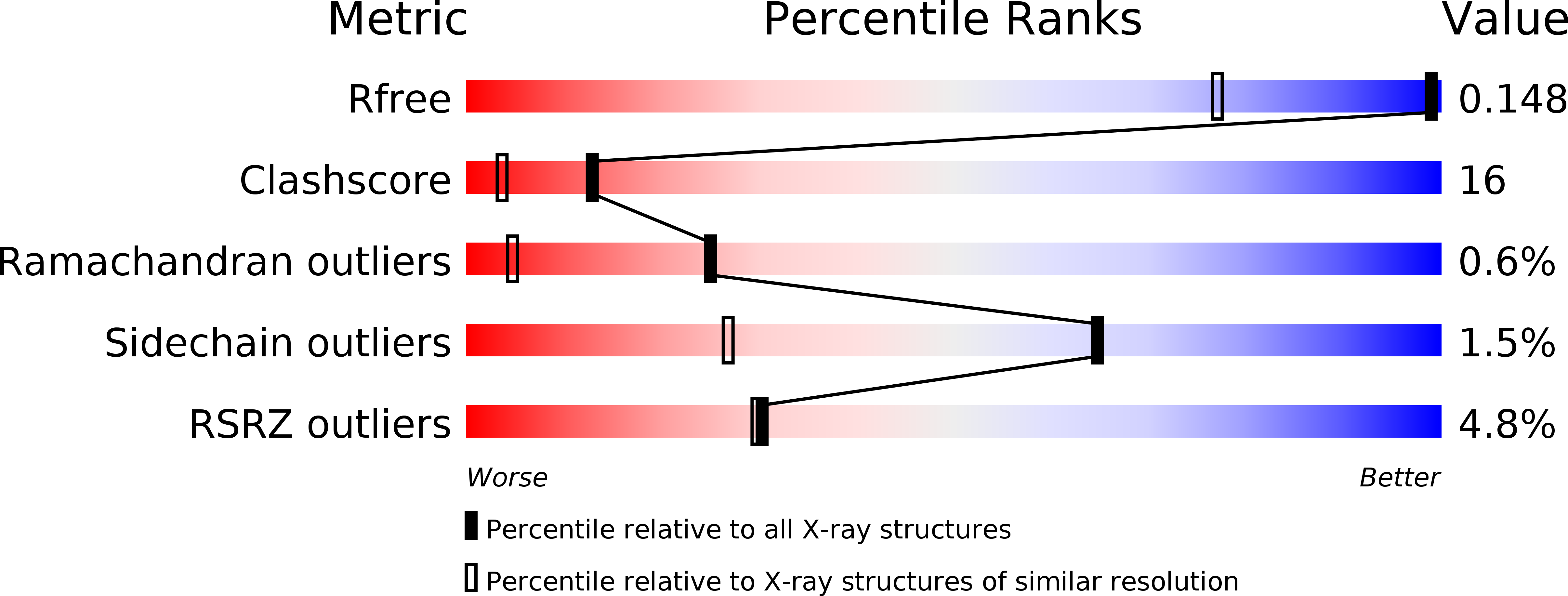
1.15 Å
R-Value Free:
0.14
R-Value Work:
0.12
R-Value Observed:
0.12
Space Group:
P 21 21 2
Macromolecular Entities
Structures with similar UniProt ID
Protein Blast
Polymer Type:polypeptide(L)
Molecule:PEPTIDYL-PROLYL CIS-TRANS ISOMERASE-LIKE 1
Gene (Uniprot):PPIL1
Chain IDs:A
Chain Length:166
Number of Molecules:1
Biological Source:HOMO SAPIENS
Polymer Type:polypeptide(L)
Molecule:CYCLOSPORIN A
Chain IDs:B
Chain Length:11
Number of Molecules:1
Biological Source:TOLYPOCLADIUM INFLATUM
Modified Residue
Compound ID Chain ID Parent Comp ID Details 2D Image
ABA B ALA ALPHA-AMINOBUTYRIC ACID
BMT B THR ?
MLE B LEU N-METHYLLEUCINE
MVA B VAL N-METHYLVALINE
SAR B GLY SARCOSINE
Peptide-like Molecules
PRD_000142
Primary Citation
The Crystal Structure of Ppil1 Bound to Cyclosporine a Suggests a Binding Mode for a Linear Epitope of the Skip Protein.
Plos One 5 13 ? (2010)
PMID: 20368803 DOI: 10.1371/JOURNAL.PONE.0010013

Abstact

BACKGROUND The removal of introns from pre-mRNA is carried out by a large macromolecular machine called the spliceosome. The peptidyl-prolyl cis/trans isomerase PPIL1 is a component of the human spliceosome and binds to the spliceosomal SKIP protein via a binding site distinct from its active site. PRINCIPAL FINDINGS Here, we have studied the PPIL1 protein and its interaction with SKIP biochemically and by X-ray crystallography. A minimal linear binding epitope derived from the SKIP protein could be determined using a peptide array. A 36-residue region of SKIP centred on an eight-residue epitope suffices to bind PPIL1 in pull-down experiments. The crystal structure of PPIL1 in complex with the inhibitor cyclosporine A (CsA) was obtained at a resolution of 1.15 A and exhibited two bound Cd(2+) ions that enabled SAD phasing. PPIL1 residues that have previously been implicated in binding of SKIP are involved in the coordination of Cd(2+) ions in the present crystal structure. Employing the present crystal structure, the determined minimal binding epitope and previously published NMR data, a molecular docking study was performed. In the docked model of the PPIL1.SKIP interaction, a proline residue of SKIP is buried in a hydrophobic pocket of PPIL1. This hydrophobic contact is encircled by several hydrogen bonds between the SKIP peptide and PPIL1. CONCLUSION We characterized a short, linear epitope of SKIP that is sufficient to bind the PPIL1 protein. Our data indicate that this SKIP peptide could function in recruiting PPIL1 into the core of the spliceosome. We present a molecular model for the binding mode of SKIP to PPIL1 which emphasizes the versatility of cyclophilin-type PPIases to engage in additional interactions with other proteins apart from active site contacts despite their limited surface area.

Legend

Protein

Chemical

Disease

Feedback Form
Name
Email
Institute
Feedback