2X2V image
Deposition Date 2010-01-18
Release Date 2010-08-18
Last Version Date 2024-11-20
Entry Detail
PDB ID:
2X2V
Title:
Structural basis of a novel proton-coordination type in an F1Fo-ATP synthase rotor ring
Biological Source:
Source Organism:
Method Details:
Experimental Method:
Resolution:
2.50 Å
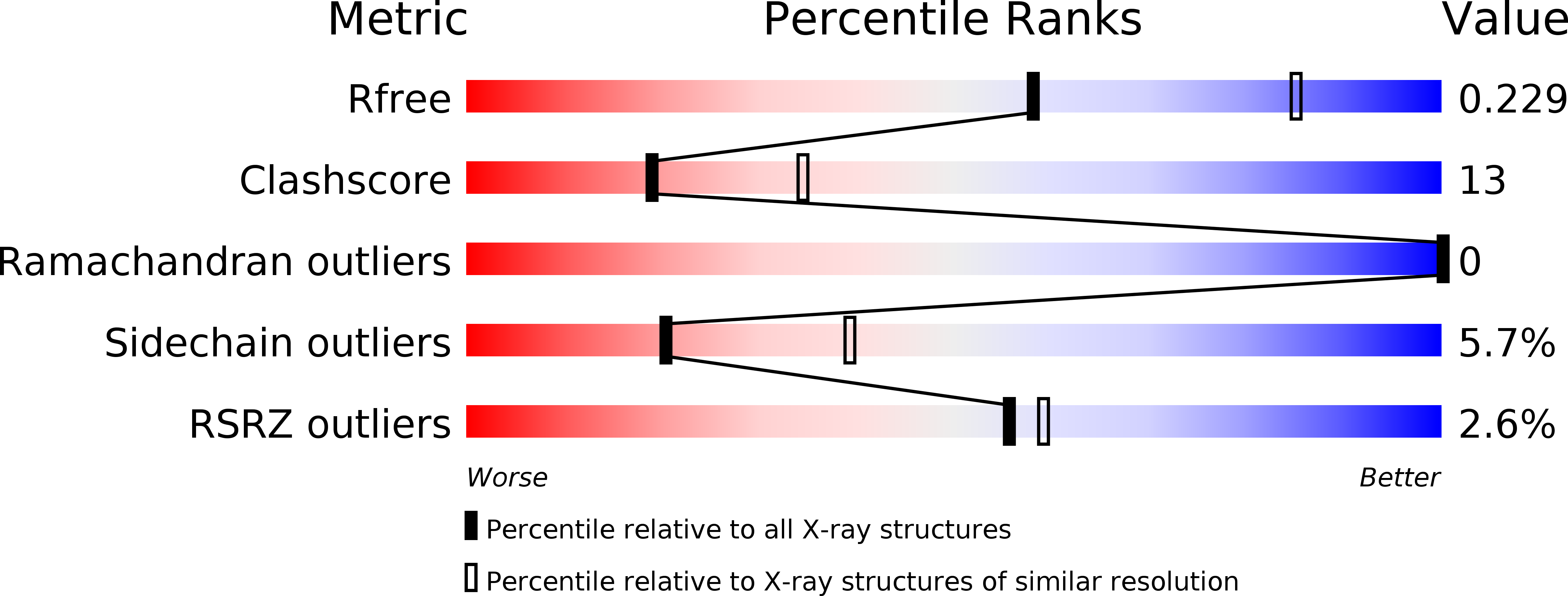
R-Value Free:
0.23
R-Value Work:
0.18
R-Value Observed:
0.18
Space Group:
P 1 21 1
Macromolecular Entities
Structures with similar UniProt ID
Protein Blast
Polymer Type:polypeptide(L)
Molecule:ATP SYNTHASE SUBUNIT C
Gene (Uniprot):atpE
Chain IDs:A, B, C, D, E, F, G, H, I, J, K, L, M
Chain Length:69
Number of Molecules:13
Biological Source:BACILLUS PSEUDOFIRMUS OF4
Modified Residue
Compound ID Chain ID Parent Comp ID Details 2D Image
FME A MET N-FORMYLMETHIONINE
Primary Citation
A New Type of Proton Coordination in an F(1)F(O)- ATP Synthase Rotor Ring.
Plos Biol. 8 443 ? (2010)
PMID: 20689804 DOI: 10.1371/JOURNAL.PBIO.1000443

Abstact

We solved the crystal structure of a novel type of c-ring isolated from Bacillus pseudofirmus OF4 at 2.5 A, revealing a cylinder with a tridecameric stoichiometry, a central pore, and an overall shape that is distinct from those reported thus far. Within the groove of two neighboring c-subunits, the conserved glutamate of the outer helix shares the proton with a bound water molecule which itself is coordinated by three other amino acids of outer helices. Although none of the inner helices contributes to ion binding and the glutamate has no other hydrogen bonding partner than the water oxygen, the site remains in a stable, ion-locked conformation that represents the functional state present at the c-ring/membrane interface during rotation. This structure reveals a new, third type of ion coordination in ATP synthases. It appears in the ion binding site of an alkaliphile in which it represents a finely tuned adaptation of the proton affinity during the reaction cycle.

Legend

Protein

Chemical

Disease

Primary Citation of related structures
Feedback Form
Name
Email
Institute
Feedback