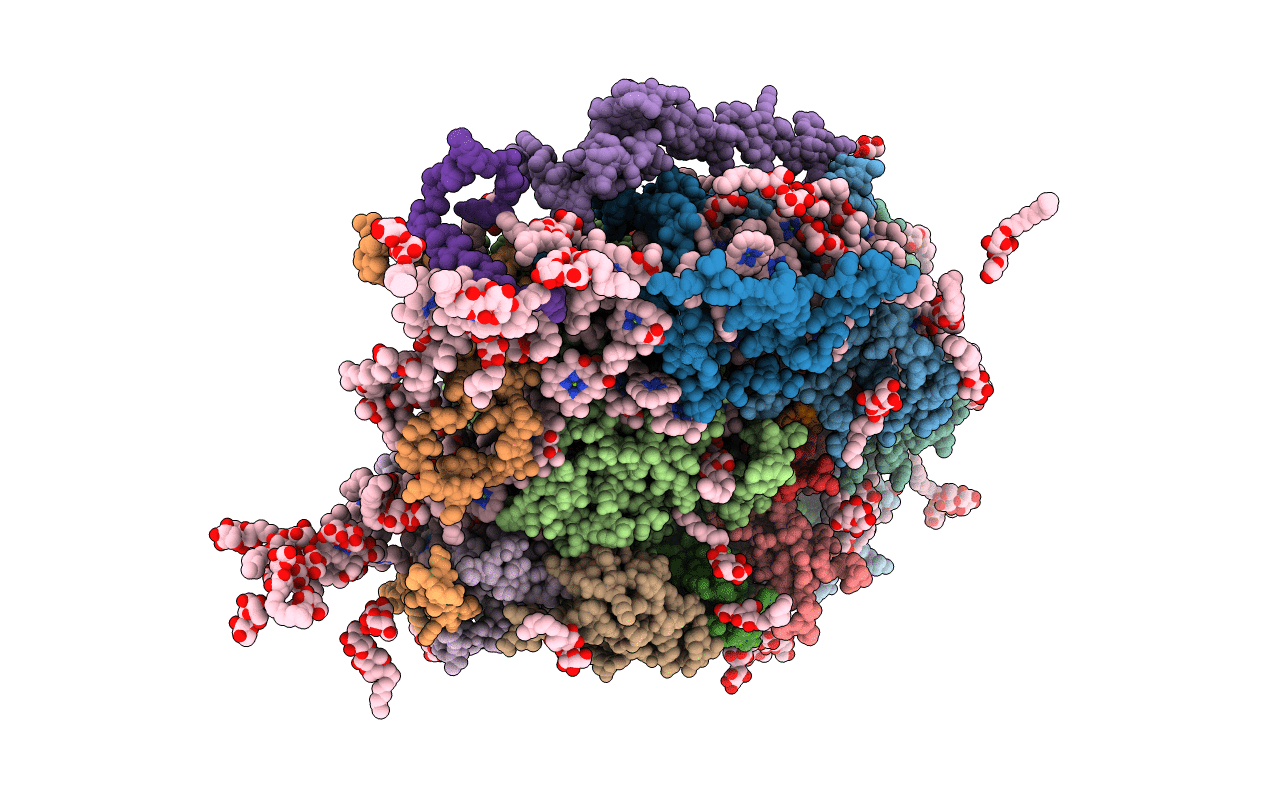
2WSF image
Deposition Date 2009-09-05
Release Date 2009-11-17
Last Version Date 2025-10-01
Entry Detail
PDB ID:
2WSF
Keywords:
Title:
Improved Model of Plant Photosystem I
Biological Source:
Source Organism:
Method Details:
Experimental Method:
Resolution:
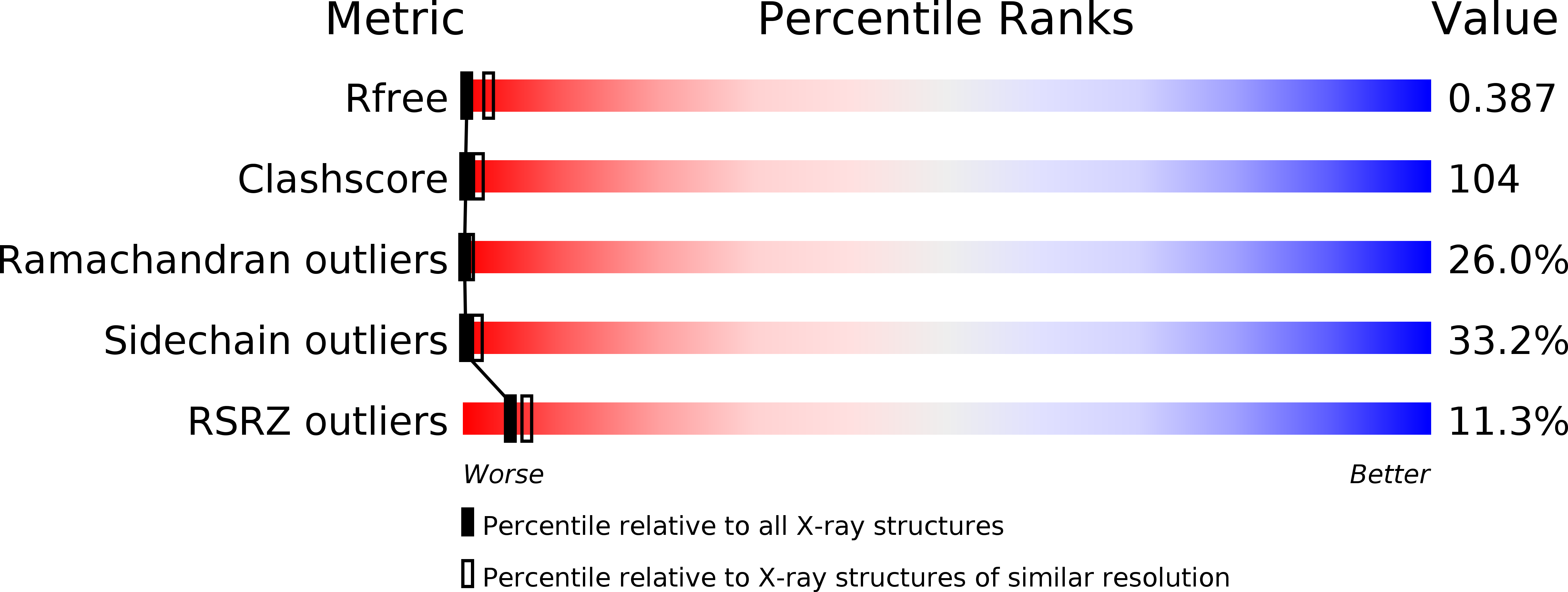
3.48 Å
R-Value Free:
0.42
R-Value Work:
0.39
R-Value Observed:
0.39
Space Group:
P 1 21 1
Macromolecular Entities
Structures with similar UniProt ID
Protein Blast
Polymer Type:polypeptide(L)
Molecule:AT3G54890
Chain IDs:A (auth: 1)
Chain Length:241
Number of Molecules:1
Biological Source:ARABIDOPSIS THALIANA
Structures with similar UniProt ID
Protein Blast
Polymer Type:polypeptide(L)
Molecule:TYPE II CHLOROPHYLL A/B BINDING PROTEIN FROM PHOTOSYSTEM I
Gene (Uniprot):lhaB
Chain IDs:B (auth: 2)
Chain Length:269
Number of Molecules:1
Biological Source:PISUM SATIVUM
Structures with similar UniProt ID
Protein Blast
Polymer Type:polypeptide(L)
Molecule:LHCA3
Chain IDs:C (auth: 3)
Chain Length:276
Number of Molecules:1
Biological Source:GLYCINE MAX
Structures with similar UniProt ID
Protein Blast
Polymer Type:polypeptide(L)
Molecule:CHLOROPHYLL A-B BINDING PROTEIN P4, CHLOROPLASTIC
Gene (Uniprot):lhcA-P4
Chain IDs:D (auth: 4)
Chain Length:251
Number of Molecules:1
Biological Source:PISUM SATIVUM
Structures with similar UniProt ID
Protein Blast
Polymer Type:polypeptide(L)
Molecule:PHOTOSYSTEM I P700 CHLOROPHYLL A APOPROTEIN A1
Gene (Uniprot):psaA
Chain IDs:E (auth: A)
Chain Length:758
Number of Molecules:1
Biological Source:PISUM SATIVUM
Structures with similar UniProt ID
Protein Blast
Polymer Type:polypeptide(L)
Molecule:PHOTOSYSTEM I P700 CHLOROPHYLL A APOPROTEIN A2
Gene (Uniprot):psaB
Chain IDs:F (auth: B)
Chain Length:734
Number of Molecules:1
Biological Source:PISUM SATIVUM
Structures with similar UniProt ID
Protein Blast
Polymer Type:polypeptide(L)
Molecule:PHOTOSYSTEM I IRON-SULFUR CENTER
Gene (Uniprot):psaC
Chain IDs:G (auth: C)
Chain Length:81
Number of Molecules:1
Biological Source:PISUM SATIVUM
Structures with similar UniProt ID
Protein Blast
Polymer Type:polypeptide(L)
Molecule:PHOTOSYSTEM I REACTION CENTER SUBUNIT II, CHLOROPLASTIC
Gene (Uniprot):psaD
Chain IDs:H (auth: D)
Chain Length:212
Number of Molecules:1
Biological Source:SPINACIA OLERACEA
Structures with similar UniProt ID
Protein Blast
Polymer Type:polypeptide(L)
Molecule:PHOTOSYSTEM I REACTION CENTER SUBUNIT IV A, CHLOROPLASTIC
Gene (Uniprot):PSAE1
Chain IDs:I (auth: E)
Chain Length:143
Number of Molecules:1
Biological Source:ARABIDOPSIS THALIANA
Structures with similar UniProt ID
Protein Blast
Polymer Type:polypeptide(L)
Molecule:PHOTOSYSTEM I REACTION CENTER SUBUNIT III, CHLOROPLASTIC
Gene (Uniprot):PSAF
Chain IDs:J (auth: F)
Chain Length:231
Number of Molecules:1
Biological Source:SPINACIA OLERACEA
Structures with similar UniProt ID
Protein Blast
Polymer Type:polypeptide(L)
Molecule:PHOTOSYSTEM I REACTION CENTER SUBUNIT V, CHLOROPLASTIC
Gene (Uniprot):PSAG
Chain IDs:K (auth: G)
Chain Length:167
Number of Molecules:1
Biological Source:SPINACIA OLERACEA
Structures with similar UniProt ID
Protein Blast
Polymer Type:polypeptide(L)
Molecule:PHOTOSYSTEM I REACTION CENTER SUBUNIT VI, CHLOROPLASTIC
Gene (Uniprot):PSAH
Chain IDs:L (auth: H)
Chain Length:144
Number of Molecules:1
Biological Source:SPINACIA OLERACEA
Structures with similar UniProt ID
Protein Blast
Polymer Type:polypeptide(L)
Molecule:PHOTOSYSTEM I REACTION CENTER SUBUNIT VIII
Gene (Uniprot):psaI
Chain IDs:M (auth: I)
Chain Length:40
Number of Molecules:1
Biological Source:PISUM SATIVUM
Structures with similar UniProt ID
Protein Blast
Polymer Type:polypeptide(L)
Molecule:PHOTOSYSTEM I REACTION CENTER SUBUNIT IX
Gene (Uniprot):psaJ
Chain IDs:N (auth: J)
Chain Length:44
Number of Molecules:1
Biological Source:SPINACIA OLERACEA
Structures with similar UniProt ID
Protein Blast
Polymer Type:polypeptide(L)
Molecule:PHOTOSYSTEM I REACTION CENTER SUBUNIT PSAK, CHLOROPLASTIC
Gene (Uniprot):PSAK
Chain IDs:O (auth: K)
Chain Length:131
Number of Molecules:1
Biological Source:HORDEUM VULGARE
Structures with similar UniProt ID
Protein Blast
Polymer Type:polypeptide(L)
Molecule:PHOTOSYSTEM I REACTION CENTER SUBUNIT XI, CHLOROPLASTIC
Gene (Uniprot):PSAL
Chain IDs:P (auth: L)
Chain Length:216
Number of Molecules:1
Biological Source:SPINACIA OLERACEA
Structures with similar UniProt ID
Protein Blast
Polymer Type:polypeptide(L)
Molecule:PHOTOSYSTEM I-N SUBUNIT
Gene (Uniprot):PSI-N
Chain IDs:Q (auth: N)
Chain Length:170
Number of Molecules:1
Biological Source:PHASEOLUS VULGARIS
Polymer Type:polypeptide(L)
Molecule:PHOTOSYSTEM I-N SUBUNIT
Chain IDs:R
Chain Length:53
Number of Molecules:1
Biological Source:PISUM SATIVUM
Peptide-like Molecules
PRD_900003
Primary Citation
Structure determination and improved model of plant photosystem I.
J. Biol. Chem. 285 3478 3486 (2010)
PMID: 19923216 DOI: 10.1074/jbc.M109.072645

Abstact

Photosystem I functions as a sunlight energy converter, catalyzing one of the initial steps in driving oxygenic photosynthesis in cyanobacteria, algae, and higher plants. Functionally, Photosystem I captures sunlight and transfers the excitation energy through an intricate and precisely organized antenna system, consisting of a pigment network, to the center of the molecule, where it is used in the transmembrane electron transfer reaction. Our current understanding of the sophisticated mechanisms underlying these processes has profited greatly from elucidation of the crystal structures of the Photosystem I complex. In this report, we describe the developments that ultimately led to enhanced structural information of plant Photosystem I. In addition, we report an improved crystallographic model at 3.3-A resolution, which allows analysis of the structure in more detail. An improved electron density map yielded identification and tracing of subunit PsaK. The location of an additional ten beta-carotenes as well as five chlorophylls and several loop regions, which were previously uninterpretable, are now modeled. This represents the most complete plant Photosystem I structure obtained thus far, revealing the locations of and interactions among 17 protein subunits and 193 non-covalently bound photochemical cofactors. Using the new crystal structure, we examine the network of contacts among the protein subunits from the structural perspective, which provide the basis for elucidating the functional organization of the complex.

Legend

Protein

Chemical

Disease

Primary Citation of related structures
Feedback Form
Name
Email
Institute
Feedback