2WHN image
Deposition Date 2009-05-05
Release Date 2010-05-19
Last Version Date 2024-05-08
Entry Detail
PDB ID:
2WHN
Title:
N-terminal domain from the PilC type IV pilus biogenesis protein
Biological Source:
Source Organism:
Host Organism:
Method Details:
Experimental Method:
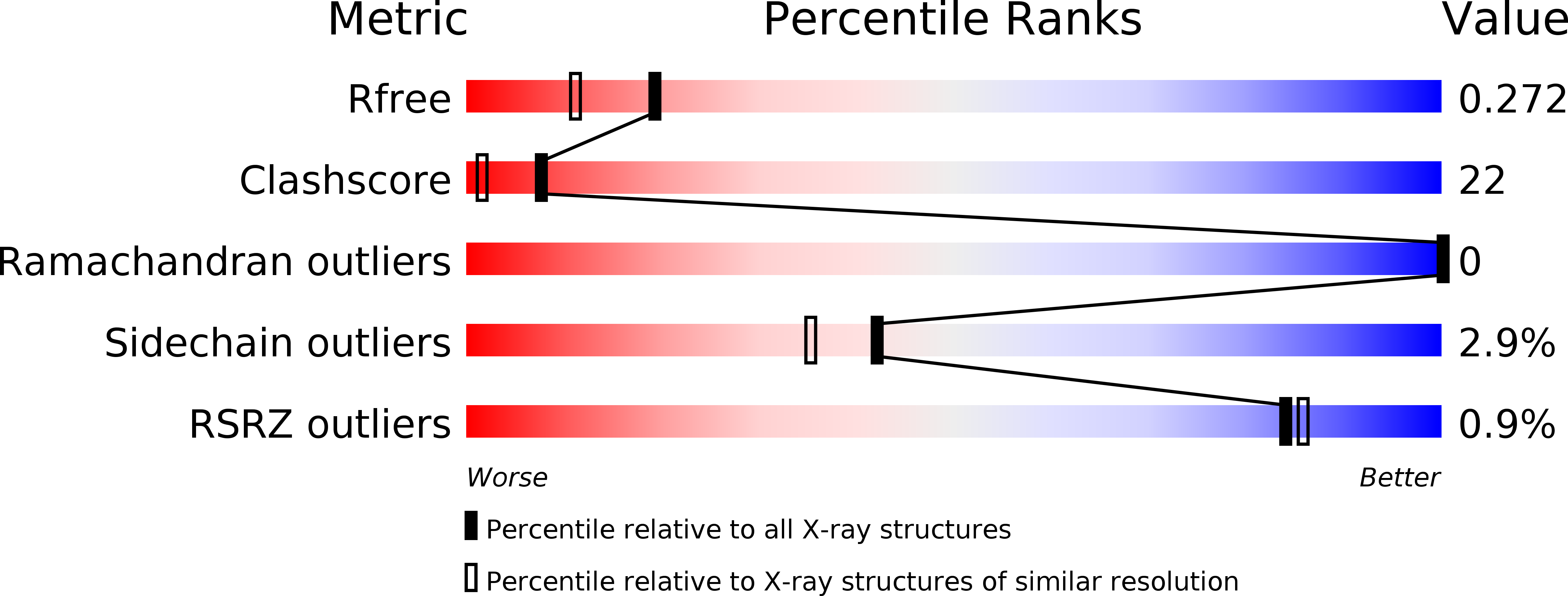
Resolution:
2.05 Å
R-Value Free:
0.26
R-Value Work:
0.21
R-Value Observed:
0.21
Space Group:
P 43 21 2
Macromolecular Entities
Structures with similar UniProt ID
Protein Blast
Polymer Type:polypeptide(L)
Molecule:PILUS ASSEMBLY PROTEIN PILC
Gene (Uniprot):TTHA0794
Chain IDs:A, B
Chain Length:116
Number of Molecules:2
Biological Source:THERMUS THERMOPHILUS
Primary Citation
Structure and Oligomerization of the Pilc Type Iv Pilus Biogenesis Protein from Thermus Thermophilus.
Proteins 78 2049 ? (2010)
PMID: 20455262 DOI: 10.1002/PROT.22720

Abstact

Type IV pili are expressed from a wide variety of Gram-negative bacteria and play a major role in host cell adhesion and bacterial motility. PilC is one of at least a dozen different proteins that are implicated in Type IV pilus assembly in Thermus thermophilus and a member of a conserved family of integral inner membrane proteins which are components of the Type II secretion system (GspF) and the archeal flagellum. PilC/GspF family members contain repeats of a conserved helix-rich domain of around 100 residues in length. Here, we describe the crystal structure of one of these domains, derived from the N-terminal domain of Thermus thermophilus PilC. The N-domain forms a dimer, adopting a six helix bundle structure with an up-down-up-down-up-down topology. The monomers are related by a rotation of 170 degrees , followed by a translation along the axis of the final alpha-helix of approximately one helical turn. This means that the regions of contact on helices 5 and 6 in each monomer are overlapping, but different. Contact between the two monomers is mediated by a network of hydrophobic residues which are highly conserved in PilC homologs from other Gram-negative bacteria. Site-directed mutagenesis of residues at the dimer interface resulted in a change in oligomeric state of PilC from tetramers to dimers, providing evidence that this interface is also found in the intact membrane protein and suggesting that it is important to its function.

Legend

Protein

Chemical

Disease

Primary Citation of related structures
Feedback Form
Name
Email
Institute
Feedback