2WDP image
Deposition Date 2009-03-25
Release Date 2009-10-27
Last Version Date 2023-12-13
Entry Detail
PDB ID:
2WDP
Keywords:
Title:
Crystal Structure of Ligand Free Human Caspase-6
Biological Source:
Source Organism:
HOMO SAPIENS (Taxon ID: 9606)
Host Organism:
Method Details:
Experimental Method:
Resolution:
1.95 Å
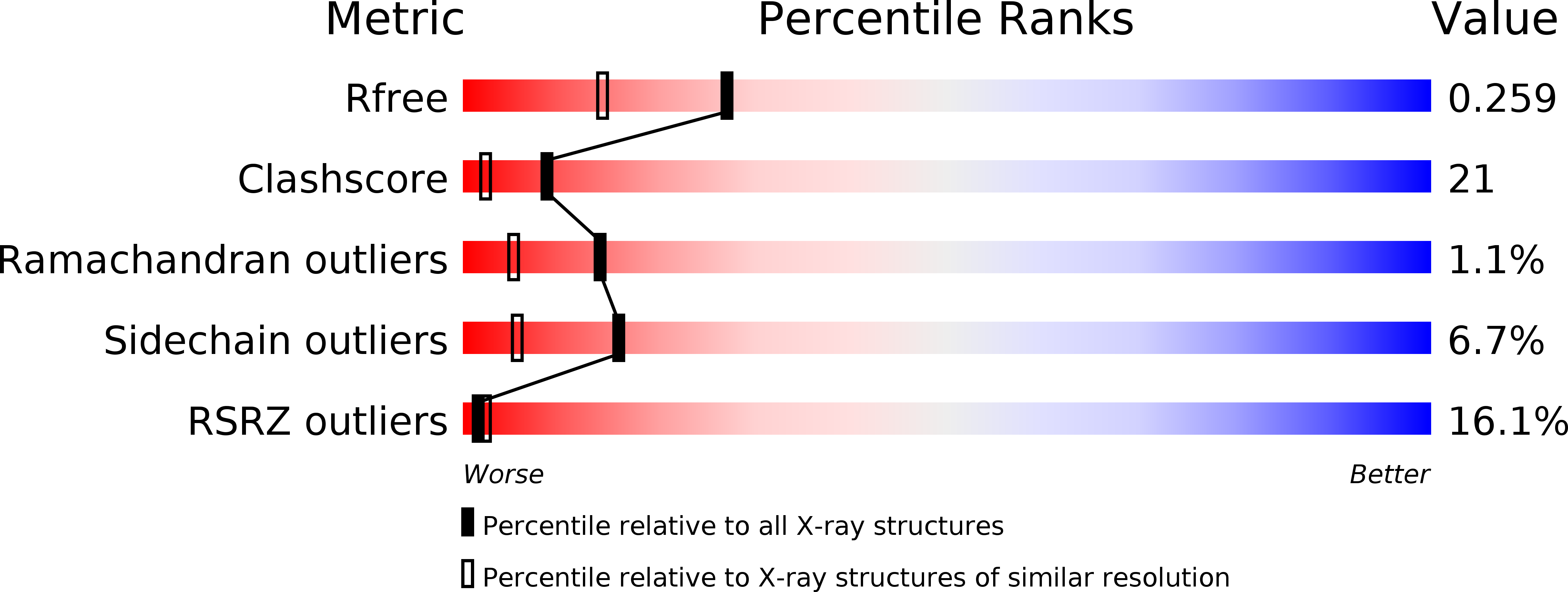
R-Value Free:
0.26
R-Value Work:
0.22
R-Value Observed:
0.22
Space Group:
P 1 21 1
Macromolecular Entities
Structures with similar UniProt ID
Protein Blast
Polymer Type:polypeptide(L)
Molecule:CASPASE-6
Gene (Uniprot):CASP6
Chain IDs:A, B, C, D
Chain Length:293
Number of Molecules:4
Biological Source:HOMO SAPIENS
Ligand Molecules
Primary Citation
The Crystal Structure of Caspase-6, a Selective Effector of Axonal Degeneration.
Biochem.J. 423 429 ? (2009)
PMID: 19694615 DOI: 10.1042/BJ20090540

Abstact

Neurodegenerative diseases pose one of the most pressing unmet medical needs today. It has long been recognized that caspase-6 may play a role in several neurodegenerative diseases for which there are currently no disease-modifying therapies. Thus it is a potential target for neurodegenerative drug development. In the present study we report on the biochemistry and structure of caspase-6. As an effector caspase, caspase-6 is a constitutive dimer independent of the maturation state of the enzyme. The ligand-free structure shows caspase-6 in a partially mature but latent conformation. The cleaved inter-domain linker remains partially inserted in the central groove of the dimer, as observed in other caspases. However, in contrast with the structures of other caspases, not only is the catalytic machinery misaligned, but several structural elements required for substrate recognition are missing. Most importantly, residues forming a short anti-parallel beta-sheet abutting the substrate in other caspase structures are part of an elongation of the central alpha-helix. Despite the dramatic structural changes that are required to adopt a canonical catalytically competent conformation, the pre-steady-state kinetics exhibit no lag phase in substrate turnover. This suggests that the observed conformation does not play a regulatory role in caspase-6 activity. However, targeting the latent conformation in search for specific and bio-available caspase-6 inhibitors might offer an alternative to active-site-directed approaches.

Legend

Protein

Chemical

Disease

Primary Citation of related structures
Feedback Form
Name
Email
Institute
Feedback