2W83 image
Deposition Date 2009-01-08
Release Date 2009-07-14
Last Version Date 2023-12-13
Entry Detail
PDB ID:
2W83
Title:
Crystal structure of the ARF6 GTPase in complex with a specific effector, JIP4
Biological Source:
Source Organism:
HOMO SAPIENS (Taxon ID: 9606)
Host Organism:
Method Details:
Experimental Method:
Resolution:
1.93 Å
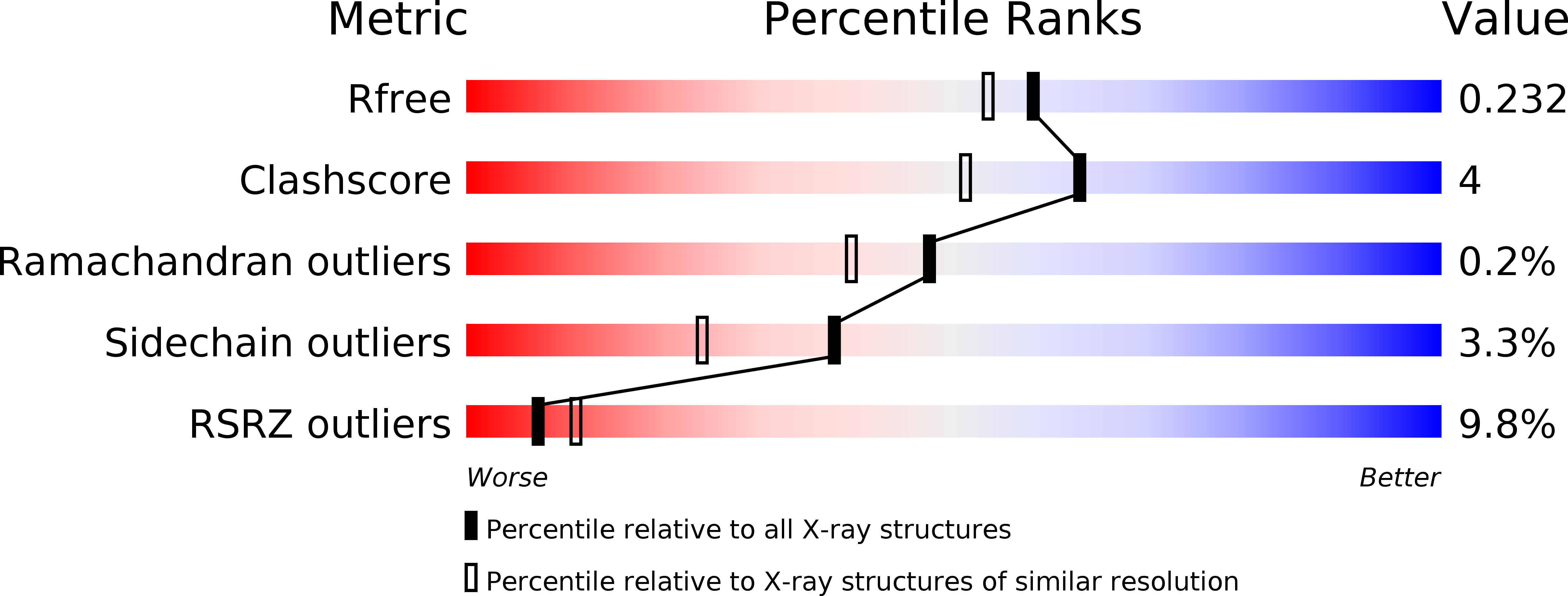
R-Value Free:
0.23
R-Value Work:
0.21
R-Value Observed:
0.21
Space Group:
P 62 2 2
Macromolecular Entities
Structures with similar UniProt ID
Protein Blast
Polymer Type:polypeptide(L)
Molecule:ADP-RIBOSYLATION FACTOR 6
Gene (Uniprot):ARF6
Mutagens:YES
Chain IDs:A, B, E
Chain Length:165
Number of Molecules:3
Biological Source:HOMO SAPIENS
Structures with similar UniProt ID
Protein Blast
Polymer Type:polypeptide(L)
Molecule:C-JUN-AMINO-TERMINAL KINASE-INTERACTING PROTEIN 4
Gene (Uniprot):SPAG9
Chain IDs:C, D
Chain Length:77
Number of Molecules:2
Biological Source:HOMO SAPIENS
Primary Citation
The Structural Basis of Arf Effector Specificity: The Crystal Structure of Arf6 in a Complex with Jip4.
Embo J. 28 2835 ? (2009)
PMID: 19644450 DOI: 10.1038/EMBOJ.2009.209

Abstact

The JNK-interacting proteins, JIP3 and JIP4, are specific effectors of the small GTP-binding protein ARF6. The interaction of ARF6-GTP with the second leucine zipper (LZII) domains of JIP3/JIP4 regulates the binding of JIPs to kinesin-1 and dynactin. Here, we report the crystal structure of ARF6-GTP bound to the JIP4-LZII at 1.9 A resolution. The complex is a heterotetramer with dyad symmetry arranged in an ARF6-(JIP4)(2)-ARF6 configuration. Comparison of the ARF6-JIP4 interface with the equivalent region of ARF1 shows the structural basis of JIP4's specificity for ARF6. Using site-directed mutagenesis and surface plasmon resonance, we further show that non-conserved residues at the switch region borders are the key structural determinants of JIP4 specificity. A structure-derived model of the association of the ARF6-JIP3/JIP4 complex with membranes shows that the JIP4-LZII coiled-coil should lie along the membrane to prevent steric hindrances, resulting in only one ARF6 molecule bound. Such a heterotrimeric complex gives insights to better understand the ARF6-mediated motor switch regulatory function.

Legend

Protein

Chemical

Disease

Primary Citation of related structures
Feedback Form
Name
Email
Institute
Feedback