2W77 image
Deposition Date 2008-12-20
Release Date 2009-05-12
Last Version Date 2023-12-13
Entry Detail
PDB ID:
2W77
Keywords:
Title:
Structures of P. aeruginosa FpvA bound to heterologous pyoverdines: FpvA-Pvd(Pfl18.1)-Fe complex
Biological Source:
Source Organism:
Host Organism:
Method Details:
Experimental Method:
Resolution:
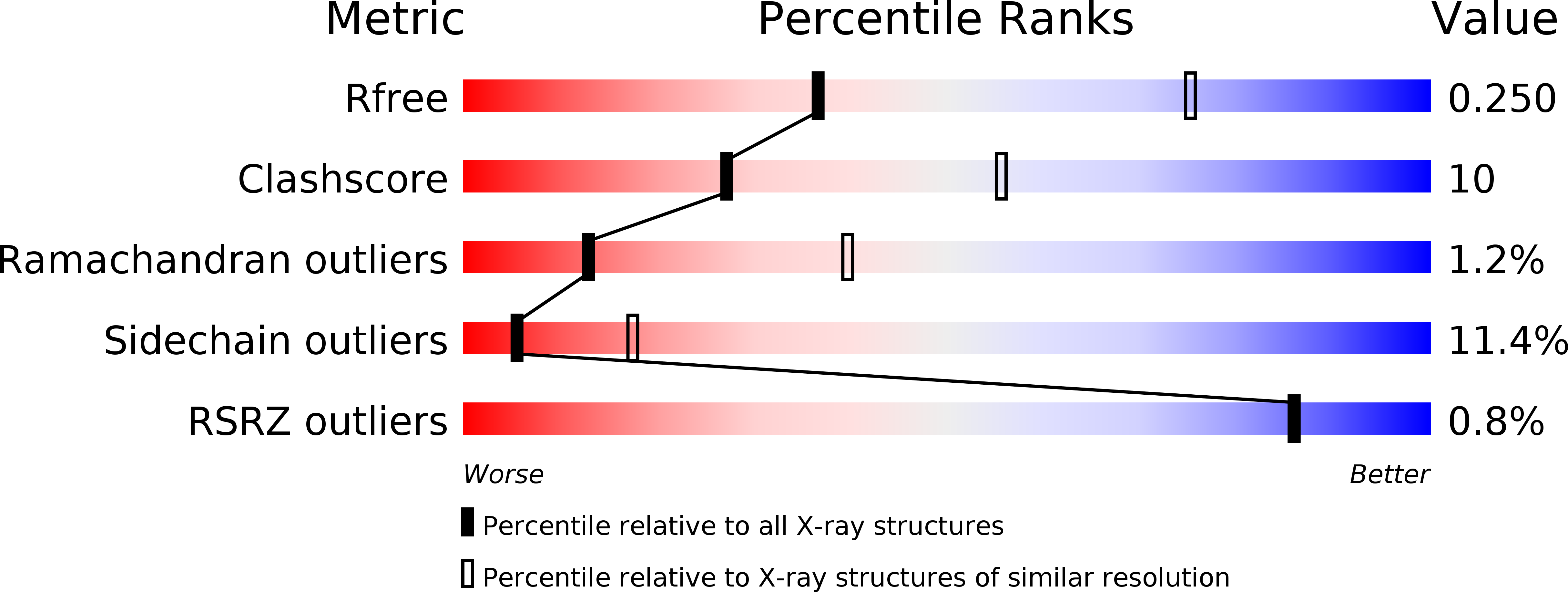
2.90 Å
R-Value Free:
0.25
R-Value Work:
0.20
R-Value Observed:
0.20
Space Group:
C 1 2 1
Macromolecular Entities
Structures with similar UniProt ID
Protein Blast
Polymer Type:polypeptide(L)
Molecule:FERRIPYOVERDINE RECEPTOR
Gene (Uniprot):fpvA
Chain IDs:A, B
Chain Length:772
Number of Molecules:2
Biological Source:PSEUDOMONAS AERUGINOSA
Polymer Type:polypeptide(L)
Molecule:PYOVERDIN 18-1
Chain IDs:C
Chain Length:10
Number of Molecules:1
Biological Source:PSEUDOMONAS FLUORESCENS
Modified Residue
Compound ID Chain ID Parent Comp ID Details 2D Image
FH7 C LYS N^5^-FORMYL-N^5^-HYDROXY-D-ORNITHINE
FHO C LYS N^5^-FORMYL-N^5^-HYDROXY-L-ORNITHINE
Peptide-like Molecules
PRD_000724
Primary Citation
Fpva Bound to Non-Cognate Pyoverdines: Molecular Basis of Siderophore Recognition by an Iron Transporter.
Mol.Microbiol. 72 1246 ? (2009)
PMID: 19504741 DOI: 10.1111/J.1365-2958.2009.06721.X

Abstact

The first step in the specific uptake of iron via siderophores in Gram-negative bacteria is the recognition and binding of a ferric siderophore by its cognate receptor. We investigated the molecular basis of this event through structural and biochemical approaches. FpvA, the pyoverdine-Fe transporter from Pseudomonas aeruginosa ATCC 15692 (PAO1 strain), is able to transport ferric-pyoverdines originating from other species, whereas most fluorescent pseudomonads are only able to use the one they produce among the more than 100 known different pyoverdines. We solved the structure of FpvA bound to non-cognate pyoverdines of high- or low-affinity and found a close correlation between receptor-ligand structure and the measured affinities. The structure of the first amino acid residues of the pyoverdine chain distinguished the high- and low-affinity binders while the C-terminal portion of the pyoverdines, often cyclic, does not appear to contribute extensively to the interaction between the siderophore and its transporter. The specificity of the ferric-pyoverdine binding site of FpvA is conferred by the structural elements common to all ferric-pyoverdines, i.e. the chromophore, iron, and its chelating groups.

Legend

Protein

Chemical

Disease

Primary Citation of related structures
Feedback Form
Name
Email
Institute
Feedback