2W69 image
Deposition Date 2008-12-17
Release Date 2009-02-03
Last Version Date 2024-05-08
Entry Detail
PDB ID:
2W69
Keywords:
Title:
Influenza polymerase fragment
Biological Source:
Source Organism:
Host Organism:
Method Details:
Experimental Method:
Resolution:
2.05 Å
R-Value Free:
0.26
R-Value Work:
0.21
R-Value Observed:
0.22
Space Group:
P 43 21 2
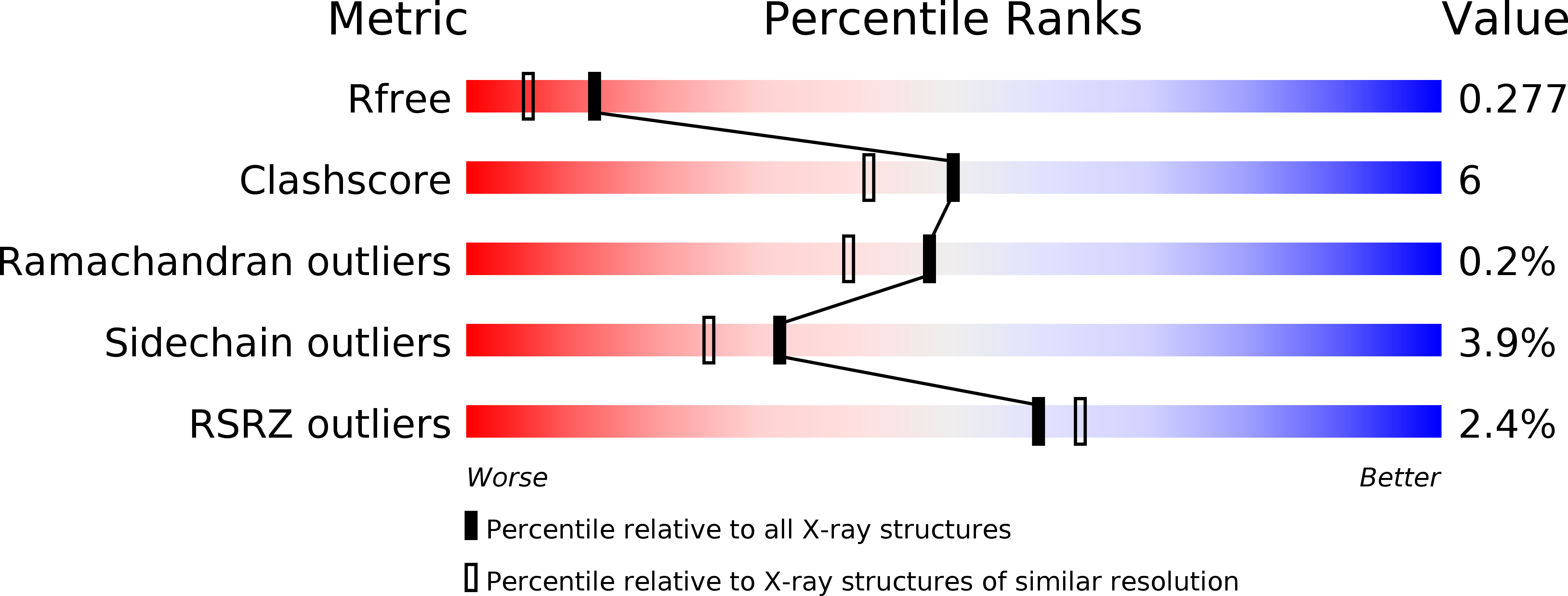
Macromolecular Entities
Structures with similar UniProt ID
Protein Blast
Polymer Type:polypeptide(L)
Molecule:POLYMERASE ACIDIC PROTEIN
Gene (Uniprot):PA
Chain IDs:A, B, C (auth: D)
Chain Length:216
Number of Molecules:3
Biological Source:INFLUENZA A VIRUS
Primary Citation
The CAP-Snatching Endonuclease of Influenza Virus Polymerase Resides in the Pa Subunit
Nature 458 914 ? (2009)
PMID: 19194459 DOI: 10.1038/NATURE07745

Abstact

The influenza virus polymerase, a heterotrimer composed of three subunits, PA, PB1 and PB2, is responsible for replication and transcription of the eight separate segments of the viral RNA genome in the nuclei of infected cells. The polymerase synthesizes viral messenger RNAs using short capped primers derived from cellular transcripts by a unique 'cap-snatching' mechanism. The PB2 subunit binds the 5' cap of host pre-mRNAs, which are subsequently cleaved after 10-13 nucleotides by the viral endonuclease, hitherto thought to reside in the PB2 (ref. 5) or PB1 (ref. 2) subunits. Here we describe biochemical and structural studies showing that the amino-terminal 209 residues of the PA subunit contain the endonuclease active site. We show that this domain has intrinsic RNA and DNA endonuclease activity that is strongly activated by manganese ions, matching observations reported for the endonuclease activity of the intact trimeric polymerase. Furthermore, this activity is inhibited by 2,4-dioxo-4-phenylbutanoic acid, a known inhibitor of the influenza endonuclease. The crystal structure of the domain reveals a structural core closely resembling resolvases and type II restriction endonucleases. The active site comprises a histidine and a cluster of three acidic residues, conserved in all influenza viruses, which bind two manganese ions in a configuration similar to other two-metal-dependent endonucleases. Two active site residues have previously been shown to specifically eliminate the polymerase endonuclease activity when mutated. These results will facilitate the optimisation of endonuclease inhibitors as potential new anti-influenza drugs.

Legend

Protein

Chemical

Disease

Primary Citation of related structures
Feedback Form
Name
Email
Institute
Feedback