2W1R image
Deposition Date 2008-10-20
Release Date 2008-11-18
Last Version Date 2024-05-08
Entry Detail
PDB ID:
2W1R
Keywords:
Title:
Crystal Structure of the C-terminal Domain of B. subtilis SpoVT
Biological Source:
Source Organism:
Method Details:
Experimental Method:
Resolution:
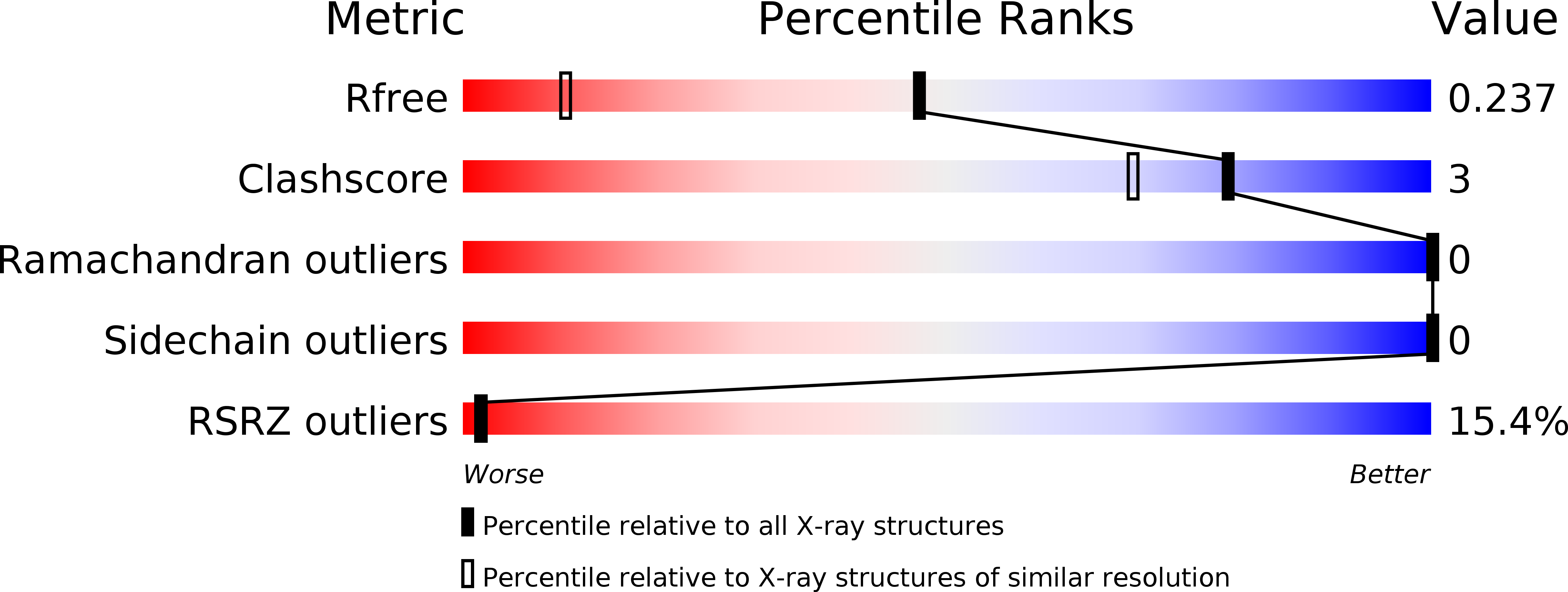
1.50 Å
R-Value Free:
0.24
R-Value Work:
0.22
R-Value Observed:
0.22
Space Group:
P 43 21 2
Macromolecular Entities
Structures with similar UniProt ID
Protein Blast
Polymer Type:polypeptide(L)
Molecule:STAGE V SPORULATION PROTEIN T
Gene (Uniprot):spoVT
Chain IDs:A
Chain Length:123
Number of Molecules:1
Biological Source:BACILLUS SUBTILIS
Primary Citation
Crystal Structure of Spovt, the Final Modulator of Gene Expression During Spore Development in Bacillus Subtilis
J.Mol.Biol. 386 962 ? (2009)
PMID: 18996130 DOI: 10.1016/J.JMB.2008.10.061

Abstact

Endospore formation in Bacillus subtilis is orchestrated by five developmental sigma factors and further modulated by several auxiliary transcription factors. One of these, SpoVT, regulates forespore-specific sigma(G)-dependent genes and plays a key role in the final stages of spore formation. We have determined the crystal structure of the isolated C-terminal domain of SpoVT at 1.5 A by experimental phasing techniques and used this model to solve the structure of the full-length SpoVT at 2.6 A by molecular replacement. SpoVT is a tetramer that shows an overall significant distortion mediated by electrostatic interactions. Two monomers dimerize via the highly charged N-terminal domains to form swapped-hairpin beta-barrels. These asymmetric dimers further tetramerize through the formation of mixed helix bundles between their C-terminal domains, which themselves fold as GAF (cGMP-specific and cGMP-stimulated phosphodiesterases, Anabaena adenylate cyclases, and Escherichia coli FhlA) domains. The combination of a swapped-hairpin beta-barrel with a GAF domain represents a novel domain architecture in transcription factors. The occurrence of SpoVT homologs throughout Bacilli and Clostridia demonstrates the ancestral origin of this factor in sporulation.

Legend

Protein

Chemical

Disease

Primary Citation of related structures
Feedback Form
Name
Email
Institute
Feedback