2VHD image
Deposition Date 2007-11-20
Release Date 2008-02-12
Last Version Date 2024-11-13
Entry Detail
PDB ID:
2VHD
Keywords:
Title:
Crystal Structure Of The Di-Haem Cytochrome C Peroxidase From Pseudomonas aeruginosa - Mixed Valence Form
Biological Source:
Source Organism:
Host Organism:
Method Details:
Experimental Method:
Resolution:
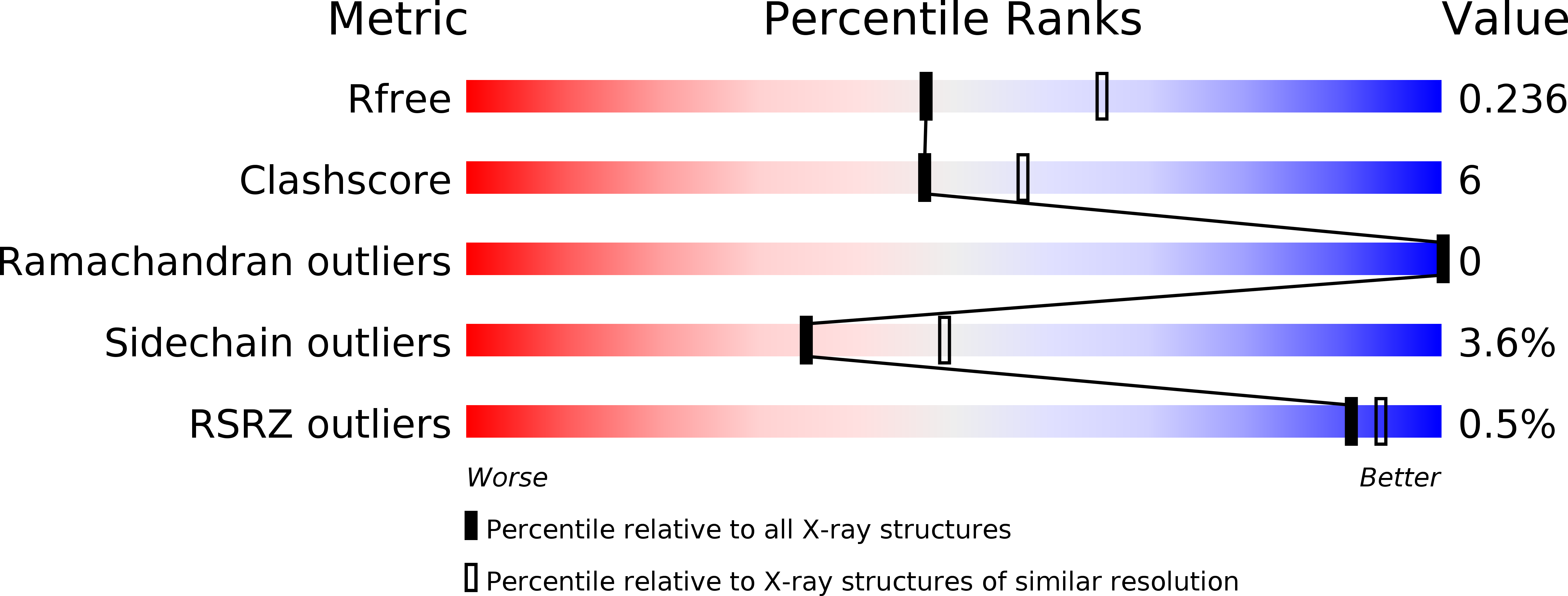
2.30 Å
R-Value Free:
0.24
R-Value Work:
0.18
R-Value Observed:
0.18
Space Group:
C 1 2 1
Macromolecular Entities
Structures with similar UniProt ID
Protein Blast
Polymer Type:polypeptide(L)
Molecule:CYTOCHROME C551 PEROXIDASE
Gene (Uniprot):ccpA
Chain IDs:A, B
Chain Length:323
Number of Molecules:2
Biological Source:PSEUDOMONAS AERUGINOSA
Primary Citation
Redox-Linked Structural Changes Associated with the Formation of a Catalytically Competent Form of the Diheme Cytochrome C Peroxidase from Pseudomonas Aeruginosa
Biochemistry 47 1947 ? (2008)
PMID: 18217775 DOI: 10.1021/BI702064F

Abstact

A recombinant form of the prototypic diheme bacterial cytochrome c peroxidase (BCCP) from Pseudomonas aeruginosa (PsaCCP) has been expressed in Escherichia coli and purified to homogeneity. This material was used to carry out the first integrated biochemical, spectroscopic and structural investigation of the factors leading to reductive activation of this class of enzymes. A single, tightly bound, Ca2+ ion (K = 3 x 10(10) M-1) found at the domain interface of both the fully oxidized and mixed-valence forms of the enzyme is absolutely required for catalytic activity. Reduction of the electron-transferring (high-potential) heme in the presence of Ca2+ ions triggers substantial structural rearrangements around the active-site (low-potential) heme to allow substrate binding and catalysis. The enzyme also forms a mixed-valence state in the absence of Ca2+ ions, but a combination of electronic absorption, and EPR spectroscopies suggests that under these circumstances the low potential heme remains six-coordinate, unable to bind substrate and therefore catalytically inactive. Our observations strongly suggest that the two mixed-valence forms of native PsaCCP reported previously by Foote and colleagues (Foote, N., Peterson, J., Gadsby, P., Greenwood, C., and Thomson, A. (1985) Biochem. J. 230, 227-237) correspond to the Ca2+-loaded and -depleted forms of the enzyme.

Legend

Protein

Chemical

Disease

Primary Citation of related structures
Feedback Form
Name
Email
Institute
Feedback