2VGM image
Deposition Date 2007-11-14
Release Date 2008-01-22
Last Version Date 2024-05-08
Entry Detail
PDB ID:
2VGM
Keywords:
Title:
Structure of S. cerevisiae Dom34, a translation termination-like factor involved in RNA quality control pathways and interacting with Hbs1 (Unlabeled protein)
Biological Source:
Source Organism(s):
Expression System(s):
Method Details:
Experimental Method:
Resolution:
2.60 Å
R-Value Free:
0.28
R-Value Work:
0.22
R-Value Observed:
0.22
Space Group:
P 32 2 1
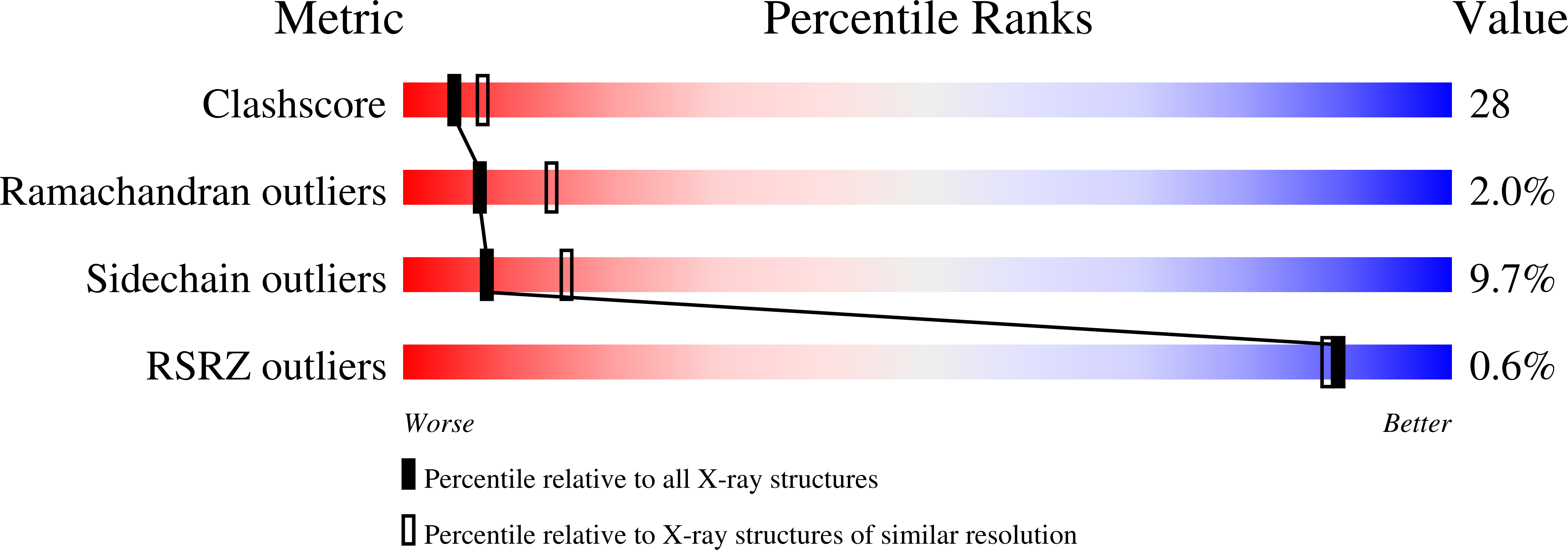
Macromolecular Entities
Structures with similar UniProt ID
Protein Blast
Polymer Type:polypeptide(L)
Molecule:DOM34
Gene (Uniprot):DOM34
Chain IDs:A
Chain Length:386
Number of Molecules:1
Biological Source:Saccharomyces cerevisiae
Primary Citation
Structure of Yeast Dom34: A Protein Related to Translation Termination Factor Erf1 and Involved in No-Go Decay.
J.Biol.Chem. 283 7145 ? (2008)
PMID: 18180287 DOI: 10.1074/JBC.M708224200

Abstact

The yeast protein Dom34 has been described to play a critical role in a newly identified mRNA decay pathway called No-Go decay. This pathway clears cells from mRNAs inducing translational stalls through endonucleolytic cleavage. Dom34 is related to the translation termination factor eRF1 and physically interacts with Hbs1, which is itself related to eRF3. We have solved the 2.5-A resolution crystal structure of Saccharomyces cerevisiae Dom34. This protein is organized in three domains with the central and C-terminal domains structurally homologous to those from eRF1. The N-terminal domain of Dom34 is different from eRF1. It adopts a Sm-fold that is often involved in the recognition of mRNA stem loops or in the recruitment of mRNA degradation machinery. The comparison of eRF1 and Dom34 domains proposed to interact directly with eRF3 and Hbs1, respectively, highlights striking structural similarities with eRF1 motifs identified to be crucial for the binding to eRF3. In addition, as observed for eRF1 that enhances eRF3 binding to GTP, the interaction of Dom34 with Hbs1 results in an increase in the affinity constant of Hbs1 for GTP but not GDP. Taken together, these results emphasize that eukaryotic cells have evolved two structurally related complexes able to interact with ribosomes either paused at a stop codon or stalled in translation by the presence of a stable stem loop and to trigger ribosome release by catalyzing chemical bond hydrolysis.

Legend

Protein

Chemical

Disease

Primary Citation of related structures
Feedback Form
Name
Email
Institute
Feedback