2V53 image
Deposition Date 2008-10-01
Release Date 2008-11-25
Last Version Date 2023-12-13
Entry Detail
PDB ID:
2V53
Keywords:
Title:
Crystal structure of a SPARC-collagen complex
Biological Source:
Source Organism:
HOMO SAPIENS (Taxon ID: 9606)
Host Organism:
Method Details:
Experimental Method:
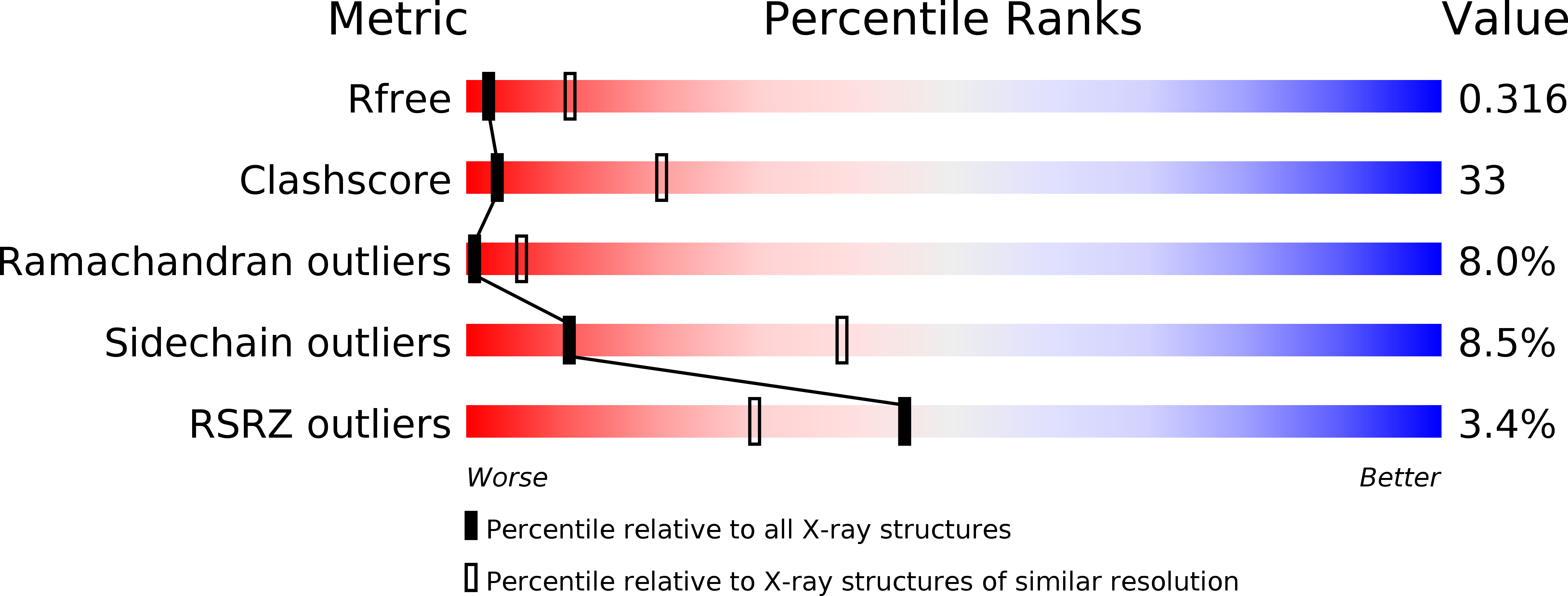
Resolution:
3.20 Å
R-Value Free:
0.32
R-Value Work:
0.25
R-Value Observed:
0.26
Space Group:
P 42 21 2
Macromolecular Entities
Structures with similar UniProt ID
Protein Blast
Polymer Type:polypeptide(L)
Molecule:SPARC
Gene (Uniprot):SPARC
Chain IDs:A
Chain Length:230
Number of Molecules:1
Biological Source:HOMO SAPIENS
Structures with similar UniProt ID
Protein Blast
Polymer Type:polypeptide(L)
Molecule:COLLAGEN ALPHA-1(III) CHAIN
Gene (Uniprot):COL3A1
Chain IDs:B, C, D
Chain Length:33
Number of Molecules:3
Biological Source:HOMO SAPIENS
Modified Residue
Compound ID Chain ID Parent Comp ID Details 2D Image
ASN A ASN GLYCOSYLATION SITE
HYP B PRO 4-HYDROXYPROLINE
Primary Citation
Structural Basis of Sequence-Specific Collagen Recognition by Sparc.
Proc.Natl.Acad.Sci.USA 105 18273 ? (2008)
PMID: 19011090 DOI: 10.1073/PNAS.0808452105

Abstact

Protein interactions with the collagen triple helix play a critical role in collagen fibril formation, cell adhesion, and signaling. However, structural insight into sequence-specific collagen recognition is limited to an integrin-peptide complex. A GVMGFO motif in fibrillar collagens (O denotes 4-hydroxyproline) binds 3 unrelated proteins: von Willebrand factor (VWF), discoidin domain receptor 2 (DDR2), and the extracellular matrix protein SPARC/osteonectin/BM-40. We report the crystal structure at 3.2 A resolution of human SPARC bound to a triple-helical 33-residue peptide harboring the promiscuous GVMGFO motif. SPARC recognizes the GVMGFO motifs of the middle and trailing collagen chains, burying a total of 720 A(2) of solvent-accessible collagen surface. SPARC binding does not distort the canonical triple helix of the collagen peptide. In contrast, a critical loop in SPARC is substantially remodelled upon collagen binding, creating a deep pocket that accommodates the phenylalanine residue of the trailing collagen chain ("Phe pocket"). This highly restrictive specificity pocket is shared with the collagen-binding integrin I-domains but differs strikingly from the shallow collagen-binding grooves of the platelet receptor glycoprotein VI and microbial adhesins. We speculate that binding of the GVMGFO motif to VWF and DDR2 also results in structural changes and the formation of a Phe pocket.

Legend

Protein

Chemical

Disease

Primary Citation of related structures
Feedback Form
Name
Email
Institute
Feedback