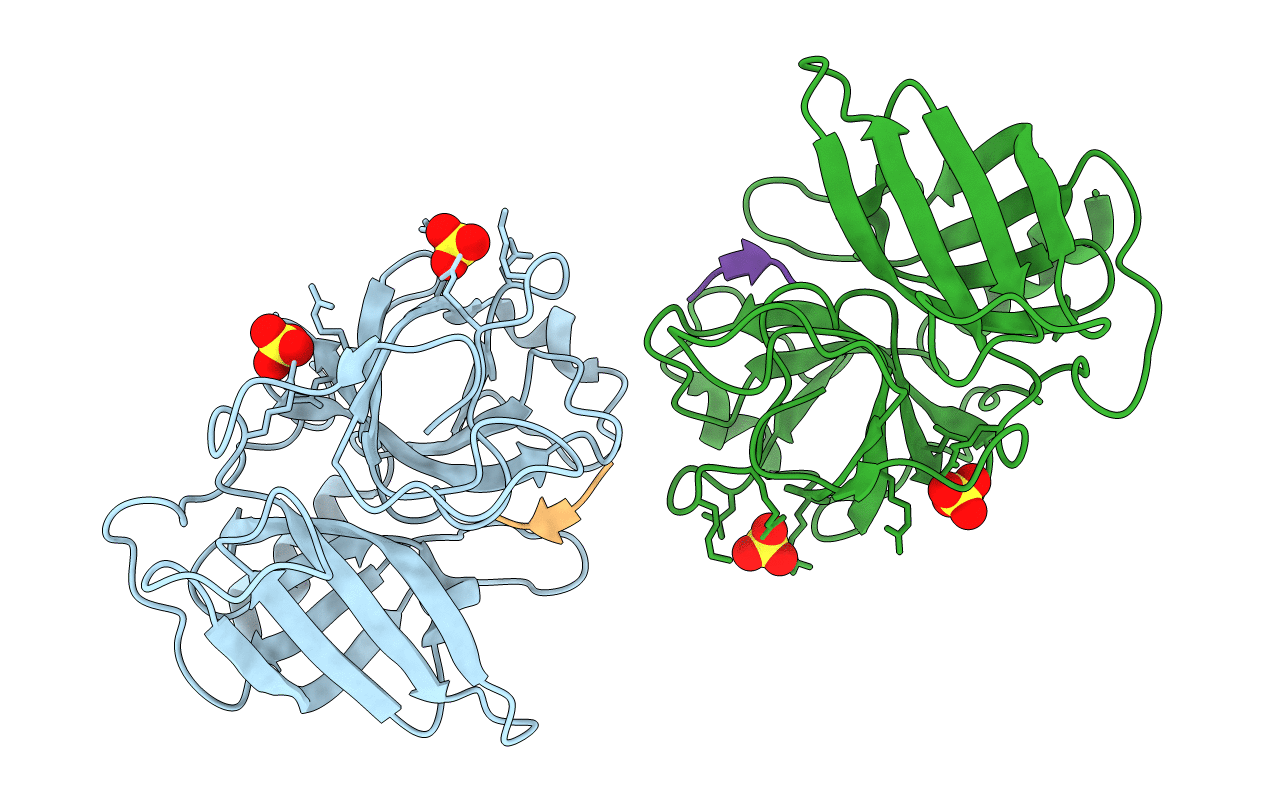
2RDL image
Deposition Date 2007-09-24
Release Date 2007-10-30
Last Version Date 2024-11-20
Entry Detail
PDB ID:
2RDL
Title:
Hamster Chymase 2
Biological Source:
Source Organism:
Method Details:
Experimental Method:
Resolution:
2.50 Å
R-Value Free:
0.25
R-Value Work:
0.18
Space Group:
P 43 21 2
Macromolecular Entities
Structures with similar UniProt ID
Protein Blast
Polymer Type:polypeptide(L)
Molecule:Chymase 2
Chain IDs:A, B
Chain Length:226
Number of Molecules:2
Biological Source:Mesocricetus auratus
Modified Residue
Compound ID Chain ID Parent Comp ID Details 2D Image
ALV C ALA (2S)-2-AMINOPROPANE-1,1-DIOL
Ligand Molecules
Peptide-like Molecules
PRD_000402
Primary Citation
Structural basis for elastolytic substrate specificity in rodent alpha-chymases.
J.Biol.Chem. 283 427 436 (2008)
PMID: 17981788 DOI: 10.1074/jbc.M707157200

Abstact

Divergence of substrate specificity within the context of a common structural framework represents an important mechanism by which new enzyme activity naturally evolves. We present enzymological and x-ray structural data for hamster chymase-2 (HAM2) that provides a detailed explanation for the unusual hydrolytic specificity of this rodent alpha-chymase. In enzymatic characterization, hamster chymase-1 (HAM1) showed typical chymase proteolytic activity. In contrast, HAM2 exhibited atypical substrate specificity, cleaving on the carboxyl side of the P1 substrate residues Ala and Val, characteristic of elastolytic rather than chymotryptic specificity. The 2.5-A resolution crystal structure of HAM2 complexed to the peptidyl inhibitor MeOSuc-Ala-Ala-Pro-Ala-chloromethylketone revealed a narrow and shallow S1 substrate binding pocket that accommodated only a small hydrophobic residue (e.g. Ala or Val). The different substrate specificities of HAM2 and HAM1 are explained by changes in four S1 substrate site residues (positions 189, 190, 216, and 226). Of these, Asn(189), Val(190), and Val(216) form an easily identifiable triplet in all known rodent alpha-chymases that can be used to predict elastolytic specificity for novel chymase-like sequences. Phylogenetic comparison defines guinea pig and rabbit chymases as the closest orthologs to rodent alpha-chymases.

Legend

Protein

Chemical

Disease

Primary Citation of related structures
Feedback Form
Name
Email
Institute
Feedback