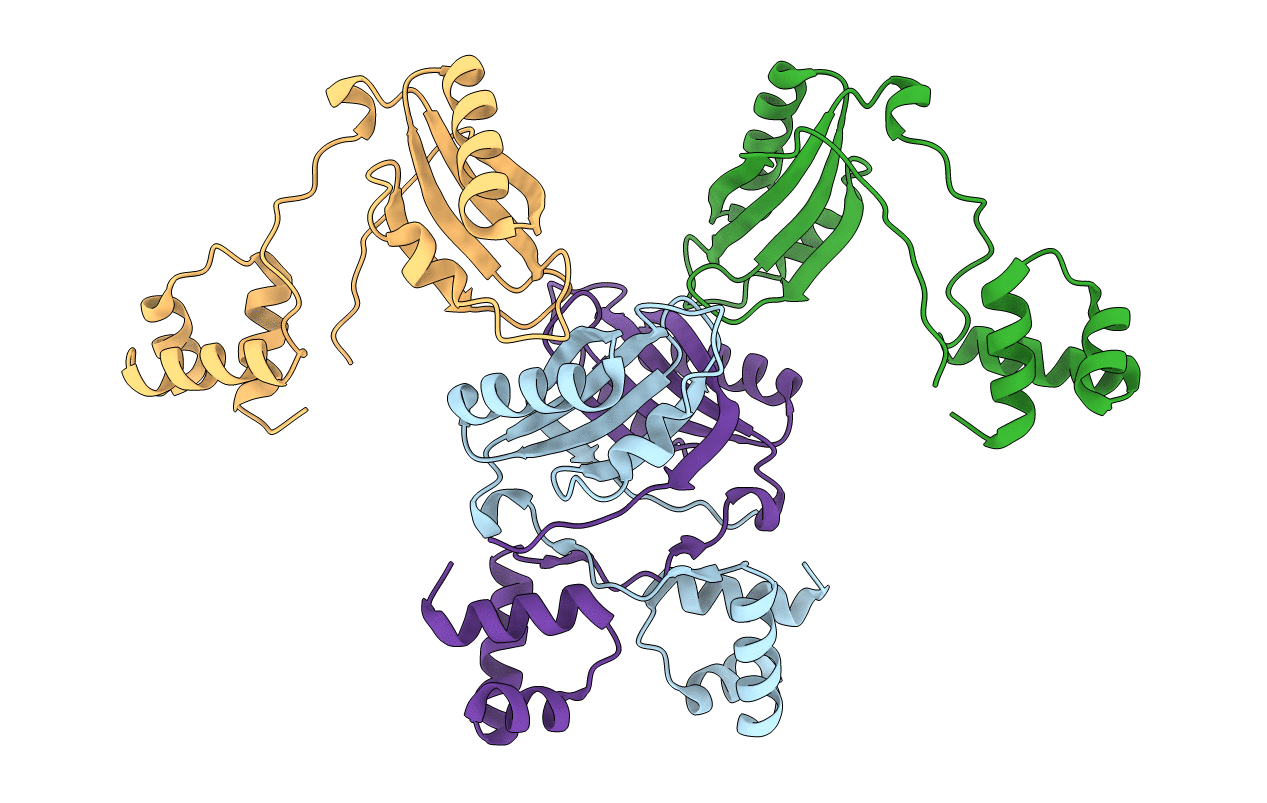
2QZ8 image
Deposition Date 2007-08-16
Release Date 2007-11-06
Last Version Date 2024-02-21
Entry Detail
PDB ID:
2QZ8
Keywords:
Title:
Crystal structure of Mycobacterium tuberculosis Leucine response regulatory protein (LrpA)
Biological Source:
Source Organism:
Host Organism:
Method Details:
Experimental Method:
Resolution:
2.16 Å
R-Value Free:
0.25
R-Value Work:
0.21
R-Value Observed:
0.21
Space Group:
C 2 2 21

Macromolecular Entities
Protein Blast
Polymer Type:polypeptide(L)
Molecule:Probable transcriptional regulatory protein
Gene (Uniprot):lrp
Mutagens:A22V, L108M
Chain IDs:A, B, C, D
Chain Length:149
Number of Molecules:4
Biological Source:Mycobacterium tuberculosis
Primary Citation
Crystal structure of Mycobacterium tuberculosis LrpA, a leucine-responsive global regulator associated with starvation response.
Protein Sci. 17 159 170 (2008)
PMID: 18042675 DOI: 10.1110/ps.073192208

Abstact

The bacterial leucine-responsive regulatory protein (Lrp) is a global transcriptional regulator that controls the expression of many genes during starvation and the transition to stationary phase. The Mycobacterium tuberculosis gene Rv3291c encodes a 150-amino acid protein (designated here as Mtb LrpA) with homology with Escherichia coli Lrp. The crystal structure of the native form of Mtb LrpA was solved at 2.1 A. The Mtb LrpA structure shows an N-terminal DNA-binding domain with a helix-turn-helix (HTH) motif, and a C-terminal regulatory domain. In comparison to the complex of E. coli AsnC with asparagine, the effector-binding pocket (including loop 100-106) in LrpA appears to be largely preserved, with hydrophobic substitutions consistent with its specificity for leucine. The effector-binding pocket is formed at the interface between adjacent dimers, with an opening to the core of the octamer as in AsnC, and an additional substrate-access channel opening to the outer surface of the octamer. Using electrophoretic mobility shift assays, purified Mtb LrpA protein was shown to form a protein-DNA complex with the lat promoter, demonstrating that the lat operon is a direct target of LrpA. Using computational analysis, a putative motif is identified in this region that is also present upstream of other operons differentially regulated under starvation. This study provides insights into the potential role of LrpA as a global regulator in the transition of M. tuberculosis to a persistent state.

Legend

Protein

Chemical

Disease

Primary Citation of related structures
Feedback Form
Name
Email
Institute
Feedback