2QZ6 image
Deposition Date 2007-08-16
Release Date 2008-03-18
Last Version Date 2023-10-25
Entry Detail
PDB ID:
2QZ6
Keywords:
Title:
First crystal structure of a psychrophile class C beta-lactamase
Biological Source:
Source Organism:
Method Details:
Experimental Method:
Resolution:
2.26 Å
R-Value Free:
0.24
R-Value Work:
0.18
R-Value Observed:
0.19
Space Group:
P 1 21 1
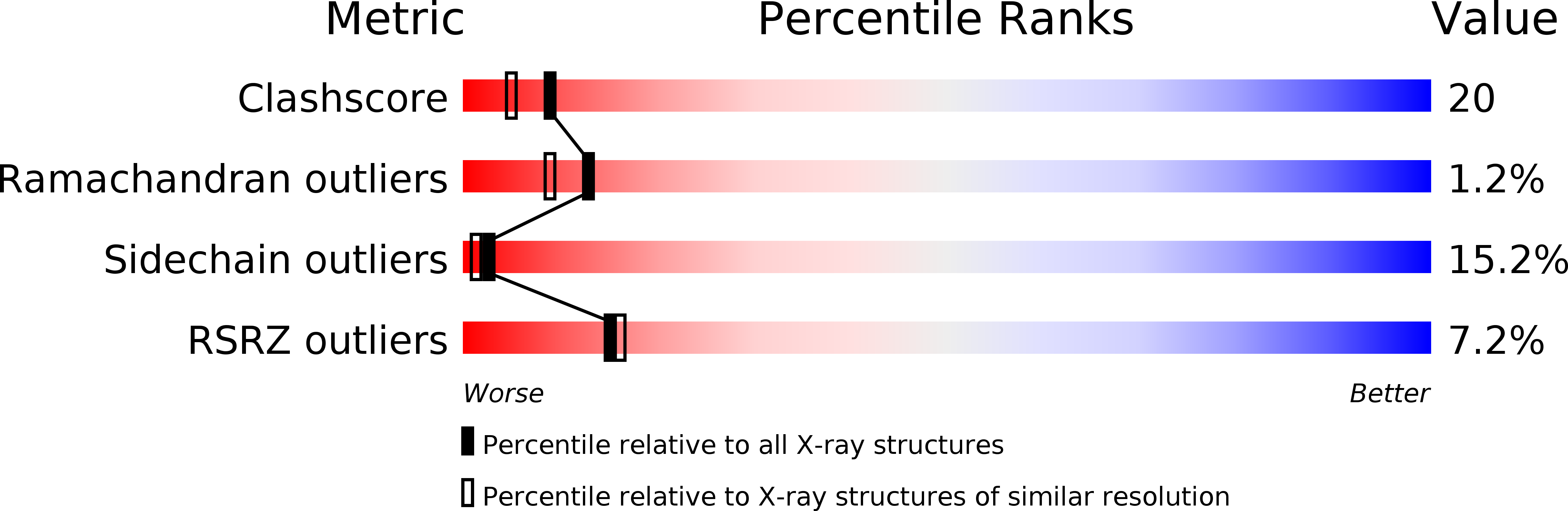
Macromolecular Entities
Structures with similar UniProt ID
Protein Blast
Polymer Type:polypeptide(L)
Molecule:Beta-lactamase
Gene (Uniprot):ampC
Chain IDs:A
Chain Length:358
Number of Molecules:1
Biological Source:Pseudomonas fluorescens
Primary Citation
Crystal structure of a cold-adapted class C beta-lactamase
Febs J. 275 1687 1697 (2008)
PMID: 18312599 DOI: 10.1111/j.1742-4658.2008.06324.x

Abstact

In this study, the crystal structure of a class C beta-lactamase from a psychrophilic organism, Pseudomonas fluorescens, has been refined to 2.2 A resolution. It is one of the few solved crystal structures of psychrophilic proteins. The structure was compared with those of homologous mesophilic enzymes and of another, modeled, psychrophilic protein. The elucidation of the 3D structure of this enzyme provides additional insights into the features involved in cold adaptation. Structure comparison of the psychrophilic and mesophilic beta-lactamases shows that electrostatics seems to play a major role in low-temperature adaptation, with a lower total number of ionic interactions for cold enzymes. The psychrophilic enzymes are also characterized by a decreased number of hydrogen bonds, a lower content of prolines, and a lower percentage of arginines in comparison with lysines. All these features make the structure more flexible so that the enzyme can behave as an efficient catalyst at low temperatures.

Legend

Protein

Chemical

Disease

Primary Citation of related structures
Feedback Form
Name
Email
Institute
Feedback