2QVS image
Deposition Date 2007-08-08
Release Date 2007-10-23
Last Version Date 2024-10-30
Entry Detail
PDB ID:
2QVS
Title:
Crystal Structure of Type IIa Holoenzyme of cAMP-dependent Protein Kinase
Biological Source:
Source Organism:
Mus musculus (Taxon ID: 10090)
Method Details:
Experimental Method:
Resolution:
2.50 Å
R-Value Free:
0.25
R-Value Work:
0.21
Space Group:
P 21 21 21
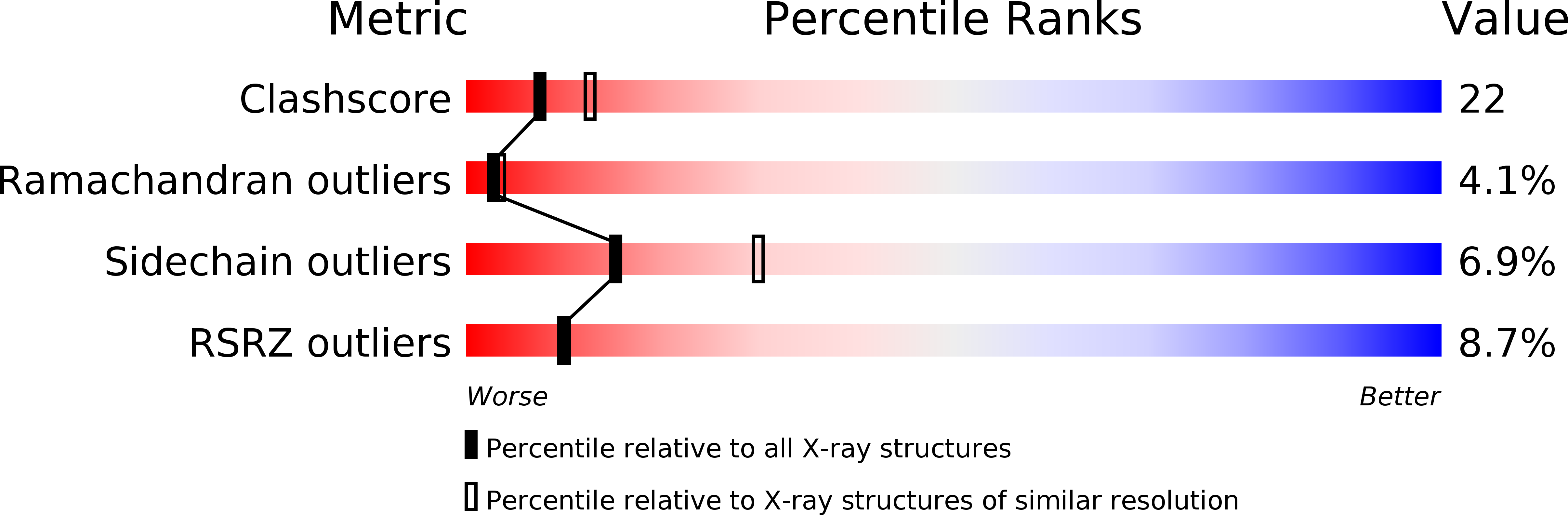
Macromolecular Entities
Structures with similar UniProt ID
Protein Blast
Polymer Type:polypeptide(L)
Molecule:cAMP-dependent protein kinase type II-alpha regulatory subunit
Gene (Uniprot):Prkar2a
Chain IDs:B
Chain Length:310
Number of Molecules:1
Biological Source:Mus musculus
Structures with similar UniProt ID
Protein Blast
Polymer Type:polypeptide(L)
Molecule:cAMP-dependent protein kinase, alpha-catalytic subunit
Gene (Uniprot):Prkaca
Chain IDs:A (auth: E)
Chain Length:350
Number of Molecules:1
Biological Source:Mus musculus
Modified Residue
Compound ID Chain ID Parent Comp ID Details 2D Image
SEP A SER PHOSPHOSERINE
TPO A THR PHOSPHOTHREONINE
Primary Citation
PKA type IIalpha holoenzyme reveals a combinatorial strategy for isoform diversity.
Science 318 274 279 (2007)
PMID: 17932298 DOI: 10.1126/science.1146447

Abstact

The catalytic (C) subunit of cyclic adenosine monophosphate (cAMP)-dependent protein kinase (PKA) is inhibited by two classes of regulatory subunits, RI and RII. The RII subunits are substrates as well as inhibitors and do not require adenosine triphosphate (ATP) to form holoenzyme, which distinguishes them from RI subunits. To understand the molecular basis for isoform diversity, we solved the crystal structure of an RIIalpha holoenzyme and compared it to the RIalpha holoenzyme. Unphosphorylated RIIalpha(90-400), a deletion mutant, undergoes major conformational changes as both of the cAMP-binding domains wrap around the C subunit's large lobe. The hallmark of this conformational reorganization is the helix switch in domain A. The C subunit is in an open conformation, and its carboxyl-terminal tail is disordered. This structure demonstrates the conserved and isoform-specific features of RI and RII and the importance of ATP, and also provides a new paradigm for designing isoform-specific activators or antagonists for PKA.

Legend

Protein

Chemical

Disease

Primary Citation of related structures
Feedback Form
Name
Email
Institute
Feedback