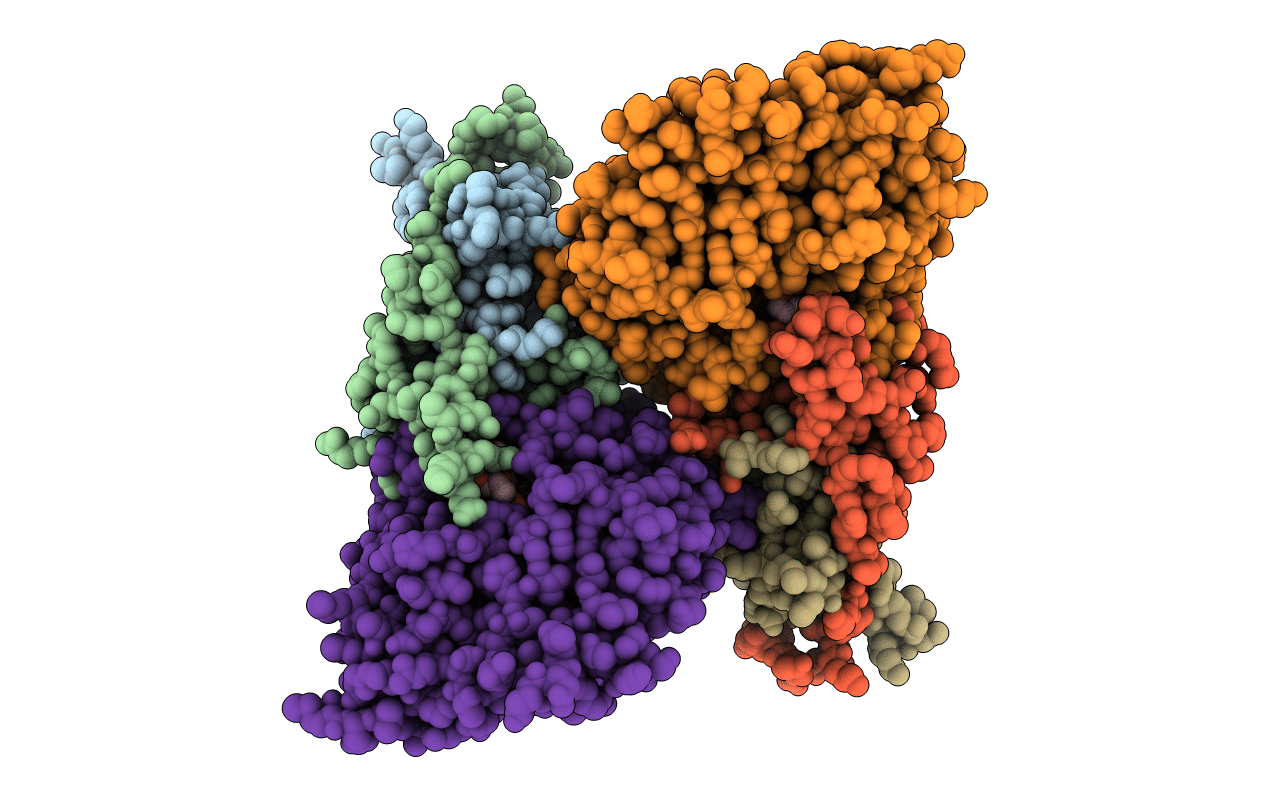
2QRC image
Deposition Date 2007-07-28
Release Date 2007-10-23
Last Version Date 2023-08-30
Entry Detail
PDB ID:
2QRC
Keywords:
Title:
Crystal structure of the adenylate sensor from AMP-activated protein kinase in complex with ADP and AMP
Biological Source:
Source Organism:
Method Details:
Experimental Method:
Resolution:
2.70 Å
R-Value Free:
0.28
R-Value Work:
0.20
R-Value Observed:
0.21
Space Group:
C 1 2 1

Macromolecular Entities
Structures with similar UniProt ID
Protein Blast
Polymer Type:polypeptide(L)
Molecule:SNF1-like protein kinase ssp2
Gene (Uniprot):ssp2
Chain IDs:A, D (auth: C)
Chain Length:137
Number of Molecules:2
Biological Source:Schizosaccharomyces pombe
Structures with similar UniProt ID
Protein Blast
Polymer Type:polypeptide(L)
Molecule:SPCC1919.03c protein
Gene (Uniprot):amk2
Chain IDs:B, E (auth: D)
Chain Length:97
Number of Molecules:2
Biological Source:Schizosaccharomyces pombe
Structures with similar UniProt ID
Protein Blast
Polymer Type:polypeptide(L)
Molecule:Protein C1556.08c
Gene (Uniprot):cbs2
Chain IDs:C (auth: G), F (auth: E)
Chain Length:334
Number of Molecules:2
Biological Source:Schizosaccharomyces pombe
Primary Citation
Structural Insight into AMPK Regulation: ADP Comes into Play.
Structure 15 1285 1295 (2007)
PMID: 17937917 DOI: 10.1016/j.str.2007.07.017

Abstact

The AMP-activated protein kinase (AMPK), a sensor of cellular energy status found in all eukaryotes, responds to changes in intracellular adenosine nucleotide levels resulting from metabolic stresses. Here we describe crystal structures of a heterotrimeric regulatory core fragment from Schizosaccharomyces pombe AMPK in complex with ADP, ADP/AMP, ADP/ATP, and 5-aminoimidazole-4-carboxamide 1-beta-D-ribofuranotide (AICAR phosphate, or ZMP), a well-characterized AMPK activator. Prior crystallographic studies had revealed a single site in the gamma subunit that binds either ATP or AMP within Bateman domain B. Here we show that ZMP binds at this site, mimicking the binding of AMP. An analogous site in Bateman domain A selectively accommodates ADP, which binds in a distinct manner that also involves direct ligation to elements from the beta subunit. These observations suggest a possible role for ADP in regulating AMPK response to changes in cellular energy status.

Legend

Protein

Chemical

Disease

Primary Citation of related structures
Feedback Form
Name
Email
Institute
Feedback