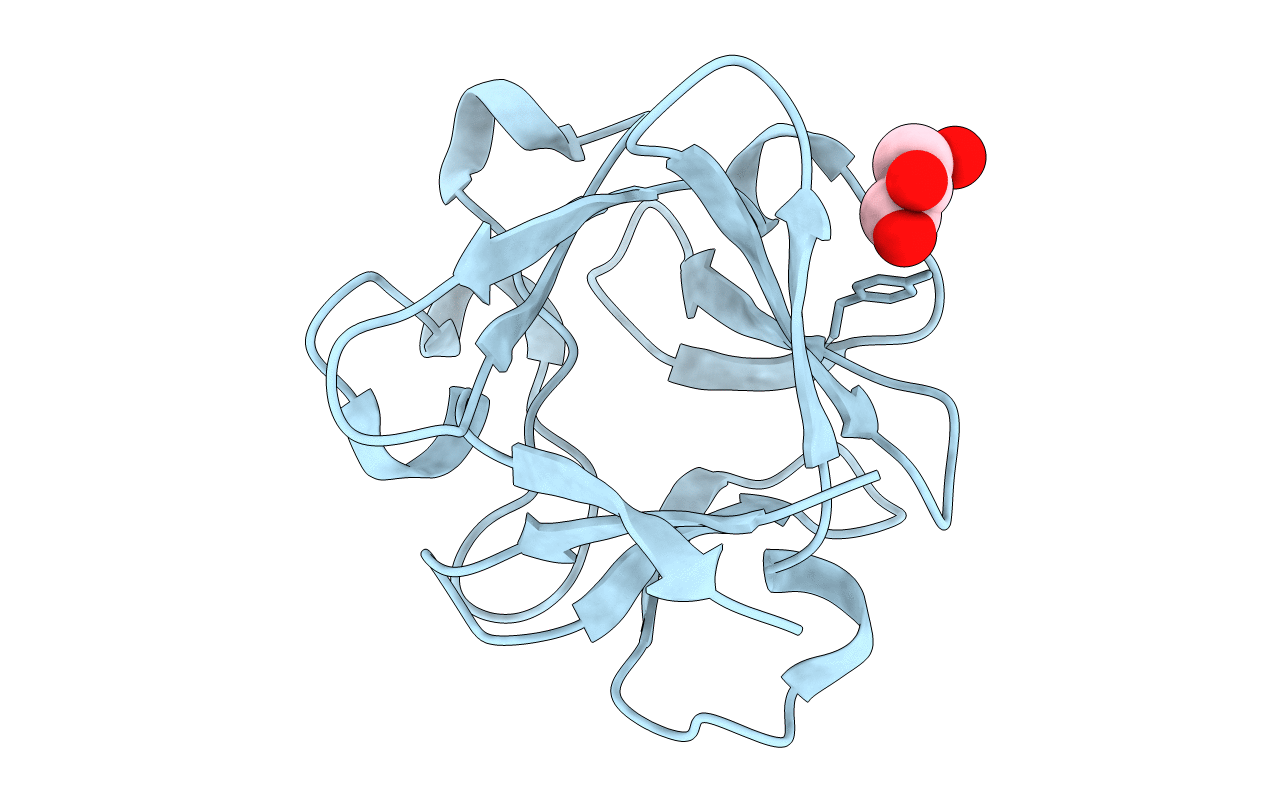
2Q9X image
Deposition Date 2007-06-14
Release Date 2008-07-01
Last Version Date 2025-11-12
Entry Detail
PDB ID:
2Q9X
Keywords:
Title:
Crystal structure of highly stable mutant Q40P/S47I/H93G of human fibroblast growth factor-1
Biological Source:
Source Organism:
Homo sapiens (Taxon ID: )
Host Organism:
Method Details:
Experimental Method:
Resolution:
1.70 Å
R-Value Free:
0.24
R-Value Work:
0.20
R-Value Observed:
0.20
Space Group:
P 21 21 21
Macromolecular Entities
Structures with similar UniProt ID
Protein Blast
Polymer Type:polypeptide(L)
Molecule:Heparin-binding growth factor 1
Gene (Uniprot):FGF1
Mutagens:Q40P, S47I, H93G
Chain IDs:A
Chain Length:140
Number of Molecules:1
Biological Source:Homo sapiens
Ligand Molecules
Primary Citation
Structure of a highly stable mutant of human fibroblast growth factor 1.
Acta Crystallogr.,Sect.D 65 67 73 (2009)
PMID: 19153468 DOI: 10.1107/S0907444908039486

Abstact

Fibroblast growth factors (FGFs) are involved in diverse cellular processes such as cell migration, angiogenesis, osteogenesis, wound healing and embryonic and foetal development. Human acidic fibroblast growth factor (FGF-1) is the only member of the FGF family that binds with high affinity to all four FGF receptors and thus is considered to be the human mitogen with the broadest specificity. However, pharmacological applications of FGF-1 are limited owing to its low stability. It has previously been reported that the introduction of single mutations can significantly improve the stability of FGF-1 and its resistance to proteolytic degradation. Here, the structure of the Q40P/S47I/H93G triple mutant of FGF-1, which exhibits much higher stability, a prolonged half-life and enhanced mitogenic activity, is presented. Compared with the wild-type structure, three localized conformational changes in the stable triple mutant were observed, which is in agreement with the perfect energetic additivity of the single mutations described in a previous study. The huge change in FGF-1 stability (the denaturation temperature increased by 21.5 K, equivalent to DeltaDeltaG(den) = 24.3 kJ mol(-1)) seems to result from the formation of a short 3(10)-helix (position 40), an improvement in the propensity of amino acids to form beta-sheets (position 47) and the rearrangement of a local hydrogen-bond network (positions 47 and 93).

Legend

Protein

Chemical

Disease

Primary Citation of related structures
Feedback Form
Name
Email
Institute
Feedback