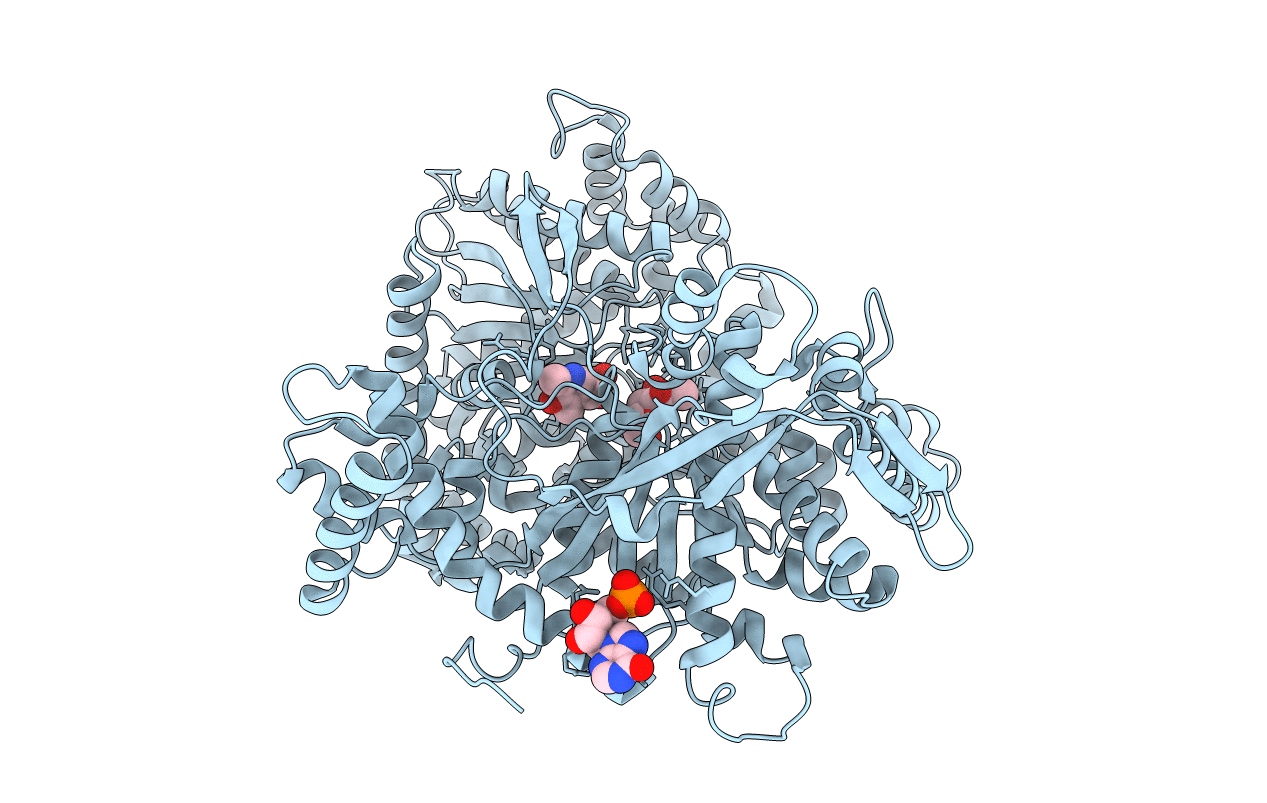
2PRJ image
Deposition Date 1998-12-11
Release Date 1998-12-16
Last Version Date 2023-12-27
Entry Detail
PDB ID:
2PRJ
Keywords:
Title:
Binding of N-acetyl-beta-D-glucopyranosylamine to Glycogen Phosphorylase B
Biological Source:
Source Organism(s):
Method Details:
Experimental Method:
Resolution:
2.30 Å
R-Value Free:
0.23
R-Value Work:
0.18
R-Value Observed:
0.18
Space Group:
P 43 21 2

Macromolecular Entities
Structures with similar UniProt ID
Protein Blast
Polymer Type:polypeptide(L)
Molecule:GLYCOGEN PHOSPHORYLASE
Gene (Uniprot):PYGM
Chain IDs:A
Chain Length:842
Number of Molecules:1
Biological Source:Oryctolagus cuniculus
Primary Citation
N-acetyl-beta-D-glucopyranosylamine: a potent T-state inhibitor of glycogen phosphorylase. A comparison with alpha-D-glucose.
Protein Sci. 4 2469 2477 (1995)
PMID: 8580837

Abstact

Structure-based drug design has led to the discovery of a number of glucose analogue inhibitors of glycogen phosphorylase that have an increased affinity compared to alpha-D-glucose (Ki = 1.7 mM). The best inhibitor in the class of N-acyl derivatives of beta-D-glucopyranosylamine, N-acetyl-beta-D-glucopyranosylamine (1-GlcNAc), has been characterized by kinetic, ultracentrifugation, and crystallographic studies. 1-GlcNAc acts as a competitive inhibitor for both the b (Ki = 32 microM) and the a (Ki = 35 microM) forms of the enzyme with respect to glucose 1-phosphate and in synergism with caffeine, mimicking the binding of glucose. Sedimentation velocity experiments demonstrated that 1-GlcNAc was able to induce dissociation of tetrameric phosphorylase a and stabilization of the dimeric T-state conformation. Co-crystals of the phosphorylase b-1-GlcNAc-IMP complex were grown in space group P4(3)2(1)2, with native-like unit cell dimensions, and the complex structure has been refined to give a crystallographic R factor of 18.1%, for data between 8 and 2.3 A resolution. 1-GlcNAc binds tightly at the catalytic site of T-state phosphorylase b at approximately the same position as that of alpha-D-glucose. The ligand can be accommodated in the catalytic site with very little change in the protein structure and stabilizes the T-state conformation of the 280s loop by making several favorable contacts to Asn 284 of this loop. Structural comparisons show that the T-state phosphorylase b-1-GlcNAc-IMP complex structure is overall similar to the T-state phosphorylase b-alpha-D-glucose complex structure. The structure of the 1-GlcNAc complex provides a rational for the biochemical properties of the inhibitor.

Legend

Protein

Chemical

Disease

Primary Citation of related structures
Feedback Form
Name
Email
Institute
Feedback