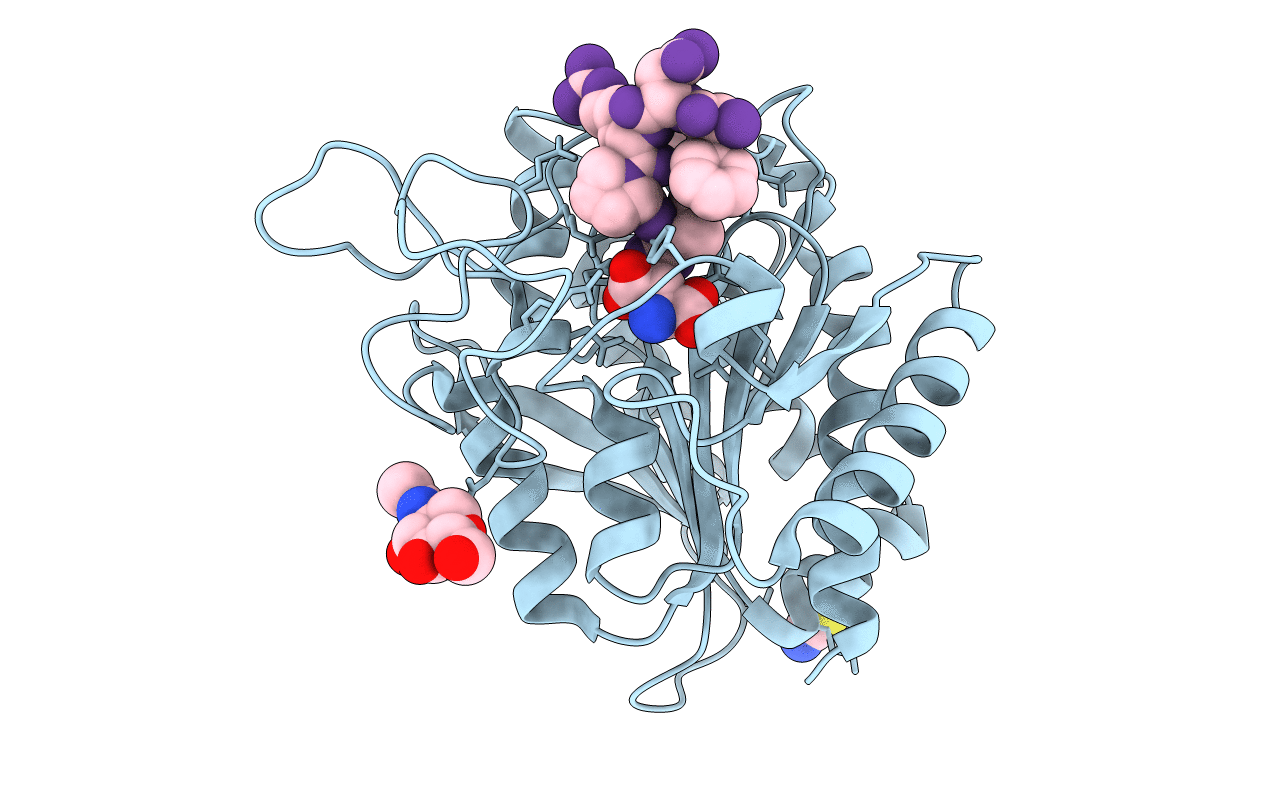
2PCU image
Deposition Date 2007-03-30
Release Date 2007-04-17
Last Version Date 2024-10-30
Entry Detail
PDB ID:
2PCU
Keywords:
Title:
Human carboxypeptidase A4 in complex with a cleaved hexapeptide.
Biological Source:
Source Organism:
Homo sapiens (Taxon ID: 9606)
Host Organism:
Method Details:
Experimental Method:
Resolution:
1.60 Å
R-Value Free:
0.17
R-Value Work:
0.15
R-Value Observed:
0.15
Space Group:
P 21 21 21
Macromolecular Entities
Structures with similar UniProt ID
Protein Blast
Polymer Type:polypeptide(L)
Molecule:Carboxypeptidase A4
Gene (Uniprot):CPA4
Chain IDs:A
Chain Length:305
Number of Molecules:1
Biological Source:Homo sapiens
Polymer Type:polypeptide(L)
Molecule:peptide
Chain IDs:B
Chain Length:5
Number of Molecules:1
Biological Source:
Modified Residue
Compound ID Chain ID Parent Comp ID Details 2D Image
ASN A ASN GLYCOSYLATION SITE
Primary Citation
Caught after the Act: a human A-type metallocarboxypeptidase in a product complex with a cleaved hexapeptide.
Biochemistry 46 6921 6930 (2007)
PMID: 17506531 DOI: 10.1021/bi700480b

Abstact

A/B-type metallocarboxypeptidases (MCPs) are among the most thoroughly studied proteolytic enzymes, and their catalytic mechanisms have been considered as prototypes even for several unrelated metalloprote(in)ase families. It has long been postulated that the nature of the side chains of at least five substrate residues, i.e., P4-P1', influence Km and kcat and that once the peptide or protein substrate is cleaved, both products remain in the first instance bound to the active-site cleft of the enzyme in a double-product complex. Structural details of binding of substrate to the nonprimed side of the cleft have largely relied on complexes with protein inhibitors and peptidomimetic small-molecule inhibitors that do not span the entire groove. In the former, the presence of N-terminal globular protein domains participating in large-scale interactions with the surface of the cognate catalytic domain outside the active-site cleft mostly conditions the way their C-terminal tails bind to the cleft. Accordingly, they may not be accurate models for a product complex. We hereby provide the structural details of a true cleaved double-product complex with a hexapeptide of an MCP engaged in prostate cancer, human carboxypeptidase A4, employing diffraction data to 1.6 A resolution (Rcryst and Rfree = 0.159 and 0.176, respectively). These studies provide detailed information about subsites S5-S1' and contribute to our knowledge of the cleavage mechanism, which is revisited in light of these new structural insights.

Legend

Protein

Chemical

Disease

Primary Citation of related structures
Feedback Form
Name
Email
Institute
Feedback