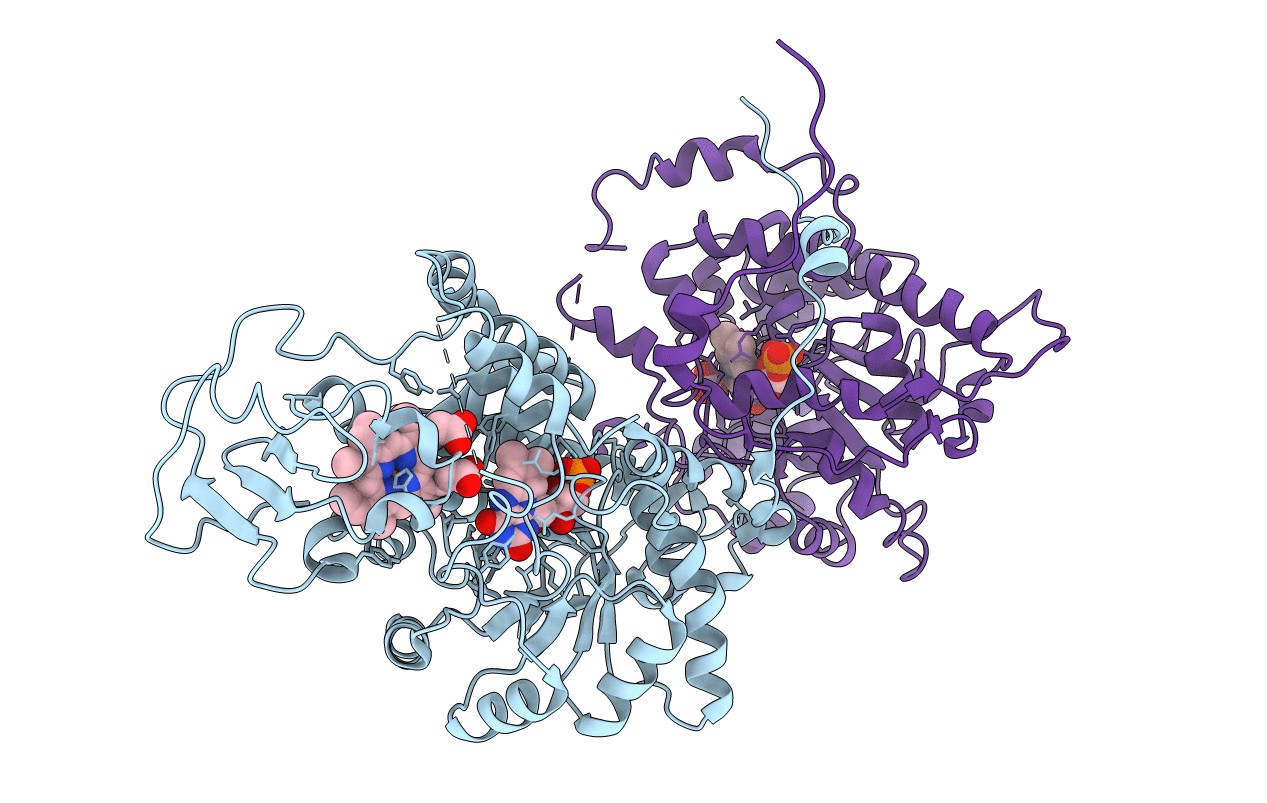
2OZ0 image
Deposition Date 2007-02-23
Release Date 2007-09-11
Last Version Date 2023-11-15
Entry Detail
PDB ID:
2OZ0
Keywords:
Title:
Mechanistic and Structural Studies of H373Q Flavocytochrome b2: Effects of Mutating the Active Site Base
Biological Source:
Source Organism:
Method Details:
Experimental Method:
Resolution:
2.80 Å
R-Value Free:
0.27
R-Value Work:
0.20
R-Value Observed:
0.21
Space Group:
P 32 2 1

Macromolecular Entities
Structures with similar UniProt ID
Protein Blast
Polymer Type:polypeptide(L)
Molecule:Cytochrome b2
Gene (Uniprot):CYB2
Mutagens:H373Q
Chain IDs:A, B
Chain Length:511
Number of Molecules:2
Biological Source:Saccharomyces cerevisiae
Primary Citation
Mechanistic and structural studies of H373Q flavocytochrome b2: effects of mutating the active site base.
Biochemistry 46 7844 7851 (2007)
PMID: 17563122 DOI: 10.1021/bi7005543

Abstact

His373 in flavocytochrome b2 has been proposed to act as an active site base during the oxidation of lactate to pyruvate, most likely by removing the lactate hydroxyl proton. The effects of mutating this residue to glutamine have been determined to provide further insight into its role. The kcat and kcat/Klactate values for the mutant protein are 3 to 4 orders of magnitude smaller than the wild-type values, consistent with a critical role for His373. Similar effects are seen when the mutation is incorporated into the isolated flavin domain of the enzyme, narrowing the effects to lactate oxidation rather than subsequent electron transfers. The decrease of 3500-fold in the rate constant for reduction of the enzyme-bound FMN by lactate confirms this part of the reaction as that most effected by the mutation. The primary deuterium and solvent kinetic isotope effects for the mutant enzyme are significantly smaller than the wild-type values, establishing that bond cleavage steps are less rate-limiting in H373Q flavocytochrome b2 than in the wild-type enzyme. The structure of the mutant enzyme with pyruvate bound, determined at 2.8 A, provides a rationale for these effects. The orientation of pyruvate in the active site is altered from that seen in the wild-type enzyme. In addition, the active site residues Arg289, Asp 292, and Leu 286 have altered positions in the mutant protein. The combination of an altered active site and the small kinetic isotope effects is consistent with the slowest step in turnover being a conformational change involving a conformation in which lactate is bound unproductively.

Legend

Protein

Chemical

Disease

Primary Citation of related structures
Feedback Form
Name
Email
Institute
Feedback