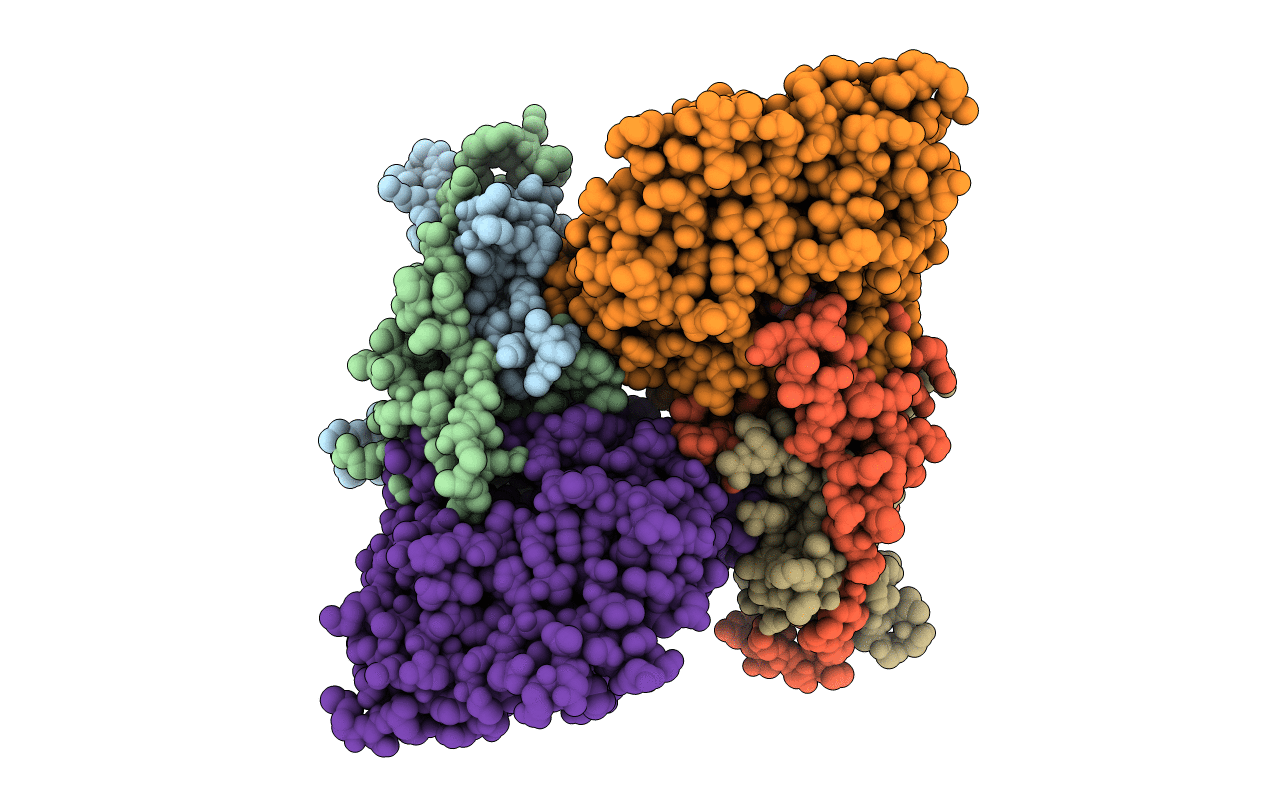
2OOY image
Deposition Date 2007-01-26
Release Date 2007-02-06
Last Version Date 2023-08-30
Entry Detail
PDB ID:
2OOY
Keywords:
Title:
Crystal structure of the adenylate sensor from AMP-activated protein kinase complexed with ATP
Biological Source:
Source Organism:
Method Details:
Experimental Method:
Resolution:
2.88 Å
R-Value Free:
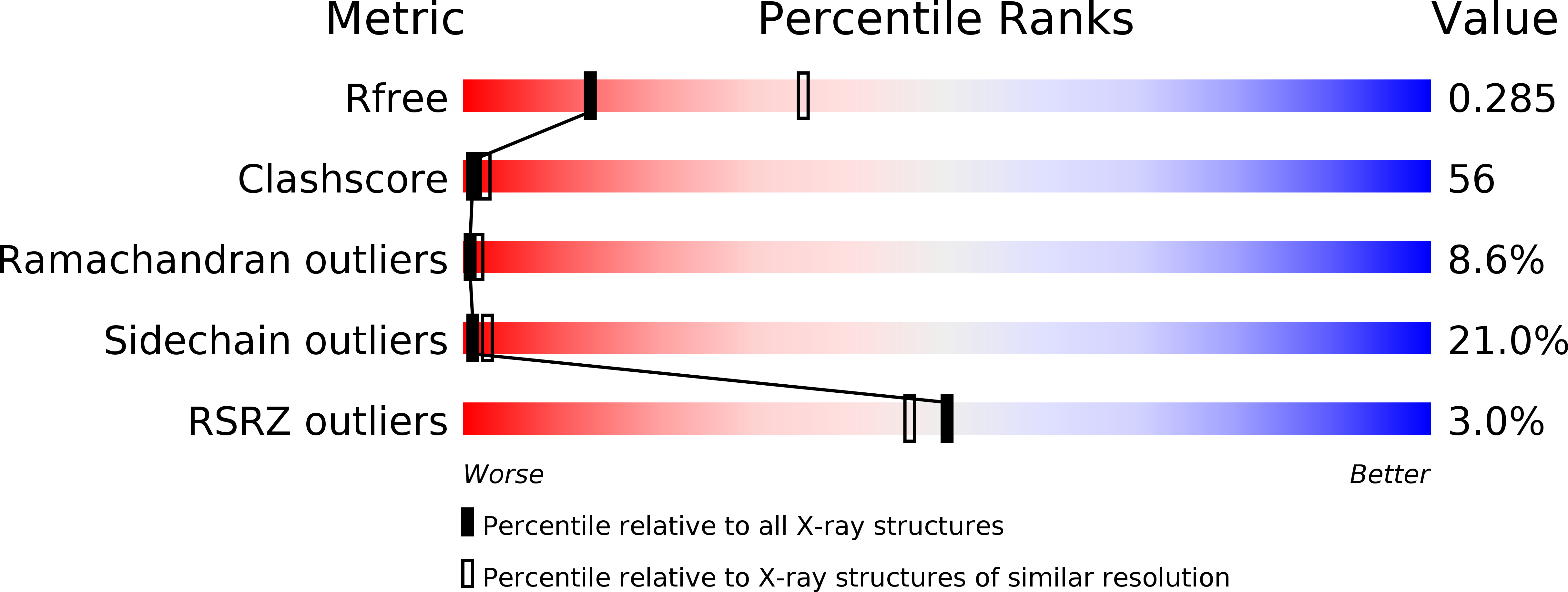
0.29
R-Value Work:
0.18
R-Value Observed:
0.19
Space Group:
C 1 2 1
Macromolecular Entities
Structures with similar UniProt ID
Protein Blast
Polymer Type:polypeptide(L)
Molecule:SNF1-like protein kinase ssp2
Gene (Uniprot):ssp2
Chain IDs:A, D (auth: C)
Chain Length:137
Number of Molecules:2
Biological Source:Schizosaccharomyces pombe
Structures with similar UniProt ID
Protein Blast
Polymer Type:polypeptide(L)
Molecule:SPCC1919.03c protein
Gene (Uniprot):amk2
Chain IDs:B, E (auth: D)
Chain Length:97
Number of Molecules:2
Biological Source:Schizosaccharomyces pombe
Structures with similar UniProt ID
Protein Blast
Polymer Type:polypeptide(L)
Molecule:Hypothetical protein C1556.08c in chromosome I
Gene (Uniprot):cbs2
Chain IDs:C (auth: G), F (auth: E)
Chain Length:333
Number of Molecules:2
Biological Source:Schizosaccharomyces pombe
Primary Citation
Crystal structures of the adenylate sensor from fission yeast AMP-activated protein kinase.
Science 315 1726 1729 (2007)
PMID: 17289942 DOI: 10.1126/science.1137503

Abstact

The 5'-AMP (adenosine monophosphate)-activated protein kinase (AMPK) coordinates metabolic function with energy availability by responding to changes in intracellular ATP (adenosine triphosphate) and AMP concentrations. Here, we report crystal structures at 2.9 and 2.6 A resolution for ATP- and AMP-bound forms of a core alphabetagamma adenylate-binding domain from the fission yeast AMPK homolog. ATP and AMP bind competitively to a single site in the gamma subunit, with their respective phosphate groups positioned near function-impairing mutants. Unexpectedly, ATP binds without counterions, amplifying its electrostatic effects on a critical regulatory region where all three subunits converge.

Legend

Protein

Chemical

Disease

Primary Citation of related structures
Feedback Form
Name
Email
Institute
Feedback